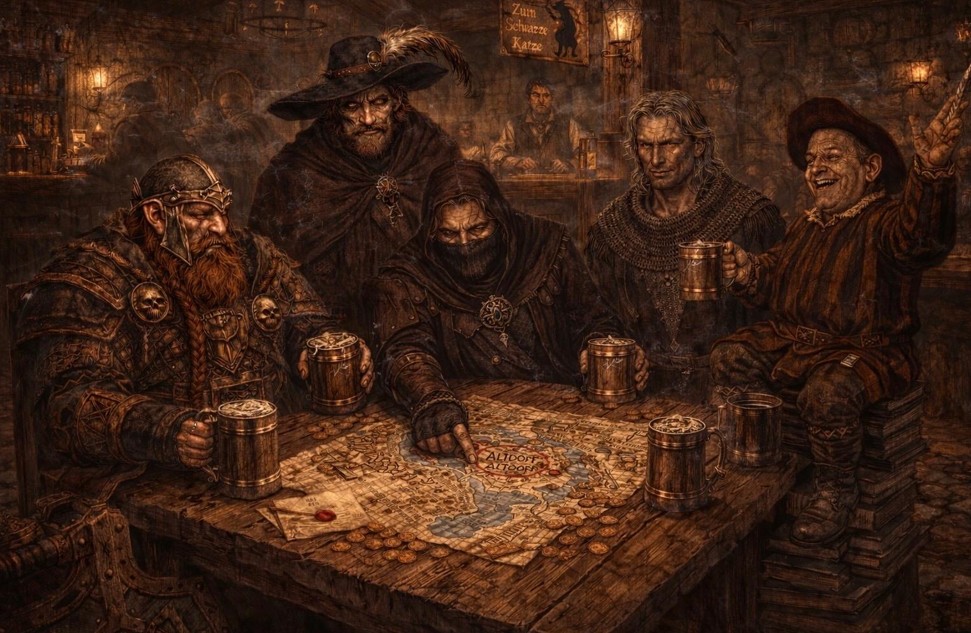
” After the terrifying ordeals in the county of Wittgendorf and the unspeakable horror of Castle Wittgenstein, you decide to grant yourselves a truce to clear your heads. The Von Wittgenstein bloodline has been annihilated, but the warpstone has been lost in the bowels of the earth; the witch Etelka Herzen has fallen, and Dwarven honor has been, as far as possible, restored. The plan of the mysterious cult of Tzeentch in Middenheim to spread corruption throughout the Reikland has been thwarted—at least for now.
Although you know that the ruthless Steinhäger still rules Bogenhafen, equally entangled with the Ruinous Powers, you do not yet possess the means to denounce or confront him.
At the suggestion of Paolino, drawn by the allure of trade and the prospect of easy coin, you spend two months as river couriers to recover your strength. Despite your lack of familiarity with bookkeeping, your reputation as men of action allows you to find work with small local entrepreneurs for short hauls. Between a mug of ale and a load of wool, a strange peace has descended upon this ragtag group: the suspicion that this life on the razor’s edge is, after all, the only dimension in which you truly feel alive, has become a certainty.
As you navigate the Reik, the news traveling from one tavern to another grows increasingly disturbing:
The Emperor, Karl Franz, is gravely ill. The nature of his malady is unknown, but the fear of a power vacuum is spreading like a contagion, fueling discontent among the provinces.
A highly controversial law has been promulgated forbidding the summary execution of mutants within Imperial lands. Many cities refuse to enforce it, sparking riots, witch hunts, and unprecedented administrative chaos.
Tensions between the Grand Principality of Ostland (led by Hals von Tasseninick) and the Grand Duchy of Talabecland (led by Gustav von Krieglitz) have reached a breaking point. The former accuses the latter of orchestrating the assassination of the heir to the Ostland throne. Rumors fly of bloody skirmishes between militias along the borders.
Even within your company, the marks of time and exposure to evil begin to manifest in unexpected ways:
Paolino: Seems to have found his true calling. Despite being a total layman in mercantile law, his affable chatter and natural charm earn him decent profits. The thought of abandoning the ship and his new life as an “entrepreneur” pains him deeply: he would much rather trade spices than sword blows.
Drumin: The Dwarf is clearly a fish out of water on the deck of a boat. He stays silent, works hard, and ignores the pleasures of dry land. For him, the “Herzen” matter is only half-resolved: the witch is dead, but whoever sent her is still out there. This nagging thought carves a deep furrow in his soul, making the journey to Middenheim a moral imperative.
Fredrich: He is the man who causes the most concern. Beyond the change in his eye color, he exhibits alien behaviors: he has become a compulsive lover of feline company, pretends to read books whose content he clearly does not understand, and shows a morbid attachment to jewelry and finery. One moment he seems himself; the next, a different presence seems hidden behind that same gaze.
Wolfgang: Has found a precarious balance between river life and his past as a man of the streets. In Altdorf, he seems to have forged shady connections that earned him a “trading license” written on a blood-stained parchment. Wolfgang is drawn north as much as the others: he has discovered a sense of brutal justice in settling scores with cultists and mutants.
Waldemar the Druid: Although the river offers a reprieve from the tormented dreams of Wittgenstein, he lives these months in a sort of spiritual exile. He spends nights watching the stars and days studying the riverbanks, seeking signs of corruption. The mutant edict unsettles him: he sees a dangerous imbalance in the natural order. He feels that the North, with its wild forests, might offer the answers he seeks to heal a land wounded by Chaos.
While the waters of the Reik flow placidly beneath your hull, one name begins to echo with increasing persistence between the docks of Altdorf and the river inns: the Middenheim Carnival.
What should be the North’s greatest festival—a riot of masks, wine, and jousting in honor of Ulric—takes on a sinister meaning for you. In the long evenings spent re-reading the letters snatched from Lady Magritte’s laboratory, the words of Gotthard von Wittgenstein resurface like corpses in the river:
“I am organizing something ‘special’ for the Carnival…”
Beyond this, the shadow of the cult of Tzeentch grows longer: it seems the sect’s leaders are involved in a plan far more ambitious and terrible than the one concocted by Etelka. Paolino’s smiles fade, Fredrich’s bicolored eye glows with a strange, feverish excitement, and Drumin’s hand tightens convulsively around his hammer’s grip.
Wolfgang sharpens his blade in the silence of the night, while Waldemar grips his gnarled staff, sensing that the North wind carries an odor of change and madness. You thwarted the Wittgenstein plan in the west, it is true, but the true heart of evil is now beating to the rhythm of festive drums…”
“Dopo le spaventose peripezie nella contea di Wittgendorf e l’orrore indicibile di Castel Wittgenstein, decidete di concedervi una tregua per schiarirvi le idee. La stirpe dei Von Wittgenstein è stata annientata, ma la malapietra è andata perduta nelle viscere della terra; la strega Etelka Herzen è caduta e l’onore dei nani è stato, per quanto possibile, ristabilito. Il piano del misterioso culto di Tzeentch a Middenheim per diffondere la corruzione nel Reikland è stato sventato, almeno per ora.
Sebbene sappiate che a capo di Bogenhafen sieda ancora lo spietato Steinhäger, anch’egli invischiato con i Poteri Perniciosi, non possedete ancora i mezzi per denunciarlo o affrontarlo.
Su suggerimento di Paolino, attratto dal fascino del commercio e dalla prospettiva di guadagni facili, trascorrete due mesi come corrieri fluviali per recuperare le forze. Nonostante la scarsa dimestichezza con la contabilità, la vostra reputazione di uomini d’azione vi permette di trovare lavoro presso piccoli imprenditori locali per brevi trasporti. Tra un boccale di birra e un carico di lana, una strana pace è discesa su questo sgangherato gruppo: il dubbio che questa vita sul filo del rasoio sia, dopotutto, l’unica dimensione in cui vi sentite davvero vivi, è ormai una certezza.
Mentre navigate lungo il Reik, le notizie che corrono tra una taverna e l’altra si fanno sempre più inquietanti:
- L’Imperatore Karl Franz è gravemente malato. La natura del suo morbo è ignota, ma il timore di un vuoto di potere si sta diffondendo come un contagio, alimentando il malcontento tra le province.
- È stata promulgata una legge estremamente controversa che vieta l’uccisione sommaria dei mutanti nelle terre imperiali. Molte città si rifiutano di applicarla, scatenando tumulti, cacce alle streghe e un caos amministrativo senza precedenti.
- Le tensioni tra il Gran Principato dell’Ostland (guidato da Hals von Tasseninick) e il Gran Ducato del Talabecland (guidato da Gustav von Krieglitz) sono giunte al punto di rottura. Il primo accusa il secondo di aver orchestrato l’assassinio dell’erede al trono dell’Ostland. Si vocifera di sanguinose scaramucce tra milizie lungo i confini.
Anche all’interno della vostra compagnia, i segni del tempo e dell’esposizione al male iniziano a manifestarsi in modi inaspettati:
· Paolino Sembra aver trovato la sua vera vocazione. Nonostante sia un totale profano delle leggi mercantili, la sua parlantina affabile e la sua simpatia naturale gli garantiscono guadagni dignitosi. L’idea di abbandonare la nave e la sua nuova vita da “imprenditore” lo ferisce profondamente: preferirebbe scambiare spezie piuttosto che colpi di spada.
· Drumin Il nano è palesemente un pesce fuor d’acqua sul ponte di una barca. Tace, lavora sodo e ignora i piaceri della terraferma. Per lui, la questione “Herzen” è risolta solo a metà: la strega è morta, ma chi l’ha inviata è ancora là fuori. Questo tarlo scava un solco profondo nel suo animo, rendendo il viaggio verso Middenheim un imperativo morale.
· Fredrich È l’uomo che desta più preoccupazione. Oltre al cambio di colore dell’occhio, manifesta comportamenti alieni: è diventato un amante compulsivo della compagnia dei gatti, finge di leggere libri di cui palesemente non comprende il contenuto e mostra un attaccamento morboso per gioielli e sfarzo. A volte sembra lui, un istante dopo sembra una presenza diversa nascosta dietro lo stesso sguardo.
· Wolfgang Ha trovato un equilibrio precario tra la vita fluviale e i suoi trascorsi da uomo di strada. Ad Altdorf sembra aver stretto legami torbidi che gli hanno fruttato una “licenza commerciale” scritta su un foglio macchiato di sangue. Wolfgang è attirato a nord tanto quanto gli altri: ha scoperto un senso di giustizia brutale nel regolare i conti con cultisti e mutanti.
· Waldemar il druido sebbene il fiume offra una tregua dai sogni tormentati di Wittgenstein, vive questi mesi in una sorta di esilio spirituale. Trascorre le notti a osservare le stelle e i giorni a studiare i margini del fiume, cercando segni della corruzione. L’editto sui mutanti lo inquieta: vede un pericoloso squilibrio nell’ordine naturale. Sente che il Nord, con le sue foreste selvagge, potrebbe offrirgli le risposte che cerca per curare una terra ferita dal Chaos.
Mentre le acque del Reik scorrono placide sotto lo scafo della vostra nave, un nome inizia a rimbalzare con insistenza crescente tra i moli di Altdorf e le locande fluviali: il Carnevale di Middenheim.
Quella che dovrebbe essere la più grande festa del Nord — un tripudio di maschere, vino e giostre in onore di Ulric — assume per voi un significato sinistro. Nelle lunghe serate trascorse a rileggere le lettere strappate dal laboratorio di Lady Magritte, le parole di Gotthard von Wittgenstein tornano a galla come cadaveri nel fiume:
“Sto organizzando qualcosa di ‘speciale’ per il Carnevale…”
Oltre a ciò, l’ombra del culto di Tzeentch si allunga: sembra che i vertici della setta siano coinvolti in un piano ben più ambizioso e terribile di quello imbastito da Etelka. I sorrisi di Paolino si spengono, l’occhio bicolore di Fredrich brilla di una strana, febbrile eccitazione e la mano di Drumin si stringe convulsamente attorno all’impugnatura del martello.
Wolfgang affila la lama nel silenzio della notte, mentre Waldemar stringe il suo bastone nodoso, percependo che il vento del Nord porta con sé un odore di mutamento e follia. Avete sventato il piano dei Wittgenstein a ovest, è vero, ma il vero cuore del male sta ora battendo al ritmo dei tamburi festivi..“


Leave a Reply