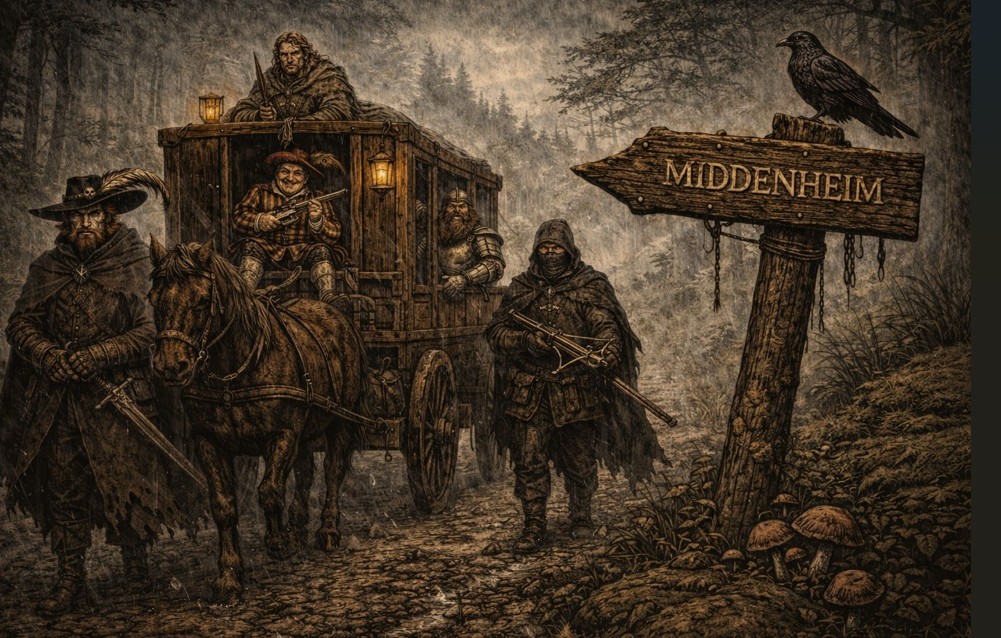
The final days of a scorching summer bring an unexpected encounter: in a crowded Altdorf tavern, where the steam from hot meals mingles with the acrid smoke of pipes, the group is approached by two figures: Father Luthor Schwartzhelm, an elderly monk with a face etched by a thousand wrinkles, and his young assistant, Brother Yulevno.
Belonging to the Order of the Anvil and devout servants of Sigmar, the two have eavesdropped on the group’s plans to head North. With a low but firm voice, Yulevno explains their need: to escort the now-fragile Luthor toward the City of the White Wolf to reach the Shrine of the Shining Rock. The old monk carries a spiritual burden heavier than his own body: a shard of black stone stolen from the sanctuary in his youth. An act of pride that now, as the shadow of death lengthens, demands a final pilgrimage of atonement.
The deal is struck amidst the fumes of ale: the clerics possess no gold, but they offer a Sigmarite Liassez-passer. In an Empire stifled by bureaucracy and corruption, this document is a magical key capable of opening the numerous toll gates and checkpoints that infest the road, exempting the group from taxes that would quickly drain their purses.
The decision to leave before winter makes the journey suicidal leads to a painful parting. The boat, a faithful companion in misfortune, is sold—a separation that Paolino experiences as personal mourning, stroking the rigging one last time. With the proceeds, the group purchases a sturdy cart and two draft horses, plate armor, rations, and firearms, ready to face the twenty days of marching that separate them from their destination.
Once past the reassuring borders of the Reikland, the landscape begins a slow transformation: the brightness of the central plains is swallowed by the gloomy majesty of the Drakwald. The days turn dismal, lashed by a fine, persistent drizzle announcing the early arrival of autumn. Mud, black and slimy, becomes a constant companion under the cart’s wheels, while the smell of rotting vegetation replaces that of the salt air.
Along the Middenheim-Altdorf Great Road, the vital artery that splits the forest, the group encounters merchants and caravans protected by nervous mercenaries who scan the edge of the woods, where shadows seem to have eyes and fangs.
In the coaching inns, gathered around hearths, the group perceives that the forest is not the only danger. An ancient theological conflict is burning once more: the rivalry between the Church of Sigmar and the Church of Ulric. The further north they travel, the more the cult of the White Wolf becomes overbearing and intolerant. For the inhabitants of the Middenland, Sigmar is often seen as a southern imposition, a “foreign” god compared to the eternal rigor of Ulric, Lord of Winter.
After a few days, the group reaches Delberz, a commercial hub at a vital crossroads. Beyond Delberz, the road enters the thick woods. Pines close the view above the cart. The companions reach Holthusen, a village protected by a log palisade. The inhabitants stare at the group, clutching axes and pitchforks.
Continuing north, the wind stings and the rain turns to sleet. The group reaches Beeckerhoven, the final stop before their destination. It is a stern town. Sigmar’s symbols vanish, replaced by wolf heads carved into wood or iron.
During stops at coaching inns along the Great Road, between watered-down soup and mugs of cider, the group gathers persistent rumors regarding new levies imposed by the Graf within the walls of Middenheim. The complaints of the affected travelers outline a climate of heavy taxation weighing on every institution in the city.
The Temple Tax: Every temple is forced to pay 1/2 Gold Crown for every square yard of ground owned. Father Luthor, hearing the news, shakes his head bitterly: “They want to tax sacred ground as if it were a stable. Faith in the North is becoming a luxury few can afford.”
The Dwarf Tax: The harshest news hits the Middenheim Dwarven Engineers’ Guild. With around 300 members, the Guild is the largest in the Empire, and Wasmeier has decided to tax every single member 1 Gold Crown per month. Drumin, clenching his fist around his hammer’s handle, growls: “A crown per head every month? It’s an insult to every honest craftsman!”
The Wizard Tax (or Scroll Tax): At the city gates, any goods destined for the Wizards’ and Alchemists’ Guild suffer a 10% levy on the gross value. Paper, ink, glassware, and chemicals are taxed without mercy. Waldemar comments: “They even tax the paper for writing. Call it the ‘Scroll Tax’ if you like, but to me, it’s just another way to shut the mouths of those who know how to read between the lines.”
Finally, at the dawn of the 20th day, the Fauschlag plateau emerges from the mist like a tooth of grey rock. Above it, the walls of Middenheim close the horizon, imposing and distant. Under the relentless rain, the Great Road becomes a torrent of mud that slows the cart and weighs down their cloaks.
The group proceeds slowly. Drumin and Paolino are the most exhausted by the twenty days of travel in the freezing cold. The dwarf walks with difficulty, his joints aching from the dampness penetrating beneath his armor. Paolino, wrapped in damp blankets inside the cart, trembles visibly.
The dwarf spits into the mud and growls through his teeth:
“I’d rather dig a tunnel under the entire mountain than take another step in this slush. My bones feel like they’re made of old glass.”
Paolino barely raises his head from the blankets, teeth chattering from the cold:
“Tell me that in Middenheim there’s a lit fireplace and a beer that doesn’t taste like rainwater. Just that. Then I can die in peace.”
Father Luthor, sitting next to the halfling, places a trembling hand on his small companion’s shoulder. The monk’s face is sallow, almost the same substance as the rain washing over him. Brother Yulevno watches the elder with fear, then turns to Wolfgang:
“We must find shelter. The Father won’t survive the night if we stay out here. The Shining Rock is near, I feel it, but his strength is failing him.”
The group finally reaches a small curve that nestles against the side of a hillock. In front of the entrance to what appears to be the sanctuary, a dozen warhorses are stationed in the rain.
Poor Luthor is at the end of his strength. With a thin voice, the old man whispers:
“Take me inside… I must return it. I must be at peace.”
Yulevno leans the old man against a tree, seeking a modicum of shelter from the relentless droplets, then approaches the door with the rest of the companions. Two Sigmarite Templars of the Order of the Fiery Heart bar the way, hands heavy on the hilt of their swords. Yulevno observes the horses and murmurs to the group:
“Such an escort… someone extremely important must be up there.”
The two Templars block the entrance coldly. One of them eyes Paolino’s form with disgust, muttering words of hatred. Yulevno shakes his head toward his companions:
“For these radicals, anyone different is just a mutant to be purified. They won’t let us in until the private service is concluded.”
Under the pouring rain, the cold bites into their limbs. Waldemar and Fredrich decide to move away to search for drier wood in the undergrowth. As they gather branches, the silence of the forest is broken by a crash. Looking up, the two see a shaggy man with a face marked by war paint and an axe in his hands. Behind him, similar figures emerge.
The man lets out a belluine scream that pierces the air. Fredrich and Waldemar drop the wood and run toward the clearing, pursued by the pack of howling berserkers.
At that same moment, Drumin sees his companions burst from the bushes. He doesn’t have time to finish his sentence:
“What in the world is going on…”
An explosion blasts the sanctuary door apart, throwing the guards to the ground and raising a cloud of splinters and dust. From within, screams and the metallic clatter of weapons immediately ring out. The group draws steel and firearms, ready to defend themselves. One of the Templars, struggling to rise amidst the rubble, shouts to his companion:
“Protect the Grand Theogonist! For Sigmar!”
Gli ultimi giorni di un’estate torrida portano un incontro inaspettato : in una taverna affollata di Altdorf, dove il vapore dei pasti caldi si mescola al fumo acre delle pipe, il gruppo viene avvicinato da due figure Padre Luthor Schwartzhelm, un anziano monaco dal volto solcato da mille rughe, e il suo giovane assistente, Fratello Yulevno.
Appartenenti all’Ordine dell’Incudine, devoti servitori di Sigmar, i due hanno origliato i piani del gruppo di dirigersi a Nord. Con voce sommessa ma ferma, Yulevno espone la loro necessità: accompagnare l’ormai fragile Luthor verso la Città del Lupo Bianco per raggiungere il santuario della Roccia Splendente. Il vecchio monaco porta con sé un fardello spirituale che pesa più del suo corpo: una scheggia di pietra nera sottratta al santuario in gioventù. Un atto di superbia che ora, con l’ombra della morte che si allunga, reclama un ultimo pellegrinaggio di espiazione.
L’accordo viene siglato tra i vapori della birra: i religiosi non possiedono oro, ma offrono un lasciapassare Sigmarita. In un Impero soffocato dalla burocrazia e dalla corruzione, quel documento è una chiave magica capace di spalancare i numerosi caselli e pedaggi che infestano la strada, esentando il gruppo da tasse che prosciugherebbero rapidamente le loro borse.
La decisione di partire prima che l’inverno renda il viaggio un suicidio,porta a una separazione dolorosa. La barca, fedele compagna di sventura, viene venduta — un distacco che Paolino vive come un lutto personale, accarezzando il sartiame un’ultima volta. Con il ricavato, il gruppo acquista un robusto carretto e due cavalli da tiro,armature di piastre ,razioni ed armi da fuoco, pronti ad affrontare i venti giorni di marcia che li separano dalla meta.
Superati i confini rassicuranti del Reikland, il paesaggio inizia un lento mutamento: La solarità delle pianure centrali viene inghiottita dalla maestosità cupa del Drakwald. Le giornate si fanno uggiose, sferzate da una pioggerella fine e persistente che annuncia l’arrivo precoce dell’autunno. Il fango, nero e viscido, diventa un compagno costante sotto le ruote del carro, mentre l’odore della vegetazione marcia sostituisce quello della salsedine.
Lungo la Grande Strada Middenheim-Altdorf, l’arteria vitale che spacca la foresta, il gruppo incrocia Mercanti e carovane Protetti da mercenari nervosi che scrutano il limitare del bosco, dove le ombre sembrano avere occhi e zanne.
Nelle stazioni di posta, attorno a focolari,il gruppo percepisce che la foresta non è l’unico pericolo. Un antico conflitto teologico sta tornando a bruciare: la rivalità tra la Chiesa di Sigmar e quella di Ulric.
Più si procede verso Nord, più il culto del Lupo Bianco si fa prepotente e intollerante. Per gli abitanti del Middenland, Sigmar è spesso visto come un’imposizione meridionale, un dio “straniero” rispetto all’eterno rigore di Ulric, signore dell’inverno.
Dopo alcuni giorni il gruppo raggiunge Delberz, un nodo commerciale su un crocevia vitale.
Oltre Delberz, la strada entra nel bosco fitto. I pini chiudono la vista sopra il carretto. I compagni raggiungono Holthusen, un villaggio protetto da una palizzata di tronchi. Gli abitanti fissano il gruppo stringendo asce e forconi.
Proseguendo a nord, il vento punge e la pioggia diventa nevischio. Il gruppo raggiunge Beeckerhoven, l’ultima sosta prima della meta. È una cittadina severa. I simboli di Sigmar spariscono, sostituiti da teste di lupo intagliate nel legno o nel ferro.
Durante le soste nelle stazioni di posta lungo la Grande Strada, tra una zuppa annacquata e un boccale di sidro, il gruppo raccoglie voci insistenti sulle nuove gabelle imposte dal Graf all’interno delle mura di Middenheim. Le lamentele dei viandanti colpiti delineano un clima di pesante tassazione che grava su ogni istituzione della città.
La Tassa sui Templi : Ogni tempio è costretto a versare 1/2 Corona d’Oro per ogni iarda quadrata di terreno posseduto. Padre Luthor, udendo la notizia, scuote il capo con amarezza:
“Vogliono tassare il suolo sacro come se fosse una stalla. La fede nel Nord sta diventando un lusso che pochi possono permettersi.”
La Tassa sui Nani La notizia più dura colpisce la Gilda degli Ingegneri Nanici di Middenheim. Con circa 300 membri, la Gilda è la più grande dell’Impero, e Wasmeier ha deciso di tassare ogni singolo membro con 1 Corona d’Oro al mese. Drumin, stringendo il pugno attorno al manico del martello, ringhia:
“Una corona a testa ogni mese? È un insulto a ogni onesto artigiano!”
La Tassa sui Maghi (o Tassa sulle Pergamene) Ai cancelli della città, ogni bene destinato alla Gilda dei Maghi e degli Alchimisti subisce un prelievo del 10% sul valore lordo. Carta, inchiostro, vetreria e reagenti chimici vengono tassati senza pietà. Waldemar commenta
“Tassano persino la carta per scrivere. Chiamatela pure ‘Tassa sulle Pergamene’, ma per me è solo un altro modo per tenere la bocca chiusa a chi sa leggere tra le righe.”
Finalmente,all’alba del 20esimo giorno, L’altopiano del Fauschlag emerge dalla nebbia come un dente di roccia grigia. Sopra di esso, le mura di Middenheim chiudono l’orizzonte, imponenti e distanti. Sotto la pioggia incessante, la Grande Strada diventa un torrente di fango che frena il carro e appesantisce i mantelli.
Il gruppo procede a rilento. Drumin e Paolino sono i più provati dai venti giorni di viaggio all’addiaccio. Il nano cammina a fatica, le articolazioni dolenti per l’umidità che penetra fin sotto l’armatura. Paolino, avvolto in coperte umide all’interno del carro, trema vistosamente.
Il nano sputa nel fango e ringhia tra i denti:
“Preferirei scavare un tunnel sotto l’intera montagna piuttosto che fare un altro passo in questa poltiglia. Le mie ossa sembrano fatte di vetro vecchio.”
Paolino solleva appena la testa dalle coperte, i denti che battono per il freddo:
“Ditemi che a Middenheim esiste un camino acceso e una birra che non sappia di acqua piovana. Solo questo. Poi potrò morire in pace.”
Padre Luthor, seduto accanto all’halfing, poggia una mano tremante sulla spalla del piccolo compagno. Il volto del monaco è cereo, quasi della stessa sostanza della pioggia che lo bagna. Fratello Yulevno osserva l’anziano con timore, poi si rivolge a Wolfgang:
“Dobbiamo trovare riparo. Il Padre non supererà la notte se restiamo qui fuori. La Roccia Splendente è vicina, lo sento, ma le forze lo stanno abbandonando.”
Il gruppo raggiunge finalmente una curva che si adagia sul fianco di una piccola collina. Davanti all’ingresso di quello che sembra il santuario, una decina di destrieri da guerra sono stazionati sotto la pioggia.
Il povero Luthor è allo stremo delle forze. Per l’ottantenne il viaggio è stato un calvario e la vita lo sta abbandonando rapidamente. Con un filo di voce, l’anziano sussurra:
“Portatemi dentro… devo restituirla. Devo essere in pace.”
Yulevno adagia il vecchio a un albero, cercando un minimo di riparo dalle gocce incessanti, poi si avvicina alla porta assieme al resto dei compagni. Due templari sigmariti dell’Ordine del Cuore Igneo sbarrano il passo, le mani pesanti sulle else delle spade. Yulevno osserva i cavalli e mormora al gruppo:
“Una scorta simile… deve esserci qualcuno di estremamente importante lassù.”
I due templari bloccano l’ingresso con freddezza. Uno di loro squadra con disgusto la figura di Paolino, mormorando parole d’odio. Yulevno scuote la testa verso i compagni:
“Per questi radicali, chiunque sia diverso è solo un mutante da purificare. Non ci lasceranno entrare finché la funzione privata non sarà conclusa.”
Sotto la pioggia battente, il freddo morde le membra. Waldemar e Fredrich decidono di allontanarsi per cercare della legna meno bagnata nel sottobosco. Mentre raccolgono rami, il silenzio della foresta viene rotto da uno schianto. Alzando lo sguardo, i due vedono un uomo irsuto con il volto solcato da pitture di guerra e un’ascia tra le mani. Alle sue spalle emergono altre figure simili.
L’uomo lancia un urlo belluino che squarcia l’aria. Fredrich e Waldemar abbandonano la legna e corrono verso la radura, inseguiti dal branco di berserker urlanti.
Nello stesso istante, Drumin vede i compagni sbucare dai cespugli. Non fa in tempo a terminare la frase:
“Ma che cavolo sta succedendo…”
Un’esplosione divelle la porta del santuario, scagliando a terra le guardie e sollevando una nuvola di schegge e polvere. Dall’interno giungono immediatamente grida e il fragore metallico delle armi. Il gruppo estrae l’acciaio e le armi da fuoco, pronti a difendersi. Uno dei templari, rialzandosi a fatica tra le macerie, grida al compagno:
“Proteggi il Gran Teogono! Per Sigmar!”


Leave a Reply