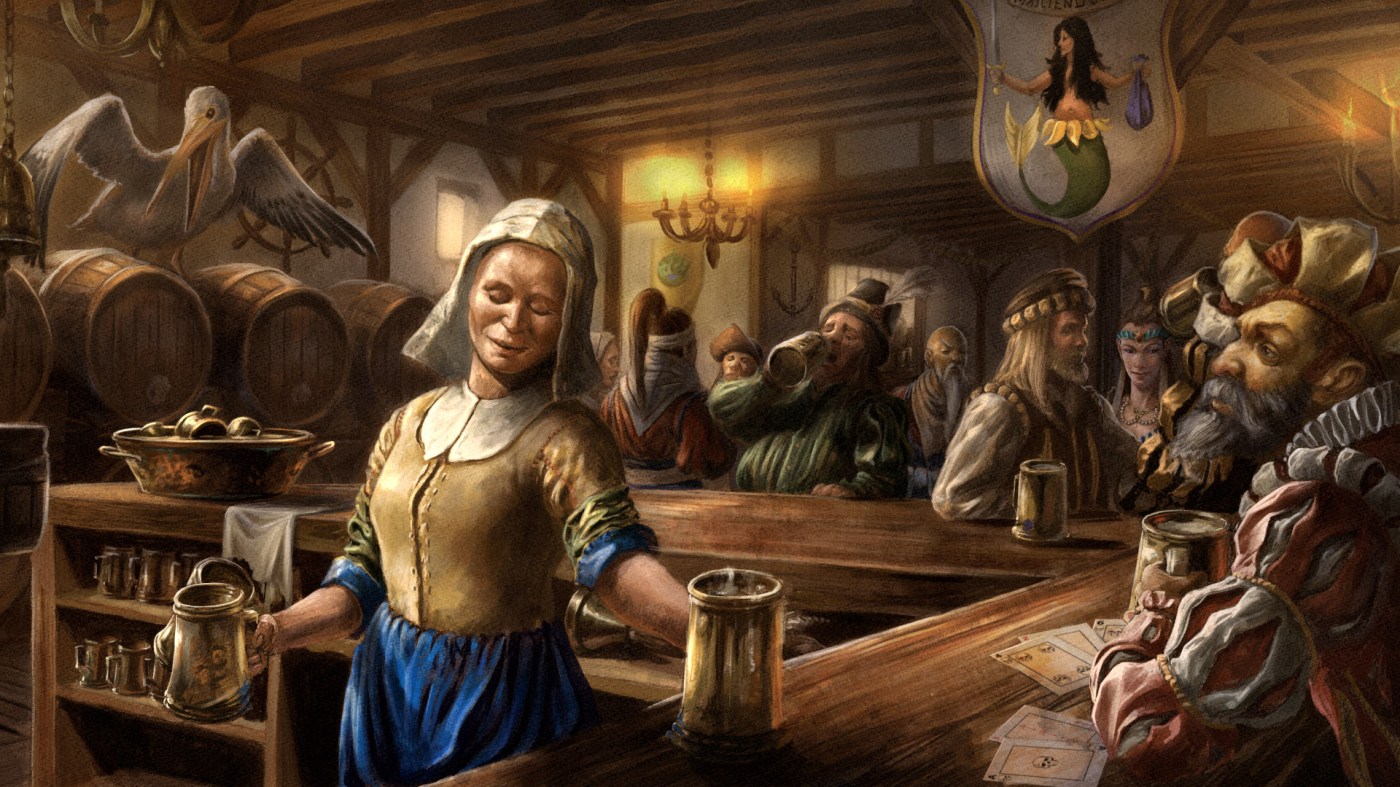
Our heroes exchange a knowing look, tighten their black cloaks, and advance toward the heavy door at the back of the tavern. As they approach, the two massive guards block their path. Without uttering a word, but with gestures that permit no argument, the two brutes disarm the group, confiscating swords, daggers, and crossbows, before giving a nod of the head: the way is clear, they may enter.
Once across the threshold, the atmosphere changes drastically. The air is thick with sweetish, oppressive fumes. Visually dominating the room is the towering figure of a gigantic Ogre, the boss’s personal bodyguard, whose massive muscles cast a shadow over a mahogany table. Behind it sits Bruno: a character whose attire is eccentric to say the least, covered in flamboyant silks entirely out of place for Ostwald, busy manipulating a series of mysterious leather pouches and a precision scale. On an adjacent small couch, a beautiful but visibly bored woman lies stretched out, playing idly with a pendant.
Invited to sit with an indolent wave of the hand, Bruno goes straight to the point, asking in a drawn-out voice what brings strangers into his office. Our heroes, moving decidedly awkwardly in that criminal territory, attempt a diplomatic card: they try to extract information about a mysterious fellow named “Joseph,” carefully omitting the Chancellor’s surname. The “dialectical” challenge and the beating around the bush lead nowhere; Bruno is an old fox of Ostwald and does not cast pearls before swine, remaining vague and stroking the scale with a mocking smirk.
The situation risks grinding to a halt until Paolino, with a stroke of genius, decides to speak the only language that holds any real value in that room: he throws a handful of coins onto the table and offers to buy some hallucinogenic herbs of the highest quality.
In the presence of the glint of gold, Bruno opens up. Cynicism gives way to business sense, and the man reveals a crucial detail: the previous evening, a man who introduced himself as “Hugo” (clearly a cover name used by Josef Sparsam) came to see him. The latter was in a frantic, desperate search for Laughing Powder, a substance so rare, expensive, and dangerous that Bruno has had one single, exclusive customer for it for months. Bruno explains that, per agreements made, he was not supposed to sell it to anyone else, but faced with a crazy offer of a whopping 40 gold crowns, he yielded. “Hugo” snatched up the dose and moved on, vanishing into the night without causing trouble.
Digging deeper, the companions try to understand where that drug comes from. Bruno, by now softened by the money, reveals that for about two or three months, a woman going by the name of “Frau Kenner” has entrusted him with a very lucrative task. She delivered to him a small wooden casket containing vials of that powder, ordering him simply to guard them and give them back to her one at a time, whenever she came by to request them. This little game went on regularly: the woman would arrive, take a vial, place an identical one inside, and pay Bruno a solid 50 gold crowns a month just for the trouble. To Bruno, honestly, it seemed like a daydream.
To back up the story, the dealer pulls the casket out from under the counter to show it to those present. As soon as it is placed on the table, Waldemar feels a literal jolt in his heart: though the wood is faded, old, and ruined by time and humidity, standing out unmistakably on the upper part is the heraldic coat of arms of the House of Wittgenstein.
While Waldemar stares at the heraldic symbol, Fredrich and Drumin discreetly analyze the substance inside the vials. Both notice something sinister, but it is the dwarf’s far more expert eye that gives the definitive confirmation: the Laughing Powder emanates that bizarre, cursed, sickly shifting glow typical of Warpstone—the exact same magical residue they had already found at the bottom of the altered wine bottles during their tribulations in the Reikland.
At that point, all masks drop. The group understands that those vials are damning evidence and an imminent threat. The negotiation with Bruno becomes tight, tense, feverish. The companions want all the remaining vials in the casket—eight in total—but the price imposed by the criminal is astronomical. Not having enough cash, in a moment of pure desperation and amidst repeated higher bids to convince the boss to permanently break the pact with his supplier, our heroes throw the precious jewels of Etelka and Lady Magritte onto the table, recovered during their past travels. Fredrich watches the scene with a tightening of his heart and deep regret at seeing that small treasure, accumulated with so much effort, vanish, but he knows there is no choice.
Bruno, his eyes widening at the gems and the gold, snatches up the hoard and closes the deal. Then, the man’s gaze turns serious and lethal, backed up by the Ogre stepping forward:
“Alright, the deal is done. But hear this, and listen well: if a single word of this story leaves this room, I’ll have you gutted. I broke the exclusivity agreement with Frau Kenner, and this is going to cause me no small amount of trouble. I’ll have to disappear from the Ostwald dealing spots for quite a while before that woman comes looking for me again.”
Realizing that the man is truly afraid of Frau Kenner, Waldemar decides to strike the final blow. He slides another heavy stack of gold coins toward the trafficker, demanding the final piece of the puzzle. Bruno pockets it, looks around nervously, and spills his guts with his grandest confession:
“When I started this business with Frau Kenner, I didn’t trust her. I feared she was a spy for the city watch, an infiltrator come to frame me. So, the first time she left, I had her followed from a distance by my best men. The woman crossed the entire city, headed to the Palace District… and walked straight into the villa of none other than Gotthard Goebbels.”
The Design of Chaos
When they step out of Bruno’s office, recovering their weapons from the guards, our heroes feel their heads spinning from the sheer amount of information. Now, in the cold Ostwald night, the truth shines with a sinister and blinding light: Gotthard Goebbels is none other than Gotthard von Wittgenstein.
Incredibly, all the pieces of the puzzle begin to fall into place:
Sparsam’s bizarre, obsessive, and mad behaviors with women and in the theater box are directly linked to the addiction to this Laughing Powder, a drug laced with magical mutation.
The substance is presumably being produced in secret by Gotthard von Wittgenstein inside his luxurious imperial villa.
The drug is “managed” and transported by Frau Kenner, who—in all likelihood—is indeed the former agent of the Grau Mantel (the Grey Cloaks) that Quintus spoke of.
While returning toward the inn for their well-deserved rest, walking with the stealthy tread of those who have much to hide, the companions manage to dodge a couple of night watch patrols, vanishing into the dark alleys the moment they hear the metallic clatter of boots on the pavement. With their minds still shaken by Bruno’s revelations, our heroes realize the bigger picture: someone is pushing the approval of the infamous taxes using a lethal mix of threats, blackmail, and dirty tricks. The romantic blackmail of the Ar-Ulric and the Graf’s concubine is now tied hand in glove to Sparsam’s chemical and psychological dependency on the Laughing Powder. But who is truly at the apex of this pyramid remains entirely to be discovered. According to most, Frau Kenner—who ironically is also the woman who informed the Ar-Ulric of the blackmail, moving like an ambiguous informant—is merely a pawn, an executor in the hands of someone higher up.
After a few hours of deep sleep, the third day of the carnival opens under the banner of haste and action. The morning’s first stop is the Merchants’ Guild. The objective is daring: verify if the signature of the president, Gotthard Goebbels, is identical to the one found in the compromising letter in Lady Magritte’s laboratory. To do this, the companions put on a masterful performance, utilizing the high-sounding cover of Paolino, presented for the occasion as a wealthy and eccentric “Tilean merchant” intending to join the guild. The trick works perfectly: the clerks display the official registers, and the comparison leaves no room for doubt. The signature matches perfectly. Gotthard Goebbels is, beyond any shadow of a doubt, Gotthard von Wittgenstein.
Secondly, our heroes head to the cathedral to retrieve the official invitation for the afternoon in the Royal Gardens promised by the Church of Ulric, the perfect venue where the vast majority of the most prominent figures of the Graf’s court will gather. During the meeting, the companions report to the Ar-Ulric the heavy findings made regarding Goebbels and the origin of the drug. The high priest, visibly shaken but paralyzed by the terror of a false move, offers to have the guild president’s villa watched by his most trusted informants, but puts his hands up: he will do nothing more. He is terribly afraid of being tailed by the blackmailers and has not the slightest intention of exposing himself any further.
Having accepted this limited help, the group pays a quick visit to the Wizards’ Guild as well. Here they manage to secure an interview with the High Wizard of the court himself, Albrecht Helseher. From the perspective of the investigation, unfortunately, the powerful caster brings no new elements: he essentially confines himself to reiterating the position already expressed by his deputy, Janna Eberhauer, confirming the guild’s deep concerns over the political tensions, but without adding useful details regarding the Wittgenstein trail of blood.
Still in a hurry and with time ticking away, our heroes rush to change their attire. Re-dressed in the refined, elegant clothes gifted by Quintus, they stride toward “The Goose” inn for their usual lunch in the company of the tenor Pavarotti and the two elven diplomats. Awaiting them they find dishes of a quality that to call incredible is an understatement: between one course and the next, the secret of such excellence slips out—namely, that the head chef of the inn is an elf, a detail that explains the extraordinary harmony of the flavors.
However, despite the exquisite company and excellent food, our heroes are forced to take their leave of the pleasant dinner companions ahead of time. They tighten their gala attire, check that the invitation tickets are safe in their pockets, and head toward the afternoon party at the Royal Gardens. The Carnival atmosphere outside continues to rage, but for the companions the games of words are over: they are more determined than ever to exploit the event to definitively close the match with Chancellor Sparsam, one way or another.
Arriving at the party, the visual impact is dazzling. The Royal Gardens are a riot of colors, sumptuous garments, and aristocratic whispers, a far cry from the squalor of Ostwald. Moving with ease through the crowd thanks to Paolino, our heroes immediately recognize many of the most well-known and influential figures of Middenheim’s high society.
There is the Ar-Ulric, maintaining a mask of fierce composure despite the weight of the confessed secret; there is the Everlasting Knight with his aura of detached nobility; there are all three Law Lords and, of course, the figure of Chancellor Josef Sparsam stands out. Looking at him now, as he sips wine and exchanges pleasantries, Sparsam looks like the usual grey, cold, and bureaucratic little man, without the slightest hint of the mad maniac the companions saw agitating in the theater box or the desperate addict searching for the Laughing Powder.
The group splits up discreetly, keeping an eye on everyone present for about an hour, studying movements, clusters of people, and potential exchanges of glances. However, the uncertainty regarding the best way to approach the Chancellor in such a formal and guarded setting makes itself felt. Aware that a false move with him could ruin the entire investigation just when things are getting good, our heroes decide to temporarily bypass Sparsam.
Instead, they choose to seize the opportunity to gather the final, fundamental piece of the city’s legal mosaic, dedicating themselves to the only one of the three Law Lords they have not yet approached: Reiner Ehrlich.
I nostri eroi si scambiano un’occhiata d’intesa, stringono i mantelli neri e avanzano verso la pesante porta sul retro della taverna. Come si avvicinano, le due enormi guardie tagliano loro la strada. Senza proferire parola, ma con gesti che non ammettono repliche, i due energumeni disarmano il gruppo, requisendo spade, pugnali e balestre, per poi fare un cenno con il capo: la via è libera, possono entrare.
Varcata la soglia, l’atmosfera cambia drasticamente. L’aria è satura di fumi dolciastri e opprimenti. A dominare visivamente la stanza è la figura torreggiante di un gigantesco Ogre, la guardia del corpo personale del boss, i cui muscoli massicci fanno ombra a un tavolino di mogano. Dietro di questo siede Bruno: un personaggio dall’abbigliamento a dir poco stravagante, coperto di sete sgargianti fuori luogo per l’Ostwald, intento a manipolare una serie di misteriosi sacchettini di pelle e un bilancino di precisione. Su un divanetto affianco, una donna bellissima ma visibilmente annoiata è sdraiata, giocherellando con un ciondolo.
Invitati a sedere con un gesto indolente della mano, Bruno va dritto al punto, chiedendo con voce strascicata cosa porti dei forestieri nel suo ufficio. I nostri, muovendosi in modo decisamente goffo in quel territorio criminale, tentano una carta diplomatica: cercano di estorcere informazioni su un misterioso tizio di nome “Joseph”, omettendo accuratamente il cognome del Cancelliere. La sfida “dialettica” e i giri di parole non portano a nulla; Bruno è una vecchia volpe dell’Ostwald e non regala perle ai porci, rimanendo sul vago e accarezzando il bilancino con un sorrisetto di scherno.
La situazione rischia di arenarsi finché Paolino, con un colpo di genio, non decide di parlare l’unica lingua che in quella stanza ha davvero valore: getta sul tavolo una manciata di monete e si offre di comprare un po’ di erbe allucinogene della migliore qualità.
Davanti al luccichio dell’oro, Bruno si sbottona. Il cinismo lascia spazio al senso degli affari e l’uomo rivela un dettaglio cruciale: la sera precedente è andato a trovarlo un uomo che si è presentato come “Hugo” (chiaramente un nome di copertura utilizzato da Josef Sparsam). Quest’ultimo era alla spasmodica, disperata ricerca di Polvere Ridente, una sostanza talmente rara, costosa e pericolosa per la quale Bruno, da mesi, ha un solo e unico cliente. Bruno spiega che, per accordi presi, non avrebbe dovuto venderla a nessun altro, ma davanti a un’offerta folle di ben 40 corone d’oro, ha ceduto. “Hugo” ha arraffato la dose ed è passato oltre, dileguandosi nella notte senza creare problemi.
Scavando più a fondo, i compagni cercano di capire da dove arrivi quella droga. Bruno, ormai ammorbidito dal denaro, rivela che da circa due o tre mesi una donna che risponde al nome di “Frau Kenner” gli ha affidato un compito molto redditizio. Gli ha consegnato un piccolo scrigno di legno contenente delle fialette di quella polvere, ordinandogli semplicemente di custodirle e di ridargliele una alla volta, ogni volta che lei fosse passata a richiederle. Questo giochino andava avanti con regolarità: la donna arrivava, prendeva una fiala, ne metteva dentro una identica e pagava a Bruno ben 50 corone d’oro al mese solo per il disturbo. A Bruno, onestamente, sembrava un sogno a occhi aperti.
Per avvalorare il racconto, lo spacciatore tira fuori da sotto il bancone lo scrigno per mostrarlo ai presenti. Non appena viene appoggiato sul tavolo, Waldemar ha un vero e proprio sussulto al cuore: sebbene il legno sia sbiadito, vecchio e rovinato dal tempo e dall’umidità, sulla parte superiore spicca, inconfondibile, lo stemma araldico della Casata dei Wittgenstein.
Mentre Waldemar fissa il simbolo araldico, Fredrich e Drumin analizzano con discrezione la sostanza all’interno delle fiale. Entrambi notano qualcosa di sinistro, ma è l’occhio ben più esperto del nano a dare la conferma definitiva: la Polvere Ridente emana quel bizzarro, maledetto bagliore cangiante e malaticcio tipico della Warpietra, lo stesso identico residuo magico che avevano già trovato sul fondo delle bottiglie di vino modificato durante le loro peripezie nel Reikland.
A quel punto, tutte le maschere saltano. Il gruppo capisce che quelle fiale sono una prova schiacciante e una minaccia imminente. La trattativa con Bruno si fa serrata, tesa, febbrile. I compagni vogliono tutte le fiale rimanenti nello scrigno — otto in totale — ma il prezzo imposto dal criminale è astronomico. Non avendo abbastanza contanti, in un momento di pura disperazione e a suon di rilanci per convincere il boss a rompere definitivamente il patto con la sua fornitrice, i nostri gettano sul piatto i preziosi gioielli di Etelka e Lady Magritte, recuperati durante i loro viaggi passati. Fredrich assiste alla scena con una stretta al cuore e un forte dispiacere nel veder svanire quel piccolo tesoro accumulato con tanta fatica, ma sa che non c’è scelta.
Bruno, sgranando gli occhi davanti alle gemme e all’oro, arraffa il gruzzolo e chiude l’affare. Poi, lo sguardo dell’uomo si fa serio e letale, supportato dal passo in avanti dell’Ogre:
“Bene, l’affare è fatto. Ma sentite e ascoltate bene: se una sola parola di questa storia esce da questa stanza, vi faccio sventrare. Ho infranto l’accordo di esclusività con Frau Kenner e questo mi causerà non pochi problemi. Dovrò sparire dalle piazze dello spaccio dell’Ostwald per un bel po’ prima che quella donna torni a cercarmi.”
Capendo che l’uomo ha davvero paura di Frau Kenner, Waldemar decide di sferrare l’ultimo colpo. Allunga un’ulteriore, pesante mazzetta di monete d’oro verso il trafficante, esigendo l’ultimo pezzo del puzzle. Bruno intasca, si guarda attorno nervosamente e vuota il sacco con la sua più grande confessione:
Quando ho iniziato questo business con Frau Kenner, non mi fidavo di lei. Temevo fosse una spia della milizia cittadina, un’infiltrata venuta a incastrarmi. Così, la prima volta che se n’è andata, l’ho fatta seguire a distanza dai miei uomini migliori. La donna ha attraversato tutta la città, si è diretta al Distretto del Palazzo… ed è entrata dritta nella villa di niente popò di meno che Gotthard Goebbels.”
Quando escono dall’ufficio di Bruno, recuperando le armi dalle guardie, i nostri eroi sentono la testa girare per la quantità di informazioni. Ora, nella fredda notte dell’Ostwald, la verità brilla di una luce sinistra e accecante: Gotthard Goebbels altri non è che Gotthard von Wittgenstein.
Tutti i pezzi del puzzle, incredibilmente, iniziano ad andare al loro posto:
I comportamenti bizzarri, ossessivi e folli di Sparsam con le donne e nel palco del teatro sono direttamente collegati alla dipendenza da questa Polvere Ridente, una droga intrisa di mutazione magica.
La sostanza viene probabilmente prodotta in segreto da Gotthard von Wittgenstein all’interno della sua lussuosa villa imperiale.
La droga viene “gestita” e trasportata da Frau Kenner, la quale — con ogni probabilità — è proprio l’ex agente dei Grau Mantel (i Manti Grigi) di cui parlava Quintus.
Mentre tornano verso la locanda per il meritato riposo, camminando con il passo felpato di chi ha molto da nascondere, i compagni riescono a schivare un paio di ronde cittadine notturne, scomparendo nei vicoli bui non appena sentono il rumore metallico degli stivali sul selciato. Con la mente ancora scossa dalle rivelazioni di Bruno, i nostri realizzano il quadro d’insieme: qualcuno sta spingendo l’approvazione delle infami tasse usando un mix letale di minacce, ricatti e sporchi trucchi. Il ricatto sentimentale all’Ar-Ulric e alla concubina del Graf si lega ora a doppio filo alla dipendenza chimica e psicologica di Sparsam dalla Polvere Ridente. Ma chi ci sia davvero al vertice di questa piramide, questo è ancora tutto da scoprire. Secondo i più, Frau Kenner — che ironicamente è anche la donna che ha informato l’Ar-Ulric del ricatto, muovendosi come un’ambigua informatrice — è solo una pedina, un’esecutrice nelle mani di qualcuno di più potente.
Dopo poche ore di sonno profondo, il terzo giorno del carnevale si apre all’insegna della fretta e dell’azione. La prima tappa della mattinata è la Gilda dei Mercanti. L’obiettivo è audace: verificare se la firma del presidente Gotthard Goebbels sia identica a quella rinvenuta nella lettera compromettente nel laboratorio di Lady Magritte. Per farlo, i compagni mettono in piedi una recita magistrale, sfruttando l’altisonante copertura di Paolino, presentato per l’occasione come un ricco ed eccentrico “mercante Tileano” intenzionato a iscriversi alla gilda. Il trucco funziona alla perfezione: gli impiegati mostrano i registri ufficiali e il confronto non lascia spazio a dubbi. La firma coincide perfettamente. Gotthard Goebbels è, senza ombra di dubbio, Gotthard von Wittgenstein.
In seconda battuta, i nostri si dirigono alla cattedrale per recuperare l’invito ufficiale per il pomeriggio nei Giardini Reali promesso dalla Chiesa di Ulric, il luogo perfetto dove si radunerà la stragrande maggioranza dei personaggi più in vista della corte del Graf. Durante l’incontro, i compagni riferiscono all’Ar-Ulric le pesanti scoperte fatte su Goebbels e sulla provenienza della droga. L’alto sacerdote, visibilmente scosso ma paralizzato dal terrore di un passo falso, si offre di far tenere d’occhio la villa del presidente della gilda dai suoi informatori più fidati, ma mette le mani avanti: non farà nulla di più. Ha una paura tremenda di essere pedinato dai ricattatori e non ha la minima intenzione di esporsi ulteriormente.
Accettato questo limitato aiuto, il gruppo fa una rapida visita anche alla Gilda dei Maghi. Qui riescono a ottenere un colloquio con il Sommo Mago di corte in persona, Albrecht Helseher. Dal punto di vista delle indagini, purtroppo, il potente incantatore non porta alcun elemento nuovo: si limita a ribadire sostanzialmente la posizione già espressa dalla sua vice, Janna Eberhauer, confermando le profonde preoccupazioni della gilda per le tensioni politiche, ma senza aggiungere dettagli utili sulla scia di sangue dei Wittgenstein.
Sempre di fretta e con il tempo che stringe, i nostri corrono a cambiarsi d’abito. Indossati nuovamente i raffinati vestiti eleganti regalati da Quintus, si dirigono a grandi passi verso la locanda All’Oca per il solito pranzo in compagnia del tenore Pavarotti e dei due diplomatici elfi. Ad attenderli trovano pietanze di una qualità che definire incredibile è riduttivo: tra una portata e l’altra, salta fuori il segreto di tanta squisitezza, ovvero che il capo cuoco della locanda è un elfo, dettaglio che spiega la straordinaria armonia dei sapori.
Tuttavia, nonostante la squisita compagnia e l’ottimo cibo, i nostri eroi sono costretti a congedarsi prima del tempo dai simpatici commensali. Stringono i loro abiti di gala, controllano che i biglietti d’invito siano al sicuro nelle tasche e si avviano verso la festa pomeridiana ai Giardini Reali. L’atmosfera del Carnevale là fuori continua a infuriare, ma per i compagni i giochi di parole sono finiti: sono decisi più che mai a sfruttare l’evento per chiudere definitivamente la partita con il Cancelliere Sparsam, in un modo o nell’altro.
Arrivati alla festa, l’impatto visivo è folgorante. I Giardini Reali sono un tripudio di colori, abiti sfarzosi e sussurri aristocratici, ben lontani dal putridume dell’Ostwald. Muovendosi con disinvoltura tra la folla grazie a Paolino, i nostri eroi riconoscono subito molti dei personaggi più noti e influenti dell’alta società di Middenheim.
C’è l’Ar-Ulric, che mantiene una maschera di fiera compostezza nonostante il peso del segreto confessato; c’è il Cavaliere Eterno con la sua aura di distaccata nobiltà; ci sono tutti e tre i Signori della Legge e, ovviamente, spicca la figura del Cancelliere Josef Sparsam. A guardarlo ora, mentre sorseggia vino e scambia convenevoli, Sparsam sembra il solito omino grigio, algido e burocratico, senza il minimo accenno del pazzo maniaco che i compagni hanno visto agitarsi nel palco del teatro o del tossico disperato che cercava la Polvere Ridente.
Il gruppo si divide discretamente, tenendo d’occhio tutti i presenti per circa un’oretta, studiando i movimenti, i capannelli di persone e i possibili scambi di sguardi. Tuttavia, l’incertezza sul modo migliore di approcciare il Cancelliere in un contesto così formale e sorvegliato si fa sentire. Consapevoli che un passo falso con lui potrebbe mandare all’aria l’intera indagine proprio sul più bello, i nostri decidono di soprassedere momentaneamente su Sparsam.
Decidono invece di sfruttare l’occasione per raccogliere l’ultimo, fondamentale tassello del mosaico legale della città, dedicandosi all’unico dei tre Signori della Legge che non hanno ancora avvicinato: Reiner Ehrlich.


Leave a Reply