After their chaotic wandering among the wooden stands of the stadium, as the sun begins to set behind the city walls, the group decides it is time to return to “The Templar’s Arms.” Fatigue and the fumes of the brandy are taking their toll, but the evening ahead requires a clarity that only a little rest and some cold water on their faces can restore.
Upon their arrival at the inn, they are greeted by the landlord who, with a submissive smirk never seen before, gives them a nod:
“Messrs, some packages arrived for you shortly after you left. I had them taken directly to your room, as befits guests of your… caliber.”
Suspicious, their hands instinctively flying to the hilt of their swords, the companions climb the stairs and enter the room. On the bed, arranged with almost manic care, lie outfits of velvet, silk, and brocade. They are not exactly their size—the shoulders of the doublet for Wolfgang are a bit too wide and the trousers for Paolino require an emergency hem—but the quality is indisputable. Exquisite fabrics, silver buttons, and gold-thread embroidery: a wardrobe that, at a rough guess, is worth several hundred crowns.
Questioned again, the innkeeper shrugs: the boy who delivered the goods fled without a word, leaving only a note with their names. Convinced that this is an investment by Gotthard Goebbels, anxious not to be disgraced by bringing beggars to the theater, the companions decide not to ask too many questions. After all, one shouldn’t look a gift horse in the mouth, especially if the horse is made of Bretonnian silk.
At dusk, a Wolfrun Coaches carriage, with the symbol of the running wolf painted on the doors, pulls up in front of the inn. Once on board, the companions cross a Middenheim transformed by the evening shadows. Carnival torches blaze everywhere, but as the carriage climbs toward the Palast District, the clamor of the rabble gives way to a more austere and aristocratic silence.
Shortly after, they enter the Freiburg district.
“It’s the quarter of scholars and artists,” Fredrich comments, looking out the window while smoothing his new lace collar. “There’s a bohemian atmosphere here, very different from the rest of the city. I lived here for a few weeks a while back… fewer guards, more philosophers, and much more trouble if you don’t know how to move.”
The carriage slows to a halt in front of a structure that takes their breath away. The Royal College of Music stands against the dark sky like a jewel of classical architecture. It is a majestic building, oval in plan, whose white stone walls seem to glow with their own light.
But it is the glass dome that dominates the scene: a masterpiece of engineering that crowns the entire structure. From within, thousands of lit candles and torches project a golden, flickering glow through the stained glass, making the building look like a giant magic lantern in the heart of the night.
The elegance is absolute. Masked nobles, wealthy merchants, and academics in long robes ascend the marble staircase between two rows of servants in livery. Our heroes, tight in their new clothes and with senses alert, step down from the carriage.
As soon as they set foot on the ground, they are joined by Gotthard Goebbels, who emerges from the crowd with a glass of wine already in hand. The man sizes the group up from head to toe, and a grimace of blatant jealousy ripples across his face; despite his wealth, the quality of the brocade worn by the heroes seems to surpass even his own.
“By the gods, Paolino! Compliments on the mise,” Gotthard exclaims, avidly feeling the sleeve of the halfling’s doublet. “Exquisite taste… I didn’t know Tilean tailors worked such rare fabrics. I should have asked you for the name of your supplier.”
At that precise moment, a shiver runs down the protagonists’ spines: if Goebbels is envious of their clothes, it means he was not the one who sent them. Someone else, an anonymous and incredibly wealthy benefactor, decided to “invest” in their image for the evening. But to what end?
Without giving their doubts time to settle, Gotthard escorts them up the marble staircase, making his way through the nobility. Once in the main lobby, beneath the golden light of the dome, the group is introduced to a small circle of personalities who seem to hold the reins of Middenheim:
- Josef Sparsam: The Chancellor of the Exchequer is exactly as Johan described him. A man five foot eleven inches tall, with a slender build that makes him resemble a heron. His gray hair is thinning, with a pronounced “widow’s peak” that accentuates the rigor of his expression, while his amber eyes seem to calculate the gross value of every person he encounters.
- Emmanuelle Schlagen: Beside the powerful sits the Graf’s concubine. A woman of ethereal beauty, tall and slender, with a cascade of ash-blonde curls and pale green eyes that observe the scene with an almost bored detachment.
- The Ar-Ulric: Even in formal attire, the high priest does not renounce his bellicose nature. He ceremonially wears a magnificent white wolf skin over his silk robes, and his gaze immediately falls upon the group.
While Paolino resumes his act as a Tilean merchant with renewed vigor, trying to charm Schlagen with improbable stories of sea routes, the other members of the group stay alert, noting subtle but unmistakable power dynamics.
The Ar-Ulric immediately recognizes the “beggars” who had knocked at the temple that morning. Seeing them so finely dressed, his jaw tightens visibly; the fact that they have obtained clothes that he himself struggles to grant his initiates triggers a strong, barely contained anger. It is also evident that the high priest constantly seeks Emmanuelle’s gaze. On the other hand, the rift between the Ar-Ulric and Sparsam is almost palpable. The two never look at each other directly, limiting themselves to exchanging cold, formal courtesies. For the companions, the diagnosis is immediate: the matter of the taxes.
The sound of a silver bell announces the imminent start of the show. The group, escorted by a servant in livery, enters the main hall where spiced wine with the intense aroma of cinnamon and cloves is offered.
Josef Sparsam slips away through the crowd with almost supernatural skill; Waldemar tries to keep an eye on him, but despite the room not being immense, the gray bureaucrat seems to literally vanish into thin air, as if the very shadows of the theater had swallowed him.
Emmanuelle Schlagen, however, approaches a woman whom Goebbels points out with a nod. This is Janna Eberhauer, the Vice High Court Wizard, second to Albrecht Helseher. She is a young woman of about 26, with a shapely build, a cascade of auburn hair, and a face dusted with charming freckles. Paolino, scenting an opportunity, breaks away from the group and approaches her just as she waits her turn for wine.
Talking with her, the halfling touches on the sore point of the taxes. Janna does not hide her emotional involvement: her voice grows tense as she reiterates that the Wizards’ Guild is furious. They feel betrayed, politically isolated, and suspect Sparsam is the true architect behind this fiscal stranglehold affecting reagents and scrolls.
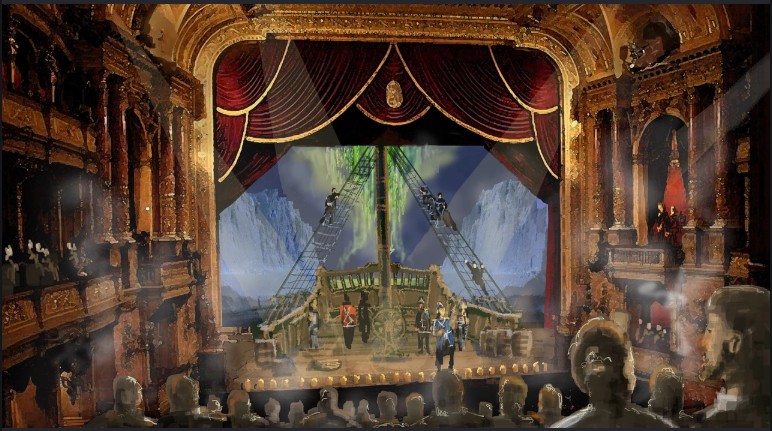
The second bell forces everyone to take their seats. Goebbels leads the companions to private boxes, from which the view is privileged. The stage is dominated by the scenery of a sailing ship silhouetted against a backdrop of snow-capped mountains.
From above, the group has a complete overview of the theater:
- In the place of honor: Emmanuelle sits next to Janna, intent on whispering.
- On the opposite side: Waldemar finally spots Sparsam.
The man, believing himself unseen in the shadow of his box, is behaving in a delusional manner. Completely alone, he waves his hands and simulates lewd acts while staring at someone in the audience (a woman, according to Wolfgang’s expert eye). Waldemar, reading his lips, catches unrepeatable insults and vulgarities. This is an unrecognizable Sparsam: no longer the ice-cold bureaucrat, but an overexcited and agitated maniac.
The lights dim and the show begins. Making his triumphant entrance onto the stage is Luigi Pavarotti, the royal physician, who turns out to be a tenor with a thundering voice. The opera is an interminable ordeal of Tilean lyricism titled “A Midsummer Knight’s Dream.”
The plot, painstakingly translated by Paolino, tells of the dilemma of a captain pushed to the ends of the world by a Doge convinced of the earth’s sphericity. Arriving at the final abyss, the captain must choose between an honorable death or a return in shame.
For the companions, it is an ordeal:
- Wolfgang and Drumin collapse after a few minutes, their snoring fortunately drowned out by Pavarotti’s high notes.
- Goebbels follows entranced, nodding his head in time.
- Paolino holds out for a while, more out of patriotic pride than real interest, before starting to fiddle with the silver buttons on his new jacket.
After no fewer than fourteen acts, the torture finally ends. During the final intermission and the concluding outflow, back in the spiced wine hall, the group notices two things: Goebbels’ shamelessly lascivious attitude, heavily courting a noblewoman who seems to enjoy the attention, and the definitive disappearance of Sparsam.
At the exit of the Royal College, the freezing Middenheim air hits the companions’ faces, helping them shake off the residues of the spiced wine and Tilean boredom. Gotthard Goebbels takes his leave with ill-concealed haste, hiding repeated yawns behind a jeweled hand. His affability seems to have withered with the end of the show.
“Yes, yes… the bear,” Gotthard says distractedly. “I’ll put it on prominent display in the Merchants’ Guild headquarters, a truly… memorable gift.”
The problem, which does not escape anyone in the group, is that Paolino has not yet physically delivered the stuffed animal to him. Goebbels’ lie sets off alarm bells in the minds of Waldemar and Wolfgang. Between the merchant’s lascivious behavior and the obscenities muttered by Sparsam in the box, the suspicion that the shadow of Chaos is corrupting the city’s leadership becomes almost a certainty. Both show extreme sexual deviations or compulsive behaviors: classic signs of the influence of Slaanesh or the madness of Tzeentch.
While the group discusses who to keep an eye on, Josef Sparsam reappears from nowhere, emerging from a side alley. He is all out of breath, with his clothes slightly rumpled and short of wind, as he frantically boards his personal carriage. The dilemma is brief: follow the lecherous Goebbels or the disturbing Sparsam? The choice falls on the latter.
Just as the rest of the group is about to leap onto a hired carriage, Paolino notices Janna Eberhauer adjusting her fur cloak nearby. Completely ignoring the tension of the moment and the urgency of the mission, the halfling launches his attack. With a gallantry that only an adopted (and very tipsy) Tilean can possess, he stops her on the stairs.
Incredibly, between a compliment on her arcane mastery and a suggestive smile, Paolino manages to extract a promise: a midnight dinner at The Goose, the most luxurious and renowned restaurant in Middenheim.
“Don’t wait up for me!” he shouts to his companions as he boards the woman’s carriage. Drumin and Wolfgang look at him with a mix of disdain and admiration for his courage (or his recklessness).
Josef Sparsam’s carriage proceeds swiftly, but the direction it takes freezes the blood in the companions’ veins more than the north wind does. Leaving behind the bohemian lights of Freiburg, the iron-shod wheels head straight for Ostwald.
If Freiburg is the intellectual heart of Middenheim, Ostwald is its darkest and most putrid gut. It is a labyrinth of dead-end alleys, dilapidated houses that seem to support each other by a miracle, and acrid smoke that stagnates among the narrow streets. Before entering the district, the Chancellor’s carriage makes a sudden stop at one of the nightly branches of Wolfrun Coaches. Under the watchful eyes of our heroes, Sparsam gets out and boards a more anonymous and battered vehicle, clearly an orchestrated change to avoid notice among the shacks.
When our heroes’ driver sees Sparsam’s carriage turn the corner that leads into the heart of Ostwald, he pulls the reins sharply, making the horses whinny.
“Stop right there,” the coachman snaps, turning toward the compartment with a grimace. “I’m not going in there at this hour. That’s the realm of the desperate and of easy knives. If you want me to risk my neck to get robbed, or worse, I want double the fare. Now.”
The group consults quickly. They look out the window and then look at themselves: they are adorned with brocades, silks, and velvets worth as much as the annual salary of an entire block in Ostwald. Entering that neighborhood dressed like princes of the Reikland would be like waving a red flag in front of a pack of hungry wolves. They would be easy targets, impossible to ignore for anyone living by their wits.
Wolfgang shakes his head, clutching the hilt of his sword under his expensive cloak.
“Following him now would be suicide. We wouldn’t go unnoticed for even a minute, and we can’t afford a brawl in the middle of this cesspool while we’re dressed like this.”
Reluctantly, but with common sense prevailing over curiosity, they decide to break off the pursuit. They order the coachman to turn the horses and take them back to “The Templar’s Arms.” They need to organize, to change these overly conspicuous clothes and, above all, to understand why the most powerful man in the city’s finances goes to hide among the alleys of Ostwald in the middle of the night…
Dopo il caotico girovagare tra le tribune di legno dello stadio, con il sole che inizia a calare dietro le mure della città, il gruppo decide che è tempo di rientrare a “Le Braccia del Templare”. La stanchezza e i fumi del brandy si fanno sentire, ma la serata che li attende richiede una lucidità che solo un po’ di riposo e dell’acqua fresca sul viso possono restituire.
Al loro ingresso in locanda, vengono accolti dal proprietario che, con un sorrisetto ossequioso mai visto prima, fa loro un cenno:
“Messeri, sono arrivati dei pacchi per voi poco dopo che siete usciti. Li ho fatti portare direttamente nella vostra camera, come si conviene a ospiti del vostro… calibro.”
Sospettosi, con le mani che corrono istintivamente alle else delle spade, i compagni salgono le scale ed entrano nella stanza. Sul letto, disposti con cura quasi maniacale, giacciono completi di velluto, seta e broccato. Non sono precisamente della loro misura — le spalle della giubba per Wolfgang sono un po’ troppo larghe e i pantaloni per Paolino richiedono un risvolto d’emergenza — ma la qualità è indiscutibile. Stoffe pregiate, bottoni d’argento e ricami in filo d’oro: un guardaroba che, a occhio e croce, vale diverse centinaia di corone.
Interrogato nuovamente, il locandiere fa spallucce: il ragazzo che ha consegnato la merce è fuggito via senza dire una parola, lasciando solo un biglietto con i loro nomi. Convinti che si tratti di un investimento di Gotthard Goebbels, ansioso di non sfigurare portando degli straccioni al teatro, i compagni decidono di non fare troppe domande. In fondo, a caval donato non si guarda in bocca, specialmente se il cavallo è fatto di seta bretone.
All’imbrunire, una carrozza della Wolfrun Coaches, con il simbolo del lupo che corre dipinto sulle portiere, si ferma davanti alla locanda. Una volta saliti a bordo, i compagni attraversano una Middenheim trasfigurata dalle ombre della sera. Le torce del Carnevale brillano ovunque, ma man mano che la carrozza risale verso il Palast District, il chiasso della plebe lascia il posto a un silenzio più austero e aristocratico.
Poco dopo, entrano nel quartiere Freiburg.
“È il quartiere degli studiosi e degli artisti,” commenta Fredrich guardando fuori dal finestrino, lisciandosi il nuovo colletto di pizzo. “C’è un’atmosfera bohémien qui, molto diversa dal resto della città. Ho vissuto qui qualche settimana tempo fa… meno guardie, più filosofi e molti più guai se non sai come muoverti.”
La carrozza rallenta fino a fermarsi davanti a una struttura che toglie il fiato. Il Royal College of Music si staglia contro il cielo scuro come un gioiello di architettura classica. È un edificio maestoso, dalla pianta ovale, le cui pareti di pietra bianca sembrano brillare di luce propria.
Ma è la cupola in vetro a dominare la scena: un capolavoro di ingegneria che corona l’intera struttura. Dall’interno, migliaia di candele e fiaccole accese proiettano un bagliore dorato e tremolante attraverso i vetri istoriati, facendo sembrare l’edificio una gigantesca lanterna magica nel cuore della notte.
L’eleganza è assoluta. Nobili in maschera, ricchi mercanti e accademici dalle lunghe toghe salgono la scalinata di marmo tra due ali di servitori in livrea. I nostri, stretti nei loro abiti nuovi e con i sensi allerta, scendono dalla carrozza.
Appena messi i piedi a terra, i compagni vengono raggiunti da Gotthard Goebbels, che sbuca dalla folla con un calice di vino già in mano. L’uomo squadra il gruppo dalla testa ai piedi e una smorfia di palese gelosia gli increspa il volto; nonostante le sue ricchezze, la qualità del broccato indossato dagli eroi sembra superare persino la sua.
“Per gli dei, Paolino! Complimenti per la mise,” esclama Gotthard, tastando con dita avide la manica della giubba dell’halfling. “Un gusto squisito… non sapevo che i sarti tileani lavorassero stoffe così rare. Avrei dovuto chiedervi il nome del vostro fornitore.”
In quel preciso istante, un brivido percorre la schiena dei protagonisti: se Goebbels è invidioso dei loro abiti, significa che non è stato lui a inviarli. Qualcun altro, un benefattore anonimo e incredibilmente facoltoso, ha deciso di “investire” sulla loro immagine per la serata. Ma con quale scopo?
Senza dare tempo ai dubbi di sedimentare, Gotthard li scorta su per la scalinata di marmo, facendosi largo tra la nobiltà. Giunti nell’atrio principale, sotto la luce dorata della cupola, il gruppo viene introdotto a un piccolo circolo di personalità che sembrano reggere le redini di Middenheim:
- Josef Sparsam: Il Cancelliere del Tesoro è esattamente come Johan lo aveva descritto. Un uomo alto un metro e ottanta, dalla corporatura esile che lo fa somigliare a un airone. I suoi capelli grigi sono radi, con un pronunciato “picco della vedova” che accentua il rigore della sua espressione, mentre i suoi occhi color ambra sembrano calcolare il valore lordo di ogni persona che incrocia.
- Emmanuelle Schlagen: Al fianco dei potenti siede la concubina del Graf. Una donna di una bellezza eterea, alta e snella, con una cascata di ricci biondo cenere e occhi verde pallido che osservano la scena con un distacco quasi annoiato.
- L’Ar-Ulric: Anche in abiti formali, l’alto sacerdote non rinuncia alla sua natura bellicosa. Indossa cerimonialmente una magnifica pelle di lupo bianco sopra le vesti di seta, e il suo sguardo si posa immediatamente sul gruppo.
- Mentre Paolino riprende con rinnovato vigore la sua recita da mercante tileano, cercando di ammaliare la Schlagen con storie di rotte marittime inverosimili, gli altri membri del gruppo restano allerta, notando sottili ma inequivocabili dinamiche di potere.
- L’Ar-Ulric riconosce immediatamente gli “straccioni” che quella mattina avevano bussato al tempio. Nel vederli così agghindati, la sua mascella si contrae vistosamente; il fatto che abbiano ottenuto abiti che lui stesso fatica a concedere ai suoi iniziati scatena in lui una forte rabbia ,a stento contenuta. È evidente, inoltre, che l’alto sacerdote cerchi costantemente lo sguardo di Emmanuelle. Dall’altro lato, la frattura tra l’Ar-Ulric e Sparsam è quasi palpabile. I due non si guardano mai direttamente, limitandosi a scambiarsi fredde cortesie di circostanza. Per i compagni, la diagnosi è immediata: la questione delle tasse.
Il suono di una campanella d’argento annuncia l’inizio imminente dello spettacolo. Il gruppo, scortato da un servitore in livrea, entra nel salone principale dove viene offerto del vino speziato dall’aroma intenso di cannella e chiodi di garofano.
Josef Sparsam scivola via tra la folla con un’abilità quasi sovrannaturale; Waldemar tenta di tenerlo d’occhio, ma nonostante la sala non sia immensa, il grigio burocrate sembra letteralmente svanire nel nulla, come se le ombre stesse del teatro lo avessero inghiottito
Emmanuelle Schlagen, invece, si avvicina a una donna che Goebbels indica con un cenno del capo. Si tratta di Janna Eberhauer, la Vice Sommo Mago di corte. È una giovane donna di circa 26 anni, dalla corporatura formosa, con una cascata di capelli ramati e il viso spruzzato di simpatiche lentiggini. Paolino, fiutando l’opportunità, si sgancia dal gruppo e la approccia proprio mentre lei attende il suo turno per il vino.
Parlando con lei, l’halfling tocca il tasto dolente delle tasse. Janna non nasconde il suo coinvolgimento emotivo: la sua voce si fa tesa mentre ribadisce che la Gilda dei Maghi è furiosa. Si sentono traditi, isolati politicamente e sospettano che Sparsam sia il vero architetto dietro questa morsa fiscale che colpisce reagenti e pergamene.
La seconda campanella costringe tutti a prendere posto. Goebbels conduce i compagni nei palchi privati, da cui la vista è privilegiata. Il palcoscenico è dominato dalla scenografia di un veliero che staglia il suo profilo contro un fondale di montagne innevate.
Dall’alto, il gruppo ha una panoramica completa del teatro:
- Al posto d’onore: Emmanuelle siede accanto a Janna, intente a bisbigliare.
- Dalla parte opposta: Waldemar individua finalmente Sparsam.
L’uomo, credendosi non visto nell’ombra del suo palco, si sta comportando in modo delirante. Completamente solo, agita le mani e simula atti osceni mentre fissa qualcuno in platea (una donna, secondo l’occhio esperto di Wolfgang). Waldemar, leggendo il labiale, coglie insulti e volgarità irripetibili. È uno Sparsam irriconoscibile: non più il burocrate di ghiaccio, ma un maniaco sovreccitato e agitato
Le luci calano e lo spettacolo ha inizio. Sul palco fa il suo ingresso trionfale Luigi Pavarotti, il medico reale, che si rivela essere un tenore dalla voce tonante. L’opera è un interminabile calvario di lirica tileana intitolato “Sogno di un Cavaliere di Mezz’estate”.
La trama, tradotta a fatica da Paolino, narra il dilemma di un capitano spinto ai confini del mondo da un Doge convinto della sfericità della terra. Arrivato all’abisso finale, il capitano deve scegliere tra la morte onorevole o il ritorno nella vergogna.
Per i compagni è un supplizio:
- Wolfgang e Drumin crollano dopo pochi minuti, il loro russare fortunatamente coperto dagli acuti di Pavarotti.
- Goebbels segue estasiato, dondolando la testa a tempo.
- Paolino regge per un po’, più per orgoglio patriottico che per reale interesse, prima di iniziare a giocherellare con i bottoni d’argento della sua giacca nuova.
Dopo ben quattordici atti, la tortura finalmente termina. Durante l’intervallo finale e il deflusso conclusivo, tornati nella sala del vino speziato, il gruppo nota due cose: l’atteggiamento spudoratamente lascivo di Goebbels, impegnato a corteggiare pesantemente una nobildonna che sembra gradire le attenzioni, e la definitiva scomparsa di Sparsam.
All’uscita del Royal College, l’aria gelida di Middenheim colpisce i volti dei compagni, aiutandoli a smaltire i residui del vino speziato e della noia tileana. Gotthard Goebbels si congeda con una fretta malcelata, nascondendo ripetuti sbadigli dietro una mano ingioiellata. La sua affabilità sembra essersi prosciugata con la fine dello spettacolo.
“Sì, sì… l’orso,” dice Gotthard con tono distratto. “Lo metterò in bella mostra nella sede della Gilda dei Mercanti, un dono davvero… memorabile.”
Il problema, che non sfugge a nessuno del gruppo, è che Paolino non gli ha ancora recapitato fisicamente l’animale impagliato. La menzogna di Goebbels fa scattare un campanello d’allarme nella mente di Waldemar e Wolfgang. Tra gli atteggiamenti lascivi del mercante e le oscenità farneticate da Sparsam nel palco, il sospetto che l’ombra del Caos stia corrompendo i vertici della città si fa quasi certezza. Entrambi mostrano deviazioni sessuali estreme o comportamenti compulsivi: segni classici dell’influenza di Slaanesh o della follia di Tzeentch? Mentre il gruppo discute su chi tenere d’occhio, Josef Sparsam ricompare dal nulla, sbucando da un vicolo laterale. È tutto trafelato, con i vestiti leggermente sgualciti e il fiato corto, mentre sale freneticamente sulla sua carrozza personale.
Il dilemma è breve: seguire il lascivo Goebbels o l’inquietante Sparsam? La scelta ricade sul secondo.
Proprio mentre il resto del gruppo sta per balzare su una carrozza a noleggio, Paolino nota Janna Eberhauer che si accomoda il mantello di pelliccia poco distante. Ignorando completamente la tensione del momento e l’urgenza della missione, l’halfling si lancia all’attacco. Con una galanteria che solo un Tileano d’adozione (e molto alticcio) può possedere, la blocca sulla scalinata.
Incredibilmente, tra un complimento alla sua maestria arcana e un sorriso ammiccante, Paolino riesce a strapparle una promessa: una cena di mezzanotte all’Oca, il ristorante più lussuoso e rinomato di Middenheim.
“Non aspettatemi alzato!” grida ai propri compagni mentre sale sulla carrozza della donna : Drumin e Wolfgang lo guardano con un misto di sdegno e ammirazione per il suo coraggio (o la sua incoscienza).
a carrozza di Josef Sparsam procede spedita, ma la direzione che imbocca gela il sangue nelle vene dei compagni più di quanto faccia il vento del nord. Lasciate alle spalle le luci bohémien del Freiburg, le ruote ferrate puntano dritte verso Ostwald.
Se il Freiburg è il cuore intellettuale di Middenheim, Ostwald è il suo intestino più buio e putrido. È un labirinto di vicoli ciechi, case fatiscenti che sembrano sorreggersi l’un l’altra per miracolo e fumo acre che ristagna tra le strade strette. Prima di addentrarsi nel quartiere, la carrozza del Cancelliere effettua una sosta repentina presso una delle sedi notturne della Wolfrun Coaches. Sotto lo sguardo attento dei nostri, Sparsam scende e sale su una vettura più anonima e malmessa, chiaramente un cambio orchestrato per non dare nell’occhio tra le baracche.
Quando il pilota dei nostri eroi vede la carrozza di Sparsam svoltare l’angolo che conduce nel cuore dell’Ostwald, tira bruscamente le redini, facendo nitrire i cavalli.
“Fermi tutti,” sbotta il cocchiere, voltandosi verso lo scompartimento con una smorfia. “Io non ci entro lì dentro a quest’ora. Quello è il regno dei disperati e dei coltelli facili. Se volete che rischi la pelle per farmi rapinare, o peggio, voglio il doppio della tariffa. Subito.”
Il gruppo si consulta rapidamente. Guardano fuori dal finestrino e poi guardano se stessi: sono agghindati con broccati, sete e velluti che valgono quanto il salario annuale di un intero isolato di Ostwald. Entrare in quel quartiere vestiti come principi del Reikland sarebbe come agitare una bandiera rossa davanti a un branco di lupi affamati. Sarebbero bersagli facili, impossibili da ignorare per chiunque viva di espedienti.
Wolfgang scuote il capo, stringendo l’elsa della spada sotto il mantello pregiato.
“Seguirlo ora sarebbe un suicidio. Non passeremmo inosservati nemmeno per un minuto e non possiamo permetterci una rissa in mezzo a questo letamaio mentre siamo conciati così.”
Con riluttanza, ma con il buonsenso che prevale sulla curiosità, i nostri decidono di interrompere il pedinamento. Danno ordine al cocchiere di girare i cavalli e riportarli verso “Le Braccia del Templare”. Hanno bisogno di organizzarsi, di cambiare questi abiti troppo appariscenti e, soprattutto, di capire perché l’uomo più potente delle finanze cittadine vada a nascondersi tra i vicoli di Ostwald nel cuore della notte..


Leave a Reply