The cart creaks heavily as it begins the ascent along the Altdorf Viaduct. Beneath the companions’ feet, the abyss is shrouded in mist; above them, the mass of the Ulricsberg looms like the fist of a stone god. The city guards, the so-called “Wolves” of Middenheim, scrutinize every traveler with suspicious eyes from the walkways of the towers dotting the bridge.
Upon reaching the South Gate, traffic grinds to a halt. A long line of merchants, pilgrims, and hawkers awaits the inspection of the tax collectors in air made thick by the scent of resin torches and wet horses. A guard officer, wearing a conspicuous wolf-fur cloak and holding a gleaming halberd, raps his armored gauntlet against the side of the group’s cart:
“Papers and entry taxes. One gold crown for the cart, two shillings per head—dwarfs excluded… for them, there is the new surcharge: a flat gold crown,” he says with a sneer directed at Drumin. “And if you are carrying paper, ink, or reagents for the Wizards’ Guild, prepare ten percent of the gross value.”
Just as Wolfgang is about to protest, a man in dark robes with a restless gaze approaches the convoy. He is one of the city’s arcane inspectors. Without asking permission, the man passes his gloved hands over the companions’ belongings, muttering incomprehensible syllables. He stops abruptly at the pouch hiding the magical dwarven ring taken from Etelka.
“There is something here,” the inspector hisses, turning to the captain of the guards. The latter approaches and, weighing the item with the air of one who knows exactly what is being discussed, imposes an extra 10-crown toll. Despite their clear annoyance, the group is forced to pay.
Before setting off again, the companions fall into conversation with the wizard regarding those cursed new gabelle taxes. The man, who introduces himself as Johan, asserts that they are the brainchild of the “Law Lords,” the three Middenheim statesmen delegated to propose and draft the laws governing the city. Once produced, these are submitted to the Graf’s scrutiny, who can approve or reject them—a process subject to palace intrigues of which the street gossip is full.
According to the Wizards’ Guild, of which Johan is a member, the taxes are the latest madness birthed by Chancellor of the Exchequer Sparsam, a cold man completely dedicated to balancing the public accounts. Johan recounts that even the Guild President and High Court Wizard, Albrecht Helseher, opposed them vehemently, but to no avail. Many of Johan’s colleagues are considering leaving the city after the Carnival. Although he has no certain proof, the wizard is convinced that the dwarfs of the Engineers’ Guild are also on the warpath.
Shrugging his shoulders, Johan bids the group farewell, recommending “The Templar’s Arms” as one of the few inns that might still have room. Meanwhile, behind the protagonists, the queue to enter the city shows no sign of diminishing despite the falling darkness.
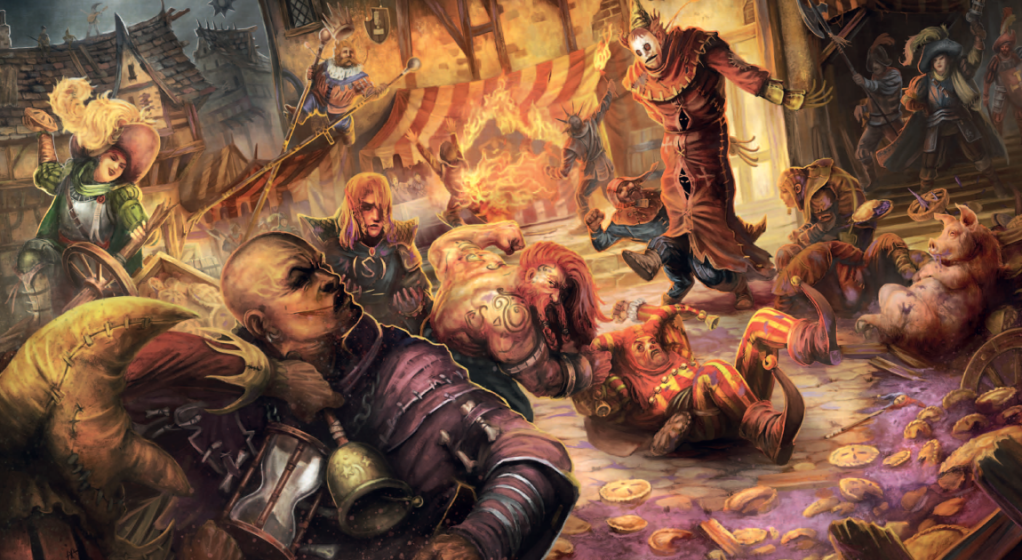
Having crossed the South Gate, the city reveals itself as an explosion of contrasts: the narrow, dark alleys smell of smoke and beer, while the main squares are already decorated for the Carnival. Flags with the rampant wolf fly everywhere, and among the crowd, one can see the first masks, fire-eaters, and preachers shouting at passersby.
Driving the cart at a walking pace through the throng, the group travels down the great central thoroughfare, attempting to reach the tavern. Finally, after more than an hour spent traveling just a few hundred yards, the companions leave the cart in a nearby stable and enter the large, four-story inn. An immense hearth warms the room, overflowing with travelers intent on drinking and joking.
Approaching the counter, the companions ask for room and board for a week, accepting the insane figure of 4 crowns a day for room and food. Exhausted by more than a month of hardships, they accept without argument. Literally tossing their swords and armor into the middle of the room, the protagonists can finally relax by the crackling warmth of the fireplace.
Before them, the typical local dish is served: the famous “1812.” It is a traditional meal of meat meatballs of dubious origin, peppered and smoked to unimaginable levels. The recipe evokes the desperate days of the Siege of Middenheim in 1812, when the great famine forced the city’s cooks to mix scraps of wild game and strong spices to feed the defenders.
As rivers of beer and food finally flow to the table, the warmth of the tavern begins to melt the frost accumulated in the Drakwald, allowing the group a moment of well-deserved rest.
The night passes without further incident, save for the heavy digestive work required by the “1812” consumed hours earlier. The companions collapse onto their beds, sinking into a dreamless sleep that tastes of mud, rain, and the fatigue accumulated over weeks of marching.
The following morning, the reality of Middenheim presents itself in the form of a frugal breakfast and a climate that leaves no room for doubt: the warmth of the Reikland is now a faded memory. Over cups of steaming decoction, the group takes stock of the situation. The list of pending matters is long and dangerous: they must track down the last Wittgenstein heir, but above all, they must eradicate the beating heart of the Tzeentch cult. Etelka and Teugen’s documents were clear: it is here, within the walls of the City of the Wolf, that the Magisters are orchestrating a plan of unimaginable proportions.
Waldemar, tormented by doubts, emphasizes how suspicious the matter of the new taxes is. Striking the dwarfs (the labor and technological force), the wizards (the arcane defense), and the cults (the spiritual glue) simultaneously seems like a surgical method to weaken the pillars of the city.
The moment for farewells arrives quickly. Yulevno, with a final nod of gratitude for having escorted him and honored Father Luthor’s wishes, takes his leave. The young monk heads toward the local Temple of Sigmar, intending to place himself at the service of the city priest and find his own path in time.
Left alone, the companions decide that their absolute priority is to replenish their purses. Winter is clawing at the plateau, and the little money remaining after the extortionate toll at the South Gate is barely enough for emergency equipment. Before heading to the temple, the group stops at an emporium in the merchants’ quarter.
The Middenheim air stings their faces like a frozen blade. With a mix of resignation and necessity, the protagonists purchase heavy boiled-wool cloaks, lined leather gloves, and fur hoods. Drumin grumbles about the excessive cost, but even his dwarven constitution is beginning to feel the dampness rising from the Ulricsberg.
Once bundled up, the companions resume their way toward the Great Temple of Ulric. As they approach the city center, the architecture becomes more austere and imposing. The temple emerges from the morning mist like a fortress of unshakeable faith: a colossus of gray stone dedicated to the God of Winter and War.
The atmosphere here is profoundly different from that of Altdorf. There are none of the golden embroideries of the Church of Sigmar; here, wolf symbols, the clang of steel, and an eternal fire burning in the central courtyard dominate. The companions approach the entrance, aware that the letter from the Grand Theogonist they carry is both a safe-conduct and a potential fuse in a city that looks upon Sigmar with ill-concealed defiance.
The interior of the Temple of Ulric is a monumental testament to the austere faith of the North. Enormous gray granite pillars support a towering vault, lost in the shadows and smoke of resinous incense. In the center of the nave, in a circular depression in the floor, roars the Eternal Flame: a fire that, according to legend, will burn as long as Middenheim stands. The heat it radiates is intense, yet not enough to dissipate the chill that seems to seep from the stone walls.
The group struggles to identify the Ar-Ulric among the dozens of fur-clad figures moving through the temple. They approach a young initiate, a gaunt-faced lad named Maximillian, who listens with skepticism to the story of the Grand Theogonist’s letter. After some hesitation, the youth moves away to report.
From a distance, the companions watch Maximillian as he approaches an imposing figure wrapped in white-wolf ceremonial vestments. With a sharp, almost violent gesture, the Ar-Ulric snatches the letter from the initiate’s hands and opens it feverishly, reading it under the embarrassed gaze of his subordinate. After a few moments, the tension in his shoulders seems to melt; he composes himself and, preceded by Maximillian, heads toward the adventurers.
Once before them, the Ar-Ulric receives the due bow with a frozen solemnity.
“You have rendered a service to the Empire by defending the person of the Grand Theogonist,” he decrees in a deep voice. “For this, you shall enjoy room and board at the expense of the Church of Ulric for the duration of your stay, dinners included.”
Paolino, seeing an opening, tries to ask if extra clothes or equipment are also provided, but the High Priest flashes him a look so sharp it silences him instantly. Maximillian is ordered to prepare a parchment pass to be shown at the contracted inns. Since the Ar-Ulric makes it clear he has no time to waste, the young initiate will become their point of contact for any needs at the temple.
Before the High Priest can take his leave, Waldemar dares to question him regarding the new taxes that are bringing the city to its knees. The Ar-Ulric betrays an ill-concealed nervousness, nervously clutching the medallion he wears around his neck.
“If this is the Graf’s will, the Church of Ulric will comply for the good of the city and its defense,” he responds curtly, before turning on his heel and vanishing into the shadows of the choir.
Left alone with Maximillian, the companions begin to pelt him with questions. The boy looks around circumspectly and rubs his thumb against his forefinger. To talk, he wants a gold crown and the promise of extra food; life as an initiate, he confesses, has become very hard. Once paid, Maximillian vents in a whisper.
“The taxes? Holy Ulric… of course we are all against them! They are an insult to the Great Father of Winter and to all the cults. Almost no one here at the temple can stand them, but the Ar-Ulric supports them, and so we must do the same. It is madness.”
The youth continues, revealing how explosive the situation is:
“Brawls have already broken out with the initiates of the Temple of Sigmar. They are convinced that the tax on the temple and the one on the dwarfs were devised by the Ar-Ulric to strike at the less wealthy cults. Werner Stolz, their head priest, is beyond angry and openly accuses our superior. Even High Priestess Isolde Begegnen of the Cult of Shallya has publicly denounced the law, claiming it siphons vital funds intended for the care of the poor. Meanwhile, we have cut all extra expenses here… look at our mess hall: it’s become as meager as a hermit’s!”
Continuing, Maximillian looks around furtively, ensuring no other initiate or Wolf Kin is within earshot, then beckons the group to come even closer, in the shadow of a massive granite pillar.
“And it’s not just a matter of money,” the initiate whispers, his voice cracking with a mix of fear and pleasure for the forbidden gossip. “Everyone knows that Graf Boris is a shadow of his former self. He is depressed, broken, at the mercy of anyone who manages to have even a shred of influence over him. Since his second wife also died during the birth of the unfortunate Stefan, his mind seems to have slipped into an abyss from which he cannot emerge.”
Maximillian crosses his arms, shaking his head with bitterness.
“The heir, young Stefan, is mentally ill. He is completely unfit to become Graf, poor lad. His father is so desperate that he has brought a luminary all the way from Tilea, one Luigi Pavarotti, appointing him court physician just to attend to him. But between a son who cannot rule and a father who no longer wants to, power has remained unguarded… and the wolves—the real ones—are taking advantage of it. The Graf, I’m telling you, is in a very bad way…”
Il carretto cigola pesantemente mentre inizia l’ascesa lungo il Viadotto di Altdorf. Sotto i piedi dei compagni, l’abisso è avvolto dalla nebbia; sopra di loro, la mole dell’Ulricsberg incombe come il pugno di un dio di pietra. Le guardie cittadine, i cosiddetti “Lupi” di Middenheim, scrutano ogni viandante con occhi sospettosi dai camminamenti delle torri che punteggiano il ponte.
Arrivati alla Porta Sud, il traffico si blocca. Una lunga fila di mercanti, pellegrini e imbonitori attende il controllo dei gabellieri in un’aria resa densa dall’odore di torce di resina e cavalli bagnati. Un ufficiale della guardia, con un vistoso mantello di pelliccia di lupo e un’alabarda lucente, picchia col guanto corazzato contro il fianco del carro del gruppo:
“Documenti e tasse d’ingresso. Una corona d’oro per il carro, due scellini per ogni testa, nani esclusi… per quelli c’è la nuova sovrattassa: una corona d’oro fissa,” dice con un ghigno rivolto a Drumin. “E se trasportate carta, inchiostro o reagenti per la Gilda dei Maghi, preparate il dieci per cento del valore lordo.”
Proprio mentre Wolfgang sta per protestare, un uomo dalle vesti scure e lo sguardo inquieto si avvicina al convoglio. È uno degli ispettori arcani della città. Senza chiedere permesso, l’uomo passa le mani guantate sopra gli averi dei compagni, mormorando sillabe incomprensibili. Si sofferma bruscamente sul sacchetto che nasconde l’anello magico dei nani preso ad Etelka.
“Qui c’è qualcosa,” sibila l’ispettore, rivolgendosi al capo delle guardie. Quest’ultimo si avvicina e, soppesando l’oggetto con l’aria di chi sa esattamente di cosa si stia parlando, impone 10 corone extra di pedaggio. Nonostante il palese fastidio, il gruppo è costretto a pagare.
Prima di ripartire, i compagni si perdono in chiacchiere con il mago riguardo a quelle maledette nuove gabelle. L’uomo, che si presenta come Johan, asserisce che sono il frutto dei “Signori della Legge”, i tre uomini di stato di Middenheim delegati a proporre e stilare le leggi che regolano la città. Queste, una volta prodotte, vengono sottoposte al vaglio del Graf, il quale le può approvare o rifiutare; un passaggio soggetto a giochi di palazzo di cui i pettegolezzi di strada sono pieni.
Secondo la Gilda dei Maghi, di cui Johan fa parte, le tasse sono l’ultima follia partorita dal Cancelliere del Tesoro Sparsam, un uomo freddo e completamente dedito a far quadrare i conti pubblici. Johan racconta che persino il presidente della Gilda, nonché sommo mago di corte Albrecht Helseher, si è opposto con veemenza, ma senza risultato. Molti colleghi di Johan stanno pensando di abbandonare la città dopo il Carnevale. Sebbene non abbia prove certe, il mago è convinto che anche i nani della Gilda degli Ingegneri siano sul piede di guerra.
Facendo spallucce, Johan saluta il gruppo, raccomandando “Le Braccia del Templare” come una delle poche locande che potrebbero avere ancora posto. Nel frattempo, dietro i protagonisti, la coda per accedere alla città non accenna a diminuire nonostante il calare delle tenebre.
Varcato il Cancello Sud, la città si rivela un’esplosione di contrasti: i vicoli stretti e bui emanano odore di fumo e birra, mentre le piazze principali sono già addobbate per il Carnevale. Bandiere con il lupo rampante sventolano ovunque e tra la folla si vedono le prime maschere, mangiafuoco e predicatori che urlano ai passanti.
Guidando il carretto a passo d’uomo nella bolgia, il gruppo percorre la grande via centrale tentando di raggiungere la taverna. Finalmente, dopo più di un’ora impiegata per fare poche centinaia di metri, i compagni abbandonano il carro in una stalla vicina ed entrano nella grande locanda a quattro piani. Un immenso focolare riscalda l’ambiente, straripante di viandanti intenti a bere e scherzare.
Avvicinatisi al bancone, i compagni chiedono vitto e alloggio per un’ottimana, accettando la folle cifra di 4 corone al giorno per stanza e cibo. Distrutti da più di un mese di peripezie, accettano senza discutere. Lanciate letteralmente le spade e le armature in mezzo alla stanza, i protagonisti possono finalmente rilassarsi al caldo scoppiettante del camino.
Davanti a loro viene servita la tipica pietanza locale: il famoso “1812”. Si tratta di un piatto tradizionale a base di polpette di carne dalla dubbia provenienza, pepate e affumicate a livelli inimmaginabili. La ricetta rievoca i giorni disperati dell’assedio di Middenheim del 1812, quando la grande carestia spinse i cuochi della città a mescolare rimasugli di carne selvatica e spezie forti per nutrire i difensori.
Mentre fiumi di birra e cibo affluiscono finalmente al tavolo, il calore della taverna inizia a sciogliere il gelo accumulato nel Drakwald, permettendo al gruppo un momento di meritato riposo.
La notte passa senza ulteriori sussulti, se non per il pesante lavorio digestivo richiesto dal “1812” consumato poche ore prima. I compagni svengono sui letti, sprofondando in un sonno senza sogni che sa di fango, pioggia e stanchezza accumulata in settimane di marcia.
La mattina seguente, la realtà di Middenheim si ripresenta sotto forma di una colazione frugale e un clima che non lascia spazio a dubbi: il calore del Reikland è ormai un ricordo sbiadito. Davanti a tazze di decotto fumante, il gruppo fa il punto della situazione. La lista delle pendenze è lunga e pericolosa: bisogna scovare l’ultimo erede dei Wittgenstein, ma soprattutto sradicare il cuore pulsante del culto di Tzeentch. I documenti di Etelka e Teugen parlavano chiaro: è qui, tra le mura della Città del Lupo, che i Magister stanno orchestrando un piano di proporzioni inimmaginabili.
Waldemar, tormentato dai dubbi, sottolinea quanto la questione delle nuove tasse sia sospetta. Colpire contemporaneamente i nani (la forza lavoro e tecnologica), i maghi (la difesa arcana) e i culti (il collante spirituale) sembra un metodo chirurgico per indebolire i pilastri della città.
Il momento dei saluti arriva presto. Yulevno, con un ultimo cenno di gratitudine per averlo scortato e aver onorato le volontà di Padre Luthor, si accomiata. Il giovane monaco si dirige verso il tempio locale di Sigmar, intenzionato a mettersi al servizio del sacerdote cittadino e a trovare, col tempo, la propria strada.
Rimasti soli, i compagni decidono che la priorità assoluta è rimpinguare le borse. L’inverno sta artigliando l’altopiano e i pochi soldi rimasti dopo il pedaggio estorsivo della Porta Sud bastano a malapena per l’equipaggiamento d’emergenza. Prima di dirigersi al tempio, il gruppo fa sosta in un emporio nel quartiere dei mercanti.
L’aria di Middenheim punge il viso come una lama gelida. Con un misto di rassegnazione e necessità, i protagonisti acquistano pesanti mantelli di lana cotta, guanti di pelle foderati e cappucci di pelliccia. Drumin brontola per il costo eccessivo, ma persino la sua tempra nanica inizia a risentire dell’umidità che sale dall’Ulricsberg.
Una volta imbacuccati, i compagni riprendono il cammino verso il Grande Tempio di Ulric. Man mano che si avvicinano al centro della città, l’architettura si fa più austera e imponente. Il tempio emerge dalla nebbia mattutina come una fortezza di fede incrollabile: un colosso di pietra grigia dedicato al Dio dell’Inverno e della Guerra.
L’atmosfera qui è profondamente diversa da quella di Altdorf. Non ci sono i ricami dorati della chiesa di Sigmar; qui dominano i simboli del lupo, il clangore dell’acciaio e un fuoco eterno che arde nel cortile centrale. I compagni si avvicinano all’ingresso, consci che la lettera del Gran Teogono che portano con sé è al contempo un salvacondotto e una potenziale miccia in una città che guarda a Sigmar con malcelata diffidenza.
L’interno del Tempio di Ulric è una testimonianza monumentale della fede austera del Nord. Enormi pilastri di granito grigio sostengono una volta altissima, persa nell’ombra e nel fumo degli incensi resinosi. Al centro della navata, in una depressione circolare del pavimento, ruggisce la Fiamma Eterna: un fuoco che, secondo la leggenda, brucerà finché Middenheim resterà in piedi. Il calore che emana è intenso, ma non basta a dissipare il gelo che sembra trasudare dalle pareti di pietra.
Il gruppo fatica a identificare l’Ar-Ulric tra le decine di figure in pelliccia che si muovono nel tempio. Interpellano un giovane iniziato, un ragazzo dal volto scavato di nome Maximillian, il quale ascolta con scetticismo la storia della lettera del Gran Teogono. Dopo qualche esitazione, il giovane si allontana per riferire.
Dalla distanza, i compagni seguono con lo sguardo Maximillian mentre approccia una figura imponente, avvolta in paramenti cerimoniali di lupo bianco. Con un gesto brusco, quasi violento, l’Ar-Ulric strappa la lettera dalle mani dell’iniziato e la apre febbrilmente, leggendola sotto lo sguardo imbarazzato del sottoposto. Dopo qualche istante, la tensione nelle sue spalle sembra sciogliersi; si ricompone e, preceduto da Maximillian, si dirige verso gli avventurieri.
Una volta al loro cospetto, l’Ar-Ulric riceve l’inchino dovuto con una solennità gelida.
“Avete reso un servizio all’Impero difendendo la persona del Gran Teogono,” sentenza con voce profonda. “Per questo, godrete di vitto e alloggio a spese della chiesa di Ulric per tutta la durata della vostra permanenza, cene incluse.”
Paolino, vedendo un’apertura, prova a chiedere se siano previsti anche vestiti extra o equipaggiamento, ma l’alto sacerdote lo fulmina con uno sguardo così tagliente da zittirlo all’istante. Maximillian riceve l’ordine di preparare un lasciapassare su pergamena da esibire nelle locande convenzionate. Dato che l’Ar-Ulric chiarisce subito di non avere tempo da perdere, il giovane iniziato diventerà il loro riferimento per qualunque necessità presso il tempio.
Prima che il sommo sacerdote possa congedarsi, Waldemar osa interrogarlo riguardo alle nuove tasse che stanno mettendo in ginocchio la città. L’Ar-Ulric tradisce un nervosismo malcelato, stringendo nervosamente il medaglione che porta al collo.
“Se questo è il volere del Graf, la chiesa di Ulric si adeguerà per il bene della città e della sua difesa,” risponde secco, prima di girare sui tacchi e sparire tra le ombre del coro.
Rimasti soli con Maximillian, i compagni iniziano a tartassarlo di domande. Il ragazzo si guarda intorno circospetto e strofina il pollice contro l’indice. Per parlare, vuole una corona d’oro e la promessa di cibo extra; la vita da iniziato, confessa, è diventata durissima. Una volta pagato, Maximillian si sfoga sottovoce.
“Le tasse? Santo Ulric… certo che siamo tutti contrari! Sono un’offesa al Grande Padre dell’Inverno e a tutti i culti. Qui al tempio quasi nessuno le sopporta, ma l’Ar-Ulric le sostiene, e quindi noi dobbiamo fare altrettanto. È una follia.”
Il giovane continua, rivelando quanto la situazione sia esplosiva:
“Sono già scoppiati tafferugli con gli iniziati del tempio di Sigmar. Loro sono convinti che la tassa sul tempio e quella sui nani siano state ideate dall’Ar-Ulric per colpire i culti meno abbienti. Werner Stolz, il loro sacerdote capo, è furioso e accusa apertamente il nostro superiore. Persino la Gran Sacerdotessa Isolde Begegnen del culto di Shallya ha denunciato la legge, sostenendo che tolga risorse vitali alla cura dei poveri. Intanto, qui abbiamo tagliato ogni spesa… guardate la nostra mensa: è diventata magra come quella di un eremita!”
Continuando, Maximillian si guarda intorno furtivamente, assicurandosi che nessun altro iniziato o cavaliere lupo sia a portata d’orecchio, poi fa cenno al gruppo di avvicinarsi ancora di più, all’ombra di un massiccio pilastro di granito.
“E non è solo una questione di soldi,” sussurra l’iniziato, la voce incrinata da un misto di paura e piacere per il pettegolezzo proibito. “Tutti sanno che il Graf Boris è l’ombra di se stesso. È depresso, distrutto, in balia di chiunque riesca ad avere anche solo un briciolo di influenza su di lui. Da quando è morta la sua seconda moglie durante il parto dello sfortunato Stefan, la sua mente sembra essere scivolata in un baratro da cui non riesce a uscire.”
Maximillian incrocia le braccia, scuotendo il capo con amarezza.
“L’erede, il giovane Stefan, è malato di mente. È completamente inadatto a diventare Graf, povero ragazzo. Il padre è così disperato che ha fatto arrivare fin dalla lontana Tilea un luminare, un tale Luigi Pavarotti, nominandolo medico di corte solo per occuparsi di lui. Ma tra un figlio che non può regnare e un padre che non vuole più farlo, il potere è rimasto incustodito… e i lupi, quelli veri, ne stanno approfittando. Il Graf, ve lo dico io, sta messo molto male…”


Leave a Reply