ITA
Reggendo Paolino, ancora rintronato dal pugno di Bruger e con una protuberanza vistosa sul mento, il gruppo si allontana dal ring, continuando a visitare la Schaffenfest. Le risate e gli schiamazzi della fiera riprendono a circondarli, ma l’umore generale è un po’ più cupo. Paolino borbotta qualcosa sulle “ingiustizie del ring” e su “come l’avrebbe fatto nero al secondo round”, ma la sua voce è ancora debole.
A poca distanza, il loro sguardo è attratto da un uomo appoggiato pigramente a un palo di legno, vicino a una sorta di arazzo logoro che recita “Doktor Mathusius Zoocopeia”. Il tendone alle sue spalle sembra modesto, ma la promessa di chissà quali meraviglie esotiche è palpabile. Il Doktor Mathusius, con un sorriso sornione e gli occhi che sembrano celare più di quanto rivelino, osserva la folla, apparentemente indifferente.
Poco più in là, mentre una leggera pioggerellina inizia a cadere, trasformando la polvere in fango leggero, spicca un tendone da circo ben più imponente, circondato da una serie di gabbie coperte con teli. Una lunga fila si snoda davanti a una sorta di biglietteria, e nell’aria si percepisce un misto di eccitazione e curiosità. Ma ciò che cattura l’attenzione di Drumin è un dettaglio inaspettato: tra le gabbie, un altro nano sta lavorando, affaccendato, spostando teli e sistemando qualcosa all’interno di una delle gabbie. Il suo cuore di nano ha un sobbalzo inaspettato alla vista di un suo simile in un contesto così singolare. Drumin lo osserva, la sua solita sfiducia che si mescola a una punta di curiosità. Che diavolo ci fa un nano in un circo? E perché non sta in una miniera o a forgiare? La visione è tanto insolita quanto intrigante.
Indecisi sul da farsi, si guardano intorno. Vedono una tenda di una chiromante, un drappo scuro e riccamente decorato con stelle e mezzelune, da cui si intravedono lanterne colorate e l’ombra ondeggiante di figure. L’aria intorno è già densa di profumi speziati e forse qualcosa di più esotico, qualcosa che sa di viaggi lontani e destini inespressi. E poi, poco più avanti, un tendone dove il profumo di birra è inequivocabile, accompagnato da risate e canti sguaiati.
Il gruppo decide di dividersi. Paolino, ancora frastornato dal pugno, si dirige claudicante verso la tenda della birra, sperando che qualche boccale possa fargli dimenticare l’umiliazione. Waldemar, Fredrich e Wolfgang si dirigono verso la tenda dell’indovina, la curiosità che vince sul loro scetticismo (o, nel caso di Wolfgang, sulla sua avarizia). Drumin, con un risolino quasi impercettibile, si dirige verso il nano del freakshow, una rara occasione per parlare Khazalid con un suo simile.
Il trio dalla veggente si accinge ad entrare. L’aria all’interno è densa di aromi, un misto inebriante di incenso, erbe bruciate e qualcosa di indefinibile, quasi elettrico. L’ambiente è buio, illuminato solo dal tremolio di tante candele di cera, le cui fiamme proiettano ombre danzanti sulle pareti decorate con simboli misteriosi. Fredrich è il primo a entrare, il suo passo sicuro che contrasta con l’atmosfera eterea. La donna, una figura avvolta in scialli colorati, con occhi penetranti, gli prende la mano. “Vedo un passaggio stretto con dell’acqua,” mormora, la sua voce raschiante che sembra venire da lontano. “C’è la morte che ti attende lì… Vedo un uomo oscuro che non è ciò che sembra… vedo sette uomini e due: uno dei due distruggerà gli altri e molti altri ancora… Attento al grande e ricco uomo, egli sarà foriero di grandi pericoli!” Le sue parole svaniscono come fumo, lasciando Fredrich con una sensazione di inquietudine.
Poi è il turno di Waldemar. La veggente gli afferra la mano con forza sorprendente. “Vedo il segno della rosa rossa che trabocca sangue…” sussurra, i suoi occhi che sembrano guardare oltre lui. “Vedo una valle lontana da qui, con molti alberi… ma che non sono ciò che sembrano… Vedo una grande gioia per te in quel posto, seguita da un grande dolore.” Waldemar sente un brivido correre lungo la schiena. Wolfgang, da parte sua, non si fa fregare la corona d’oro, preferendo attendere all’esterno, il suo pragmatismo che vince sulla curiosità.
Nel frattempo, Drumin si avvicina al nano del freakshow. “Saluti, fratello di ascia,” borbotta, un raro sorriso che gli increspa la barba. Il nano si volta, i suoi occhi piccoli che si illuminano. “Ehilà! Grunni Granmartello, del clan di Gorim Granmartello, dei Monti Grigi!” risponde con entusiasmo. Dopo un caloroso scambio di convenevoli in Khazalid, le antiche parole nane che suonano come musica per le orecchie di Drumin, Grunni racconta la sua triste storia. “Il clan di mio zio Gorim ha lasciato le montagne,” inizia, la sua voce che si fa più cupa, “in cerca di fortuna. Siamo arrivati a Grissenwald, e lì abbiamo comprato una vecchia miniera, certi che nascondesse oro che gli umani non avevano fiutato. Ma gli scavi… beh, niente. Solo roccia e speranze infrante.” I debiti li hanno strangolati. Gorim, in un atto di disperazione, ha accettato l’offerta di acquisto della miniera da una “strega”, come la definisce Grunni con disprezzo. Poi, il disastro. “Il vino,” sibila Grunni, “un vino maledetto che genera una terribile dipendenza e trasforma i nostri in ubriaconi. Hanno speso tutti i soldi, e il clan è caduto in rovina.” Per salvare la dinastia dei Granmartello, Grunni ha preso una decisione disperata: convincere suo cugino, Gottri, figlio del capo clan Gorim, a seguirlo per scappare dal nefasto destino. “Vorrei guadagnare abbastanza soldi per darli a Gottri,” spiega, “in attesa che lo zio muoia o se ne vada, per rilanciare le sorti dei Granmartello.” Ma ci sono due problemi: Gottri è anch’egli diventato un ubriacone e Grunni deve fargli da badante. E, lasciata Grissenwald, i soldi sono finiti in fretta. “Solo grazie a Herr Doktor Mathusius,” ammette Grunni, “che mi ha arruolato come handler dei ‘freak’, siamo riusciti a trovare una temporanea stabilità.” Grunni assicura che il dottore è “una buona anima, genuinamente convinto di quel che fa con i suoi freak,” e si è rivelato “un umano affidabile anche per gli standard nanici.” Salutandosi con Drumin, i due si separano, giurandosi eterna assistenza, un legame nato dal comune destino e dalla dura realtà della vita fuori dalle montagne.
Radunati tutti vicino alla tenda della birra, dove Paolino si sta riprendendo con qualche boccale, il gruppo decide che è ora di andare a cercare un posto dove passare la notte che possa accettare le poche corone che sono rimaste nelle loro tasche. La Schaffenfest è un richiamo costante al divertimento e alle spese, e loro hanno bisogno di riposo e, soprattutto, di un tetto sopra la testa.
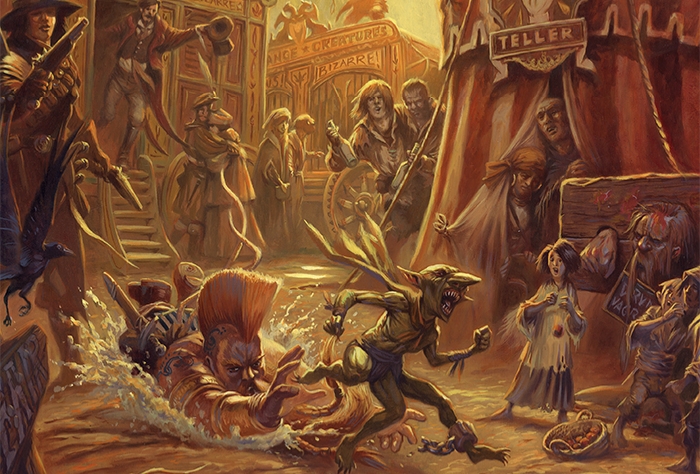
Il gruppo fa per avviarsi quando un gran frastuono li blocca. La folla grida, le voci che si accavallano nel panico, e si sente la voce di un uomo urlare: “Grunni, fermalo!” La folla si allarga terrorizzata, rivelando la causa di tanto scompiglio: un goblin a tre gambe, piccolo e sgraziato, che ringhia e tiene tutti a distanza con una furia sorprendente. L’essere si lancia con un guizzo dentro a una feritoia di una fogna, scomparendo dall’improvviso. Il panico si generalizza, le urla si intensificano. Grunni, vedendo la fuga, bestemmia sonoramente, lanciandosi per provare a prendere il goblin nascostosi nell’accesso alle fogne. Mathusius, nel panico più totale, prova a placare la folla con frasi rassicuranti e del tutto inutili, urlando che è tutto sotto controllo. Il goblin, nascosto, morde la mano al nano che aveva infilato il braccio dentro la feritoia per provare a prenderlo, dileguandosi nell’oscurità delle fogne con un riso stridulo.
Pochi secondi dopo, le alabarde della guardia cittadina piombano sul posto. Un gruppo di cinque miliziani robusti, guidati da un sergente con un’espressione severa, si fa largo tra la folla. Il drappello si fa spiegare da Mathusius cos’è successo, le sue parole balbettanti che si mescolano ai lamenti di Grunni. I miliziani provano a loro volta, con i manici delle alabarde, a vedere se il goblin esce dal pertugio, ma nulla: l’essere è scappato dentro il condotto fognario.
Placata la folla urlante, il sergente, con un’espressione di disgusto, arresta Mathusius e Grunni per disordine pubblico, scortandoli alla tenda del tribunale della festa, un tribunale speciale istituito per gestire le piccole infrazioni durante lo Schaffenfest. I nostri, guidati da Drumin, che ha un’espressione decisa e preoccupata per il suo nuovo amico Grunni, li seguono.
La tenda del tribunale è un luogo caotico e fumoso. Lunghe panche di legno sono occupate da ubriaconi in attesa di processo, i loro volti paonazzi e gli occhi vitrei. Guardie corpulente si aggirano qua e là, alcune bevono birra in attesa di essere chiamate a deporre o a scortare. In fondo alla tenda, dietro a due grandi e alte scrivanie ricoperte di carte e inchiostro, due uomini seduti sembrano le figure centrali di questo pandemonio. Uno è il Magistrato Richter, un uomo corpulento dal volto burbero, che emana sentenze a destra e a manca con una velocità disarmante. L’altro è lo scrivano del consiglio cittadino, un ometto secco e pallido che annota freneticamente ogni parola.
Qualche ora passa, fatta di attesa e poche parole scambiate con Mathusius, che gesticola nervosamente. Alla fine, i due vengono portati davanti a Richter. Leggendo i capi d’accusa per disordine pubblico, Richter, scuotendo la testa e mancando evidentemente di casi simili a cui fare riferimento per commutare la giusta pena per un goblin in fuga, decide che Mathusius dovrà pagare cinquanta corone di multa E dovrà altresì organizzarsi per recuperare il goblin prima che questo crei ulteriori disordini o, peggio, si avventuri nelle parti nobiliari della città. Mathusius tenta una debole difesa, le sue parole che cadono nel vuoto, ignorate dalle sorde orecchie di Richter.
Mathusius, disperato, si gioca l’ultima carta. Il suo sguardo si posa sul gruppo, in particolare su Drumin, avendocapito che corre buon sangue fra lui e Grunni. “Cinquanta corone,” proclama, la sua voce un po’ più forte, “a chiunque mi aiuti a recuperare il… l’animale!” ammicca verso Drumin. Richter alterna gli sguardi tra il gruppo di Drumin e i due imputati, una luce di comprensione nei suoi occhi. Ha capito che forse c’è un modo per chiudere la faccenda velocemente ed evitare noiose rogne con il consiglio cittadino, che sicuramente non gradirebbe un goblin in giro per Bogenhafen.
Guidati da Drumin, che percepisce la disperazione di Grunni e l’allettante promessa di cinquanta corone “facili” (o almeno così sembra), i nostri si fanno avanti. Il magistrato, con un colpo di martelletto, decide di offrire, a nome della città, ulteriori cinquanta corone agli avventurieri per il servizio, seguite da vitto e alloggio gratuiti alla locanda “Alla Fine del Viaggio”, a spese della città. I nostri, chi felice per la prospettiva di un po’ di denaro e un letto caldo, chi più preoccupato per l’ignoto compito, accettano. Mathusius e Grunni verranno trattenuti agli arresti fino a che il goblin (o quel che ne rimane) non verrà riportato al Magistrato Richter.
Registrati i nomi sul grande libro dell’assistente di Richter, i nostri si fanno scortare alla locanda. L’insegna, un vecchio stivale appeso, ondeggia leggermente. Lì cenano, un pasto semplice ma abbondante, e si preparano a scendere nelle fogne. Il piano è quello di calarsi in un tombino vicino e provare a rintracciare il goblin partendo da lì, dato che entrare dal pertugio da dove è scappato l’essere è impossibile per le loro dimensioni.
Preparati armi e bagagli, al tramonto il gruppo si fa scortare da una guardia annoiata al tombino nei pressi delle mura cittadine. Qui, con un sforzo congiunto, alzano la pesante botola in metallo e vengono immediatamente investiti da una nuvola di odore di liquami indescrivibile, un’ondata nauseabonda che sembra volerli soffocare. La guardia e Waldemar vomitano, entrambi si allontanano dal nero buco, l’uno per il disgusto, l’altro per il terrore di ciò che li attende. Ripresosi, Waldemar, con un’espressione determinata ma pallida, prepara dei tamponi nasali intrisi di un’erba aromatica mentolata, il cui forte odore brucia le narici ma allevia la nausea. Certi che queste cento corone non saranno così facili da guadagnare, il nostro gruppo si cala nelle fogne, non prima di minacciare la guardia: chiunque osi chiudere il tombino subirà violente ritorsioni da parte di Waldemar, che non ha intenzione di rimanere intrappolato in quell’inferno puzzolente…
“Ci calammo in quel fetido anfratto sicuri che il compito assegnatoci dal Richter ci avrebbe permesso un facile guadagno ,permettendoci di tornare in sella con poca fatica..mai pensiero partorito dalle nostre elucubrazioni fu peggiore “– Tratto da ” Il nemico dentro ” , anonimo, Stamperie Krofulzh – Rauchen , Nuln, 2514.
ENG
Holding Paolino, still dazed from Bruger’s punch and with a noticeable lump on his chin, the group moved away from the ring, continuing to visit the Schaffenfest. The fair’s laughter and clamor resumed surrounding them, but the general mood was a bit gloomier. Paolino mumbled something about the “injustices of the ring” and “how he would have pounded him in the second round,” but his voice was still weak.
A short distance away, their gaze was drawn to a man leaning lazily against a wooden post, near a tattered tapestry that read “Doktor Mathusius Zoocopeia.” The tent behind him seemed modest, but the promise of who-knows-what exotic wonders was palpable. Doktor Mathusius, with a sly smile and eyes that seemed to hide more than they revealed, observed the crowd, seemingly indifferent.
A little further on, as a light drizzle began to fall, turning the dust into light mud, a much more imposing circus tent stood out, surrounded by a series of cages covered with tarps. A long queue wound in front of a sort of ticket booth, and in the air, a mix of excitement and curiosity could be felt. But what truly captured Drumin’s attention was an unexpected detail: among the cages, another dwarf was working, busy, moving tarps and arranging something inside one of the cages. His dwarven heart gave an unexpected leap at the sight of one of his own in such a singular context. Drumin watched him, his usual distrust mixed with a hint of curiosity. What in the blazes was a dwarf doing in a circus? And why wasn’t he in a mine or at a forge? The sight was as unusual as it was intriguing.
Undecided on what to do, they looked around. They saw a fortune teller’s tent, a dark drape richly decorated with stars and crescents, from which colorful lanterns and the swaying shadow of figures could be seen. The air around was already thick with spicy perfumes and perhaps something more exotic, something that spoke of distant travels and unexpressed destinies. And then, a little further on, a tent where the smell of beer was unmistakable, accompanied by laughter and raucous songs.
The group decided to split up. Paolino, still dazed from the punch, hobbled towards the beer tent, hoping a few tankards might make him forget the humiliation. Waldemar, Fredrich, and Wolfgang headed for the fortune teller’s tent, curiosity overcoming their skepticism (or, in Wolfgang’s case, his avarice). Drumin, with an almost imperceptible chuckle, headed towards the dwarf at the freakshow, a rare opportunity to speak Khazalid with one of his own kind.
The trio approached the seer’s tent. The air inside was thick with aromas, an intoxicating mix of incense, burnt herbs, and something indefinable, almost electric. The interior was dark, illuminated only by the flickering of many wax candles, whose flames cast dancing shadows on the walls decorated with mysterious symbols. Fredrich was the first to enter, his steady gait contrasting with the ethereal atmosphere. The woman, a figure wrapped in colorful shawls, with piercing eyes, took his hand. “I see a narrow passage with water,” she murmured, her raspy voice seeming to come from afar. “Death awaits you there… I see a dark man who is not what he seems… I see seven men and two: one of the two will destroy the others and many more… Beware of the great and rich man, he will bring great dangers!” Her words vanished like smoke, leaving Fredrich with a sense of unease.
Then it was Waldemar’s turn. The seer grasped his hand with surprising force. “I see the sign of the red rose overflowing with blood…” she whispered, her eyes seeming to look beyond him. “I see a valley far from here, with many trees… but they are not what they seem… I see great joy for you in that place, followed by great sorrow.” Waldemar felt a shiver run down his spine. Wolfgang, for his part, wouldn’t be swindled out of his gold crown, preferring to wait outside, his pragmatism winning over his curiosity.
Meanwhile, Drumin approached the freakshow dwarf. “Greetings, axe-brother,” he grumbled, a rare smile creasing his beard. The dwarf turned, his small eyes lighting up. “Hey there! Grunni Stonehammer, of the Gorim Stonehammer clan, from the Grey Mountains!” he replied enthusiastically. After a warm exchange of pleasantries in Khazalid, the ancient Dwarven words that sounded like music to Drumin’s ears, Grunni recounted his sad story. “My uncle Gorim’s clan left the mountains,” he began, his voice growing darker, “in search of fortune. We came to Grissenwald, and there we bought an old mine, certain it held gold the humans hadn’t sniffed out. But the digging… well, nothing. Just rock and shattered hopes.” Debts strangled them. Gorim, in an act of desperation, accepted an offer to buy the mine from a “witch,” as Grunni disdainfully called her. Then, disaster struck. “The wine,” Grunni hissed, “a cursed wine that creates a terrible addiction and turns our kin into drunkards. They spent all their money, and the clan fell into ruin.” To save the Stonehammer dynasty, Grunni made a desperate decision: to convince his cousin, Gottri, son of clan chief Gorim, to follow him to escape their dire fate. “I want to earn enough money to give to Gottri,” he explained, “waiting for my uncle to die or leave, to restore the Stonehammers’ fortunes.” But there were two problems: Gottri had also become a drunkard and Grunni had to act as his caretaker. And, after leaving Grissenwald, their money quickly ran out. “Only thanks to Herr Doktor Mathusius,” Grunni admitted, “who hired me as a ‘freak’ handler, have we managed to find temporary stability.” Grunni assured Drumin that the Doktor was “a good soul, genuinely convinced of what he does with his freaks,” and had proven to be “a reliable human, even by Dwarven standards.” Bidding Drumin farewell, the two parted, swearing eternal assistance to each other, a bond born of shared destiny and the harsh reality of life outside the mountains.
Gathered near the beer tent, where Paolino was recovering with a few tankards, the group decided it was time to find a place to spend the night that would accept the few crowns left in their pockets. The Schaffenfest was a constant lure of entertainment and expenses, and they needed rest and, above all, a roof over their heads.
The group was about to set off when a great commotion stopped them. The crowd screamed, voices overlapping in panic, and a man’s voice roared: “Grunni, stop it!” The terrified crowd parted, revealing the cause of the uproar: a three-legged goblin, small and ungainly, snarling and keeping everyone at bay with surprising ferocity. The creature darted with a flick into a sewer grating, disappearing suddenly. Panic spread, the screams intensifying. Grunni, seeing the escape, cursed loudly, lunging to try and catch the goblin hidden in the sewer entrance. Mathusius, in total panic, tried to calm the crowd with reassuring and utterly useless phrases, shouting that everything was under control. The hidden goblin bit the dwarf’s hand, who had thrust his arm into the grating to try and grab it, vanishing into the darkness of the sewer with a shrill laugh.
A few seconds later, the city guard’s halberds crashed onto the scene. A group of five sturdy militiamen, led by a sergeant with a stern expression, pushed through the crowd. The patrol had Mathusius explain what happened, his stammering words mixing with Grunni’s groans. The militiamen, in turn, tried with the shafts of their halberds to see if the goblin would emerge from the opening, but to no avail: the creature had escaped into the sewer pipe.
After calming the screaming crowd, the sergeant, with an expression of disgust, arrested Mathusius and Grunni for public disorder, escorting them to the fair’s tribunal tent, a special court set up to handle minor infractions during the Schaffenfest. Our group, led by Drumin, who had a determined and worried expression for his new friend Grunni, followed them.
The tribunal tent was a chaotic and smoky place. Long wooden benches were occupied by drunkards awaiting trial, their faces flushed and eyes glassy. Burly guards moved about, some drinking beer while waiting to be called to testify or escort prisoners. At the back of the tent, behind two large, tall desks covered with papers and ink, two seated men seemed to be the central figures of this pandemonium. One was Magistrate Richter, a portly man with a gruff face, dispensing sentences right and left with disarming speed. The other was the city council’s scribe, a thin, pale man frantically scribbling every word.
A few hours passed, consisting of waiting and a few exchanged words with Mathusius, who gestured nervously. Finally, the two were brought before Richter. Reading the charges for public disorder, Richter, shaking his head and clearly lacking similar cases to refer to for commuting the correct penalty for a runaway goblin, decided that Mathusius would have to pay a fifty-crown fine AND would also have to arrange to retrieve the goblin before it caused further disturbances or, worse, ventured into the city’s noble quarters. Mathusius attempted a weak defense, his words falling on deaf ears, ignored by Richter.
Mathusius, desperate, played his last card. His gaze fell on the group, particularly on Drumin, having understood that there was good blood between him and Grunni. “Fifty crowns,” he proclaimed, his voice a little louder, “to anyone who helps me retrieve the… the animal!” he winked at Drumin. Richter alternated glances between Drumin’s group and the two defendants, a light of understanding in his eyes. He realized that perhaps there was a way to quickly settle the matter and avoid annoying trouble with the city council, which certainly wouldn’t appreciate a goblin running loose in Bogenhafen.
Led by Drumin, who perceived Grunni’s desperation and the tempting promise of fifty “easy” crowns (or so it seemed), our group stepped forward. The magistrate, with a bang of his gavel, decided to offer, on behalf of the city, an additional fifty crowns to the adventurers for their service, followed by free food and lodging at the inn “At the Journey’s End,” at the city’s expense. Our group, some happy at the prospect of some money and a warm bed, others more worried about the unknown task, accepted. Mathusius and Grunni would be held under arrest until the goblin (or what remained of it) was brought back to Magistrate Richter.
After their names were registered in Richter’s assistant’s large book, our group was escorted to the inn. The sign, an old hanging boot, swayed slightly. There, they ate dinner, a simple but hearty meal, and prepared to descend into the sewers. The plan was to climb down a nearby manhole and try to track the goblin from there, as entering through the opening where the creature escaped was impossible due to their size.
Weapons and gear prepared, at dusk the group was escorted by a bored guard to a manhole near the city walls. Here, with a combined effort, they lifted the heavy metal hatch and were immediately hit by an indescribable cloud of sewage odor, a nauseating wave that seemed to want to suffocate them. The guard and Waldemar vomited, both retreating from the black hole, one from disgust, the other from terror of what awaited them. Recovering, Waldemar, with a determined but pale expression, prepared nasal plugs soaked in a mentholated aromatic herb, whose strong smell burned their nostrils but relieved the nausea. Certain that these hundred crowns would not be so easy to earn, our group descended into the sewers, not before threatening the guard: anyone who dared to close the manhole would suffer violent retaliation from Waldemar, who had no intention of being trapped in that stinking inferno.
Here’s the English translation of the passage:
“We descended into that fetid crevice, confident that the task assigned to us by Richter would bring us easy money, allowing us to get back on our feet with little effort…never was a thought born from our musings worse.”
— From “The Enemy Within“, anonymous, Krofulzh Printing House – Rauchen, Nuln, 2514.


Leave a Reply