ITA
La sgangherata ciurma della Berebelli riparte dunque alla volta di Bogenhafen, a soli tre giorni di viaggio lungo il placido fiume Bogen.
Il primo giorno di navigazione scorre via tranquillo, con la quieta routine fluviale a scandire il tempo. La Berebelli scivola sull’acqua calma, incrociando di tanto in tanto qualche barca di mercanti carichi di merci o abili pescatori intenti a calare le reti. L’aria è mite, e il paesaggio verdeggiante delle rive sembra quasi invitare alla pace, un contrasto stridente con la furia della notte precedente. Drumin si esercita con le carte nautiche, la sua mente analitica che cerca schemi anche nelle correnti più piccole, mentre Paolino, con una piuma in mano, tenta di tracciare lettere goffe sotto l’occhio vigile di Waldemar, che pazientemente corregge ogni sbavatura. Fredrich si cimenta con i nodi marini, le sue mani abituate alla balestra che si adattano lentamente alla complessità delle cime. Wolfgang, invece, si dedica più che altro a osservare le rive, il suo spirito irrequieto che si domanda cosa riserverà il porto successivo. Joseph, il capitano, è insolitamente taciturno. La sua risata tonante è scomparsa, sostituita da un cipiglio costante. Gira per il ponte, sistemando questo e quello, ma i suoi occhi sono lontani, persi in un’ansia che gli legge sul volto: i guai che gli “amici” di Waldemar potrebbero portare alla sua nave e, di conseguenza, alla sua stessa esistenza.
Il secondo giorno porta con sé un’imponente visione: le maestose mura del castello di Grauenburg si ergono sulla cima di una collina, dominando il paesaggio fluviale. È la residenza del Barone Wilhelm Saponatheim, un nome che risuona di nobiltà ma che, per quanto ne sa il gruppo, si dedica esclusivamente a cacciare, bere e frequentare donne. Formalmente, Bogenhafen si trova nei suoi territori, ma la città si autogestisce con un proprio consiglio cittadino, ignorando, o venendo ignorato da, il suo pigro signore. La visione del castello ricorda al gruppo la complessità del potere nel Vecchio Mondo, un groviglio di autorità e indolenza. Continuano gli esercizi: Drumin a studiare le rotte alternative, Fredrich a maneggiare la balestra in spazi ristretti, Paolino a cimentarsi con la scrittura di semplici note e Wolfgang a prendere dimestichezza con la navigazione base. Joseph, il suo volto una maschera di preoccupazione, si limita a dare ordini concisi, evitando qualsiasi conversazione superflua, la sua ansia palpabile come la nebbia mattutina.
La mattina del terzo giorno, una fitta nebbia avvolge il Bogen, rendendo l’atmosfera quasi surreale. Poi, lentamente, le forme indistinte di Bogenhafen iniziano a emergere. Prima, si intravedono le sagome scure di giganteschi magazzini e moli affollati, un segno inequivocabile dell’importanza commerciale della città. Man mano che la Berebelli si avvicina, il rumore e il trambusto del porto crescono: il clangore dei martelli dei carpentieri, le grida dei facchini che scaricano merci, il richiamo dei venditori. Le gru svettano verso il cielo, scheletri di legno contro il grigio dell’alba. Oltre i moli, si alzano tetti a punta e ciminiere fumanti, le case che si ammassano l’una sull’altra in un labirinto di vicoli. La Torre della Campana del Tempio di Sigmar spicca su tutte, un faro nella confusione urbana, seguita dalle mura robuste che circondano la città più antica. L’odore del fiume si mescola a quello del pesce, del legno umido e di qualcosa di meno gradevole, un sentore di vita e di sporcizia tipico di ogni grande centro abitato. Bogenhafen si rivela una città vibrante e caotica, un crogiolo di attività e misteri, che accoglie la Berebelli e la sua sgangherata ciurma tra le sue braccia affollate. Joseph, nonostante il sollievo di essere arrivato, non accenna a sciogliere la sua tensione, i suoi occhi che scrutano ogni angolo del porto come se cercasse un presagio.
Il clangore delle catene e il gemito del legno annunciano l’ormeggio della Berebelli al porto di Bogenhafen. Joseph, con un sospiro di sollievo che non basta a dissipare il suo cipiglio, saluta la sua sgangherata compagnia. “Bene, siamo arrivati. Io mi fermo qui per qualche giorno,” borbotta, indicando con un cenno del capo le banchine affollate. “C’è questo carico di vino da scaricare, e spero si presenti qualche lavoretto prima di tornare ad Altdorf.” Gli avventurieri lo ringraziano con un cenno del capo, comprendendo la sua preoccupazione per la nave e per i guai che, forse, stavano involontariamente portando con sé.
Lasciato Joseph alla sua ansia e al suo vino, il gruppo si muove attraverso la confusione del porto, seguendo le indicazioni per lo studio legale Lock, Stock and Barrel. Vogliono mettere fine a questa storia dell’eredità di Kastor. Attraversano la piazza centrale, un vasto spazio aperto dove il Municipio si erge imponente alle spalle della Chiesa di Sigmar. L’edificio è un’architettura robusta, simbolo del potere cittadino, con le sue guglie affusolate che cercano di toccare il cielo grigio di Bogenhafen. La Chiesa di Sigmar, dal canto suo, è un colosso di pietra e fede, circondata da una costellazione di cappelle e chiesette dedicate agli altri dei, come la snella e graziosa cappella di Myrmidia e il robusto tempio di Ulric, con le sue mura grezze e il tetto spiovente. Tra queste, spiccano due templi di dei più locali: il modesto ma amato santuario di Bogenauer, il patrono della città, e il più opulento tempio di Handrich, il dio dei mercanti, un edificio che risplende di vetrate colorate, un chiaro segno della prosperità commerciale di Bogenhafen.
Perdendosi tra le viuzze tortuose della Bogenhafen vecchia, un labirinto di case a graticcio e botteghe strette, il gruppo trova finalmente lo studio legale. Entrando, vengono accolti da un’aria stantia e dal fruscio di innumerevoli pergamene. Due vecchi decrepiti, coperti di polvere almeno quanto le pile di documenti che li circondano, sollevano lo sguardo dalle loro carte, interrogandoli con occhi acquosi sui loro affari. Drumin si fa avanti, spiegando la questione dell’eredità di Kastor Lieberung.
Ma fin dalle prime parole, è evidente che qualcosa non quadra. I due anziani si guardano con espressioni confuse, scuotendo la testa. “L’eredità di chi, scusate?” mugugna uno, mentre l’altro si strofina gli occhi annebbiati. È palese che siano decisamente anziani e, ancor di più, confusi. Inizia un’infinita e frustrante ricerca tra i documenti decrepiti, una montagna di carte polverose e legali incomprensibili, che risulta immediatamente inutile. A tutti i membri del gruppo, ormai, appare chiaro: la questione dell’eredità è un’enorme trappola, orchestrata dal cacciatore di taglie per attirarli qui, o forse per spingerli verso Bogenhafen.
Decisi comunque ad andare a fondo della questione, il gruppo esce dallo studio legale, lasciando i due vecchi a litigare fra di loro su quale mucchio di pergamene contenesse il loro pranzo. Il loro prossimo obiettivo è la stamperia che ha preparato l’atto di eredità. Dopo qualche indicazione e un po’ di cammino, la trovano. Il commesso, un giovane spigliato e sorprendentemente disponibile, li accoglie. Spiega che un uomo che si spacciava per avvocato – “ma che palesemente non lo era,” aggiunge con un sorriso sornione – gli aveva fatto produrre il documento dell’eredità. La descrizione dell’uomo combacia perfettamente con quella di Adolphus.
Amareggiati e con la consapevolezza di essere stati ingannati, il gruppo si ritrova senza un becco di quattrino, la promessa di un’eredità svanita come fumo. A questo punto, l’unica speranza è trovare un impiego, qualsiasi cosa, per sbarcare il lunario. Decidono di dirigersi verso la Schaffenfest. Superata la porta della città a sud, una massiccia costruzione in pietra incrostata di muschio, il gruppo si immerge nella fiera.
La Schaffenfest è un’esplosione di colori, suoni e odori. Migliaia di persone affollano il vasto campo, una marea umana che si muove tra tende variopinte e bancarelle improvvisate. L’aria è satura del profumo di carne arrostita e birra spillata, mescolato a sentori di spezie esotiche e pelliccia bagnata. Giocolieri e menestrelli si esibiscono su palchi improvvisati, le loro voci che si mescolano al richiamo stridulo dei venditori e al grugnito dei maiali nelle gabbie. Bambini corrono tra le gambe della folla, mentre artigiani mostrano le loro merci: cuoio lavorato, armature lucide, gioielli scintillanti. C’è l’odore dolciastro dei dolciumi e quello acre del concime, il tutto avvolto nel clamore assordante di una celebrazione. È un microcosmo vivace del Vecchio Mondo, dove ogni professione ha il suo spazio e ogni borsa può essere alleggerita. E in mezzo a tutto questo caos, il gruppo cerca un’opportunità, una scintilla di speranza in un mondo che sembra deciso a metterli alla prova.
Drumin, con la sua solita astuzia, riesce a piazzare la polvere da sparo che aveva prodotto con quel poco che aveva trovato a Weissbruck, guadagnando una decina di corone, un piccolo barlume di speranza. Mentre il nano contratta, Waldemar viene agganciato da un’affascinante erborista, i suoi occhi verdi che brillano di curiosità. La donna si presenta come Emma Strauss, originaria di Weissbruck, dove con la sorella raccoglie piante e le vende. Parlando del più e del meno, Emma rivela che i suoi compratori più grossi sono un gruppo di druidi di Kemperbad, che acquistano ingenti quantità di valeriana. “Non mi sono sembrati tipi particolarmente raccomandabili..ma probabilmente mi sbaglio io! I religiosi sono persone sempre molto strane..” confessa Emma, stringendosi nelle spalle, “ma ai soldi non si dice di no, sai com’è.” Incuriosito, dopo un pallido tentativo di avances andato miseramente in fumo, Waldemar raccoglie più informazioni su questi adepti dell’Antica Fede. È intenzionato ad abbracciarne il culto e vorrebbe trovare qualcuno a cui chiedere come diventare un Druido. Emma, con un sorriso complice, risponde che sua sorella, Hilma, è colei che rifornisce regolarmente questo gruppo che fa la spola tra Weissbruck e Kemperbad, a est di Altdorf. Disegna anche a Waldemar il simbolo del culto, cucito sulle tuniche dei due druidi che si occupano del commercio, un nodo intricato e stilizzato. Waldemar si segna ogni dettaglio, la mente già proiettata verso una nuova vocazione.
La confusione della Schaffenfest è un muro di suoni e odori, ma per il gruppo, ormai senza un soldo e con la morale a terra, ogni bancarella sembra urlare la propria indifferenza. Poi, una scintilla. O meglio, un anello di corde che delimita un ring improvvisato.
Al centro dell’attenzione, un uomo sulla quarantina, una montagna di muscoli, siede all’angolo, il respiro affannoso, il volto rigato di sudore. È Bruger, “il Frantumatore”, e l’imbonitore, un omone dalla voce cavernosa, sta sfidando il pubblico. “Dieci corone a chi resiste tre minuti contro Bruger!” tuona, battendo un pugno sulla ringhiera. Il suo sguardo scende sulla folla, in cerca di un incosciente.
Ed è in quel momento che Paolino, con un’espressione sorniona dipinta sul volto, si fa avanti, lasciando tutti a bocca aperta. Drumin sbuffa, Fredrich scuote la testa, e persino Wolfgang trattiene un risolino incredulo. L’imbonitore, perplesso, appoggia una mano sul megafono, un’ombra di divertimento misto a preoccupazione nei suoi occhi. “Mezzuomo, sei sicuro?” domanda, la sua voce ora meno tonante. “Guarda che questo ti ammazza… Bruger non va per il sottile con i piccoletti.”
Ma Paolino non cede, il suo sorriso sfrontato che non vacilla. Sale sul ring con un’agilità inaspettata. L’incontro ha inizio. Il primo minuto è un’esibizione quasi comica. Paolino si mantiene alla distanza di sicurezza da Bruger, muovendosi con un passo leggero e incessante. Bruger sembra stare al gioco, le sue possenti braccia che oscillano pigramente, mentre l’halfling non smette di parlare, una serie ininterrotta di battute orride, insulti velati e commenti sull’alito del gigante. Il pubblico, inizialmente divertito dalla stranezza della situazione, passa rapidamente dall’acclamazione alla richiesta di botte e sangue, evidentemente annoiato da quella che sembra una parodia di un vero combattimento.
Bruger, cogliendo la sensazione del pubblico, decide che è ora di chiudere i giochi. Un lampo di determinazione nei suoi occhi stanchi. Con uno scatto improvviso, sferra un pugno diretto al Tileano, un colpo che trasporta il peso di tutta la sua mole. Paolino tenta una pallida difesa, un braccio alzato che è un rametto contro una tempesta. Inutile. Il colpo lo colpisce in pieno, quasi decapitandolo. L’halfling stramazza a terra in un silenzio generale, il suo corpo che sembra un sacco di stracci. Tutti pensano sia morto. Lo stesso Bruger si avvicina, il suo volto una maschera di preoccupazione, quasi rimorso.
Sul ring salgono anche i compagni di viaggio di Paolino, gli sguardi tesi. Drumin si china, Fredrich mette una mano sul suo petto, e Wolfgang, dopo un attimo di esitazione, lo scuote. E in quel momento, il mezzuomo emette un gemito. Non è morto. È semplicemente svenuto.
Rinvendendolo con uno schiaffo rinvigorente di Wolfgang e qualche rimedio di Drumin, Paolino riapre gli occhi, confuso. Oltre alle botte, si prende anche una serie di insulti per la sua scarsa prestazione e per aver spaventato tutti. “Ma come ti salta in mente di fare una cosa del genere?” gli ringhia Wolfgang. Paolino si limita a scrollare le spalle, un altro sorriso che tenta di farsi strada sul volto pesto. “Beh, almeno ci ho provato, no?”
Reggendo Paolino, ancora rintronato dal pugno di Bruger e con una protuberanza vistosa sul mento, il gruppo si allontana dal ring, continuando a visitare la Schaffenfest. Le risate e gli schiamazzi della fiera riprendono a circondarli, ma l’umore generale è un po’ più cupo. Paolino borbotta qualcosa sulle “ingiustizie del ring” e su “come l’avrebbe fatto nero al secondo round”, ma la sua voce è ancora debole.
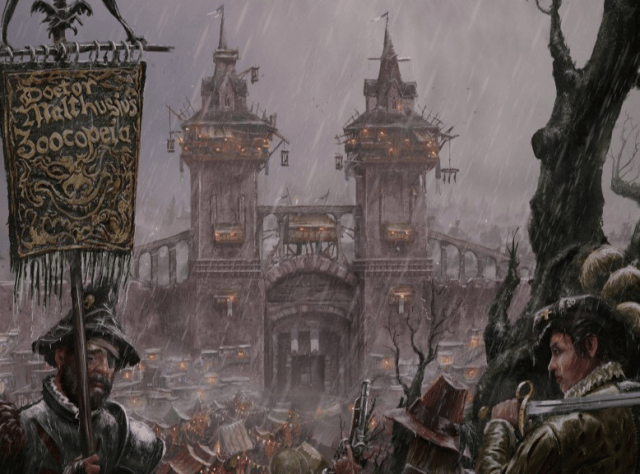
A poca distanza, il loro sguardo è attratto da un uomo appoggiato pigramente a un palo di legno, vicino a una sorta di arazzo logoro che recita “Doktor Mathusius Zoocopeia”. Il tendone alle sue spalle sembra modesto, ma la promessa di chissà quali meraviglie esotiche è palpabile. Il Doktor Mathusius, con un sorriso sornione e gli occhi che sembrano celare più di quanto rivelino, osserva la folla, apparentemente indifferente.
Poco più in là, mentre una leggera pioggerellina inizia a cadere, trasformando la polvere in fango leggero, spicca un tendone da circo ben più imponente, circondato da una serie di gabbie coperte con teli. Una lunga fila si snoda davanti a una sorta di biglietteria, e nell’aria si percepisce un misto di eccitazione e curiosità. Ma ciò che cattura l’attenzione di Drumin è un dettaglio inaspettato: tra le gabbie, un altro nano sta lavorando, affaccendato, spostando teli e sistemando qualcosa all’interno di una delle gabbie. Il suo cuore di nano ha un sobbalzo inaspettato alla vista di un suo simile in un contesto così singolare. Drumin lo osserva, la sua solita sfiducia che si mescola a una punta di curiosità. Che diavolo ci fa un nano in un circo? E perché non sta in una miniera o a forgiare? La visione è tanto insolita quanto intrigante…
“Beffati dai due avvocati decrepiti, ci ritrovammo per un buffo gioco del destino a vagare nella ricca Bogenhafen piu poveri che mai. “– Tratto da ” Il nemico dentro ” , anonimo, Stamperie Krofulzh – Rauchen , Nuln, 2514.
ENG
The battered crew of the Berebelli set off for Bogenhafen, a mere three-day journey along the tranquil Bogen River.
The first day of sailing passes peacefully, with the quiet river routine marking the time. The Berebelli glides on the calm water, occasionally passing merchant boats laden with goods or skilled fishermen busy casting their nets. The air is mild, and the green landscape of the banks seems to invite peace, a striking contrast to the fury of the previous night. Drumin practices with nautical charts, his analytical mind searching for patterns even in the smallest currents, while Paolino, with a quill in hand, tries to awkwardly trace letters under the watchful eye of Waldemar, who patiently corrects every smudge. Fredrich grapples with knots, his hands accustomed to the crossbow slowly adapting to the complexity of the ropes. Wolfgang, on the other hand, mostly observes the banks, his restless spirit wondering what the next port will hold. Joseph, the captain, is unusually taciturn. His booming laugh has vanished, replaced by a constant frown. He moves around the deck, adjusting this and that, but his eyes are distant, lost in an anxiety that is clear on his face: the troubles that Waldemar’s “friends” might bring to his ship and, consequently, to his very existence.
The second day brings with it an imposing sight: the majestic walls of Grauenburg Castle stand on a hilltop, dominating the river landscape. It is the residence of Baron Wilhelm Saponatheim, a name that resonates with nobility but who, as far as the group knows, dedicates himself exclusively to hunting, drinking, and pursuing women. Formally, Bogenhafen lies within his territories, but the city is self-governed by its own town council, ignoring, or being ignored by, its lazy lord. The sight of the castle reminds the group of the complexity of power in the Old World, a tangle of authority and indolence. Their exercises continue: Drumin studying alternative routes, Fredrich handling the crossbow in confined spaces, Paolino trying his hand at writing simple notes, and Wolfgang getting acquainted with basic navigation. Joseph, his face a mask of worry, limits himself to concise orders, avoiding any superfluous conversation, his anxiety as palpable as the morning fog.
On the morning of the third day, a thick fog envelops the Bogen, making the atmosphere almost surreal. Then, slowly, the indistinct shapes of Bogenhafen begin to emerge. First, the dark silhouettes of gigantic warehouses and crowded docks become visible, an unequivocal sign of the city’s commercial importance. As the Berebelli approaches, the noise and hustle of the port grow: the clanging of carpenters’ hammers, the shouts of porters unloading goods, the calls of vendors. Cranes tower towards the sky, wooden skeletons against the grey dawn. Beyond the docks, pointed roofs and smoking chimneys rise, houses crammed one on top of the other in a maze of alleys. The Bell Tower of Sigmar’s Temple stands out above all, a lighthouse in the urban confusion, followed by the robust walls that surround the oldest part of the city. The smell of the river mixes with that of fish, damp wood, and something less pleasant, a scent of life and dirt typical of any large inhabited center. Bogenhafen reveals itself as a vibrant and chaotic city, a melting pot of activity and mysteries, welcoming the Berebelli and its motley crew into its crowded arms. Joseph, despite the relief of having arrived, shows no sign of easing his tension, his eyes scanning every corner of the port as if searching for an omen.
The clang of chains and the groaning of wood announce the Berebelli‘s mooring at the port of Bogenhafen. Joseph, with a sigh of relief that isn’t enough to dispel his frown, bids farewell to his motley crew. “Well, we’ve arrived. I’ll be staying here for a few days,” he grumbles, gesturing towards the crowded docks. “There’s this wine cargo to unload, and I hope some work turns up before heading back to Altdorf.” The adventurers nod their thanks, understanding his concern for the ship and for the troubles they, perhaps unintentionally, were bringing with them.
Leaving Joseph to his anxiety and his wine, the group moves through the port’s confusion, following directions to the legal firm of Lock, Stock and Barrel. They want to put an end to this Kastor inheritance business. They cross the central square, a vast open space where the Town Hall stands imposing behind Sigmar’s Church. The building is a robust piece of architecture, a symbol of civic power, with its tapering spires trying to touch Bogenhafen’s grey sky. Sigmar’s Church, for its part, is a stone and faith colossus, surrounded by a constellation of chapels and smaller churches dedicated to other gods, such as the slender and graceful Myrmidia chapel and the robust Ulric temple, with its rough walls and steeply pitched roof. Among these, two temples of more local gods stand out: the modest but beloved shrine of Bogenauer, the city’s patron, and the more opulent temple of Handrich, the god of merchants, a building that gleams with stained-glass windows, a clear sign of Bogenhafen’s commercial prosperity.
Getting lost among the winding alleys of old Bogenhafen, a labyrinth of half-timbered houses and narrow shops, the group finally finds the legal firm. Upon entering, they are met by stale air and the rustle of countless parchments. Two decrepit old men, as covered in dust as the piles of documents surrounding them, lift their gaze from their papers, questioning them with watery eyes about their business. Drumin steps forward, explaining the matter of Kastor Lieberung’s inheritance.
But from the very first words, it’s clear something isn’t right. The two old men look at each other with confused expressions, shaking their heads. “Whose inheritance, excuse me?” one mumbles, while the other rubs his bleary eyes. It’s obvious they are decidedly old and, even more so, confused. An endless and frustrating search through the decrepit documents begins, a mountain of dusty, incomprehensible legal papers, which immediately proves useless. To all members of the group, by now, it is clear: the inheritance matter is a huge trap, orchestrated by the bounty hunter to lure them here, or perhaps to push them towards Bogenhafen.
Determined to get to the bottom of the matter anyway, the group leaves the law firm, leaving the two old men arguing among themselves about which pile of parchments contained their lunch. Their next objective is the printing house that prepared the deed of inheritance. After some directions and a short walk, they find it. The clerk, a quick-witted and surprisingly helpful young man, greets them. He explains that a man posing as a lawyer – “but who clearly wasn’t,” he adds with a sly smile – had him produce the inheritance document. The man’s description perfectly matches that of Adolphus.
Bitter and aware of having been deceived, the group finds themselves penniless, the promise of an inheritance vanished like smoke. At this point, their only hope is to find employment, anything, to make ends meet. They decide to head towards the Schaffenfest. Passing through the city’s south gate, a massive stone structure encrusted with moss, the group plunges into the fair.
The group moves through the stalls of the Schaffenfest, a human tide where every shout and every smell blend into a single, deafening symphony. Drumin, with his usual cunning, manages to sell the gunpowder he had produced with the little he found in Weissbruck, earning about ten crowns, a small glimmer of hope. While the dwarf haggles, Waldemar is approached by a fascinating herbalist, her green eyes sparkling with curiosity. The woman introduces herself as Emma Strauss, originally from Weissbruck, where she and her sister gather and sell plants. Talking about this and that, Emma reveals that her biggest buyers are a group of druids from Kemperbad, who purchase large quantities of valerian. “They didn’t seem particularly trustworthy types,” Emma confesses, shrugging, “but maybe I’m wrong! Religious people are always very strange…” she adds, shrugging, “but you don’t say no to money, you know how it is.” Intrigued, after a feeble attempt at advances that fizzled out miserably, Waldemar gathers more information about these adherents of the Old Faith. He intends to embrace their cult and wants to find someone to ask how to become a Druid. Emma, with a knowing smile, replies that her sister, Hilma, is the one who regularly supplies this group that travels between Weissbruck and Kemperbad, east of Altdorf. She also draws Waldemar the cult’s symbol, sewn onto the tunics of the two druids involved in the trade, an intricate and stylized knot. Waldemar notes down every detail, his mind already set on a new calling.
The Schaffenfest is an explosion of colors, sounds, and smells. Thousands of people fill the vast field, a human tide moving between colorful tents and makeshift stalls. The air is thick with the scent of roasted meat and spilled beer, mingled with exotic spices and wet fur. Jugglers and minstrels perform on makeshift stages, their voices blending with the shrill cries of vendors and the grunting of pigs in cages. Children run between the legs of the crowd, while artisans display their wares: worked leather, gleaming armor, sparkling jewelry. There’s the sweet smell of sweets and the acrid smell of manure, all enveloped in the deafening clamor of a celebration. It’s a lively microcosm of the Old World, where every profession has its place and every purse can be lightened. And amidst all this chaos, the group seeks an opportunity, a spark of hope in a world that seems determined to test them.
The spark appears in the sight of a ring. A man in his forties, a mountain of muscles seemingly exhausted, sits in the corner while the barker challenges the audience to last three minutes against Bruger “the Smasher” to win ten crowns. Paolino, leaving everyone speechless, steps forward to challenge him. The barker himself, perplexed, places a hand on his megaphone. “Halfling, are you sure? This one will kill you…” but Paolino does not yield. The match begins. For the first minute, Paolino keeps his distance from Bruger, who seems to play along with the halfling’s incessant stream of awful jokes. The audience quickly shifts from cheering to demanding blows and blood, clearly bored. Bruger, sensing the crowd’s mood, decides to end the game, delivering a direct punch to the Tilean. A weak, useless defense. Paolino is almost decapitated by the blow, collapsing to the ground in general silence. Everyone thinks he’s dead… Bruger himself approaches, visibly worried. Paolino’s traveling companions also climb into the ring and confirm that the halfling has simply fainted. When revived, in addition to the blows, he also receives insults for his poor performance.
Holding Paolino, still dazed from the punch and with a noticeable bump on his chin, the group continues to visit the Schaffenfest. The laughter and shouts of the fair resume surrounding them, but the general mood is a bit gloomier. Paolino mumbles something about the “injustices of the ring” and “how he would have pounded him in the second round,” but his voice is still weak.
A short distance away, their gaze is drawn to a man leaning lazily against a wooden post, near a tattered tapestry that reads “Doktor Mathusius Zoocopeia.” The tent behind him seems modest, but the promise of who-knows-what exotic wonders is palpable. Doktor Mathusius, with a sly smile and eyes that seem to hide more than they reveal, observes the crowd, seemingly indifferent.
A little further on, as a light drizzle begins to fall, turning the dust into light mud, a much more imposing circus tent stands out, surrounded by a series of cages covered with tarps. A long queue winds in front of a sort of ticket booth, and in the air, a mix of excitement and curiosity can be felt. But what truly captures Drumin’s attention is an unexpected detail: among the cages, another dwarf is working, busy, moving tarps and arranging something inside one of the cages. His dwarven heart gives an unexpected leap at the sight of one of his own in such a singular context. Drumin watches him, his usual distrust mixed with a hint of curiosity. What in the blazes is a dwarf doing in a circus? And why isn’t he in a mine or at a forge? The sight is as unusual as it is intriguing…
“Fooled by the two decrepit lawyers, we found ourselves, by a strange turn of fate, wandering through wealthy Bogenhafen poorer than ever.” – Excerpt from “The Enemy Within,” anonymous, Krofulzh – Rauchen Printworks, Nuln, 2514.


Leave a Reply