ITA
Più di uno si fa ancora il segno del martello di Sigmar quando Marius, la guardia del corpo silenziosa e vigile di Lady Isolde, si stacca dal gruppo. La sua sagoma alta e scura si avvicina al ciglio della strada, stringendo l’elsa della spada con forza. Scruta avanti, oltre il tratto fangoso del sentiero che si snoda nella brughiera umida.
«Là…» bisbiglia con voce roca, indicando con un gesto minimo del mento.
Tra i rovi e il fumo di un incendio ormai spento, si distingue il contorno di una carrozza rovesciata. I cavalli sono morti, ancora attaccati ai finimenti spezzati, le zampe rigide rivolte al cielo. Intorno al relitto si intravedono almeno cinque cadaveri. E poi… movimento. Sagome deformi, oscillanti, si muovono lente, frugando tra i resti. Mutanti.
Occhi scavati, braccia contorte, un odore dolciastro e nauseabondo trasportato dal vento. Alcuni si aggirano barcollando, altri si chinano sui morti come cani randagi.
Waldemar si avvicina a Marius, lo sguardo teso. «Li attiriamo qui. Trappola con una corda tesa. Poi li finiamo.»
Fredrich annuisce, tirando fuori una bobina di canapa dal suo zaino. Drumin, il nano, non dice nulla ma inizia subito a legarla tra due ceppi, mimetizzandola nel fango denso e tra i rami spezzati.
Appostati dietro i cespugli, trattengono il respiro. Fredrich alza la balestra. Mira. Click. Il primo quadrello vola alto, perdersi nel nulla. Il secondo colpisce un albero con un rumore secco. Un attimo di silenzio, poi un ringhio rabbioso.
Un urlo ferino squarcia l’aria: il mutante con la faccia di cane alza il muso al cielo e fiuta. Poi parte, correndo a quattro zampe, trascinando con sé il resto del branco.
Fredrich spara un altro quadrello. Questa volta sfiora il muso del cane-umano, lasciandogli una striscia di sangue nero su una guancia. Quello ulula, poi si getta in avanti con un ruggito.
E inciampa nella corda.
Il corpo crolla in avanti, spalancando il varco della mischia. Marius piomba su di lui con un ruggito suo, colpendolo con una forza brutale del suo martello. Paolino, l’halfing partecipa con il suo coltello e insieme finiscono il cane-uomo con colpi secchi e rabbiosi.
Drumin si ritrova davanti un mutante dalla testa minuscola, con un’unica orbita vacua e una lancia scheggiata. L’abominio emette suoni gorgoglianti e attacca, fendendo l’aria con colpi scoordinati ma feroci. Il nano ara con il coltello miracolosamente, bestemmiando in khazalid, mentre Waldemar ,al suo fianco, prega in fretta e sferra un fendente che lacera il fianco del mostro. Sangue nerastro spruzza come da un otre bucato.
Fredrich combatte con un essere alto e dinoccolato, con gambe caprine e occhi gialli. L’ascia a due mani fende l’aria con violenza, costringendolo a indietreggiare. Ma Fredrich è veloce, calcola ogni mossa. Para, schiva, colpisce. Alla fine,,il morale dei mutanti cede alla vista del corpo del loro compagno a terra e fuggono. In un solo gesto,Fredrich pone fine alla alla vita del mutante che sta affrontando: schlack! La testa rotola nel fango.
Wolfgang, nel frattempo, si impappina in un movimento goffo, e la spada gli si conficca in un tronco, rimbalzando in una pozzanghera. Bestemmia Sigmar ed arretra,impotente nell’aiutare Drumin e Waldemar.
Presto,tutti i mutanti scappano nella foresta, ululando di dolore e rabbia. Nessuno li insegue.
Il silenzio scende. Il fiato del gruppo si condensa nell’aria umida. Nessuno è ferito, ma gli occhi sono colmi di stanchezza.
Si avanza.
La carrozza rovesciata infondo alla strada è una rovina. Il portello laterale è spezzato. Dentro, ci sono quattro adulti. Uomini e donne, borghesi probabilmente, abiti costosi, ora strappati e macchiati. Fra di loro, un iniziato di Sigmar quasi sicuramente. Ma ciò che paralizza tutti è il piccolo corpo nell’angolo, coperto da una mantellina azzurra. Un infante. Le mani minute chiuse a pugno. Nessun segno di violenza evidente. Morto rapidamente… forse.
Drumin si schiarisce la voce, ma resta muto. Waldemar si inginocchia e inizia una breve preghiera a Morr, Signore dei Morti. Il gruppo scava con le mani, con lame e vanghe improvvisate, nel terreno fradicio.
Fredrich si sofferma sul volto del bambino prima di deporlo nella fossa. Una rabbia muta gli serra lo stomaco. Nessuno parla.
Un mucchietto di terra. Una croce di legno spezzato. Un ultimo sguardo.
«Che i Giardini di Morr li accolgano» sussurra Waldemar,mentre Fredeich recita una breve preghiera al dio dei morti e dei sogni.
Poi si riparte, nel silenzio irreale del crepuscolo.La decisione si prende all’unanimità: la tappa successiva è Brockel, un villaggio non lontano, dove sistemare finalmente il gigo rotto che lega i due cavalli extra alla carrozza. Un piccolo inconveniente, ma che non possono più ignorare.
La sera in locanda trascorre senza eventi degni di nota, come un respiro trattenuto che finalmente si libera. Tutti sono troppo stanchi, troppo scossi dagli ultimi avvenimenti per trovare la forza di parlare o di fare rumore. Alcuni di loro, nel silenzio della notte, rivedono l’infante morto nei loro sogni, lo sguardo spento e le mani piccole strette in un eterno pugno di gelo. Per loro, quella notte sarà lunga.
La mattina seguente, con il cielo coperto da un sole pallido e senza pioggia, il gruppo riprende il viaggio a bordo della carrozza della compagnia Cannonball . Il viaggio si fa vagamente più confortevole: i cavalli sono più calmi, le gambe meno affaticate. si doppia Kutenholz senza fermarsi; la Grande Strada Middenheim-Altdorf brulica di vita: mercanti con i loro carretti, guardiavie dagli sguardi torvi e piccole carovane di contadini cariche di sacchi e speranze. Ma la foresta ai lati della strada resta lì, minacciosa e impenetrabile, come un ricordo oscuro che non lascia tregua.
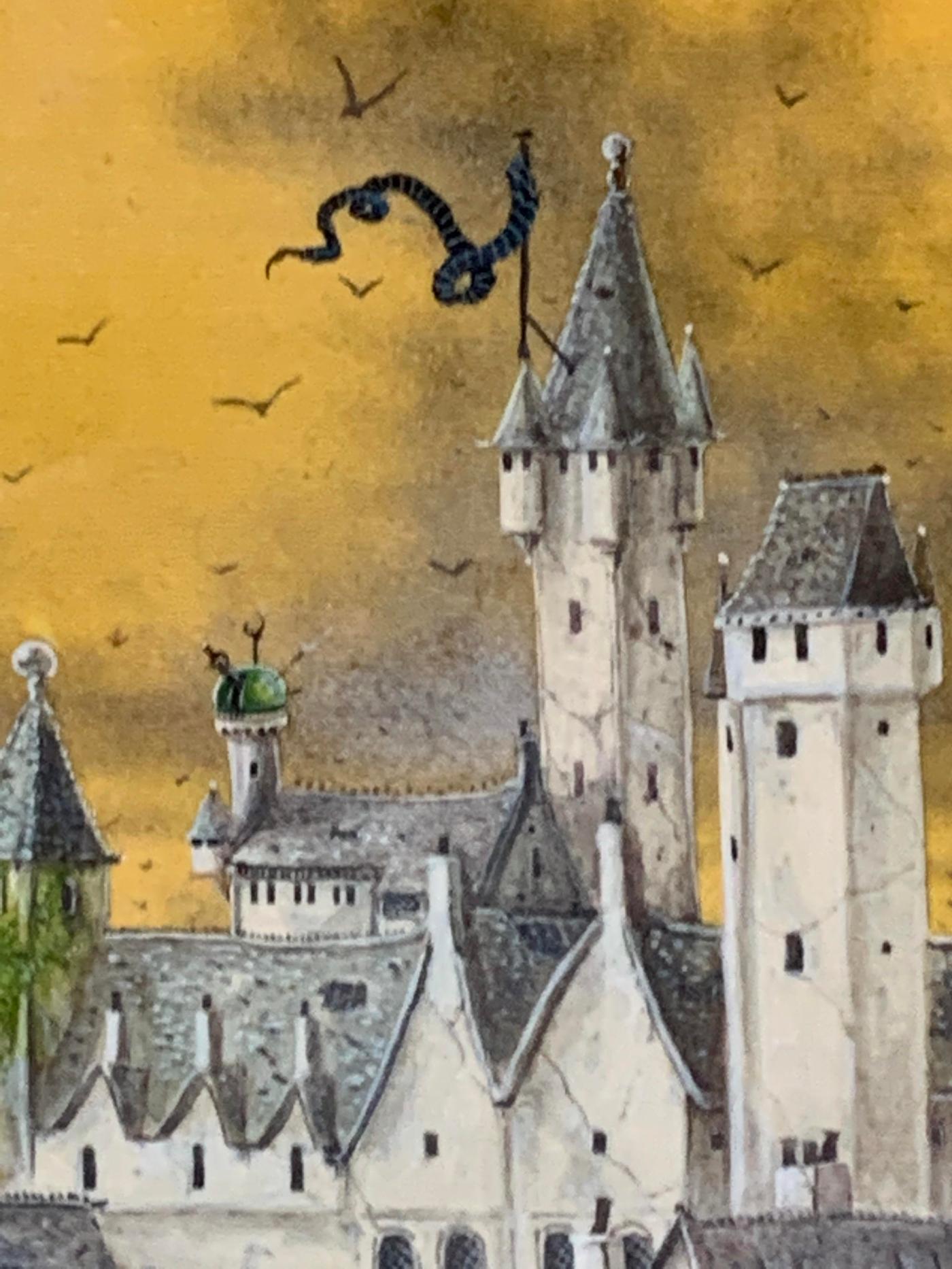
Dopo una curva lenta, quando il sole inizia a calare all’orizzonte, finalmente appare Altdorf. Le sue mura grigie e solide, le torri alte, i tetti rossi ed i muri bianchi, si stagliano contro il cielo crepuscolare, come una promessa di fine viaggio e inizio di nuove prove.
“…La città si estendeva davanti a noi come un mare di tetti spioventi, camini fumanti e torri che si stagliavano verso il cielo come alberi in una foresta di pietra. Ogni edificio sembrava avere una storia antica da raccontare: alcune strutture snelle e affusolate, altre tozze e annerite dal tempo, tutte testimoni di vite passate.
Le nubi basse scivolavano sulle guglie più alte, quasi a volerle sfiorare con dolcezza, mentre il fiume Reik scorreva lento e torbido ai piedi della città, come una vena d’argento sporco che attraversa la terra. Da quella distanza, si percepiva appena il brusio della vita cittadina: un rintocco di campana, l’eco lontana di ferri battuti, il richiamo di una sirena sul fiume. Quell’attimo sospeso mi fece capire che Altdorf non era solo una città, ma un essere vivo, sveglio e incessante.
Ricordo anche il profilo delle mura, che si delineavano con sempre maggiore chiarezza man mano che ci avvicinavamo. Erano immense, fatiscenti ma colossali, costruite con blocchi di pietra grigia annerita dal tempo e dai fumi dei secoli. Le loro cicatrici – crepe, segni di incendi, pezze di mattoni nuovi, impalcature lasciate a metà – raccontavano vecchi assedi e battaglie mai dimenticate. Eppure quelle mura restavano salde, quasi fossero tenute insieme dalla volontà stessa della città.
L’edera e il muschio si arrampicavano ovunque, come se volessero nascondere quelle ferite, ma nessuna parte pareva sul punto di crollare. Le torri svettavano alte e silenziose, testimoni silenziosi di un passato oscuro e combattuto, e sembravano dire: “Siamo ancora qui. E ci saremo anche domani.”
Quando infine raggiungemmo le porte principali, immense e borchiate, sorvegliate da guardie implacabili, mi colpì la folla che vi si accalcava: mercanti, pellegrini, contadini, soldati — tutti con i propri sogni, i propri scopi e i propri fardelli.
Varcare quelle porte non significava solo entrare in città, ma passare in un altro mondo: più vasto, più crudele, ma anche carico di infinite possibilità. Quel giorno cominciava una nuova vita, e io ne sentivo il peso e la promessa tutta sulle spalle.” – Tratto da ” Il nemico dentro ” , anonimo, Stamperie Krofulzh – Rauchen , Nuln, 2514.
ENG
More than one still makes the sign of Sigmar’s hammer when Marius, Lady Isolde’s silent and watchful bodyguard, steps away from the group. His tall, dark silhouette approaches the roadside, fingers gripping the hilt of his sword with quiet strength. He scans the path ahead, where the muddy trail winds through the damp moor.
“There…” he mutters in a hoarse voice, gesturing subtly with his chin.
Through the smoke of a long-extinguished fire and the bramble thickets, the outline of an overturned carriage becomes visible. The horses are dead, still bound to their broken tack, legs stiff and pointed skyward. Around the wreck, at least five bodies lie scattered. And then… movement. Twisted, swaying figures shift slowly through the wreckage. Mutants.
Hollow eyes, deformed limbs, and a sickly-sweet stench carried by the wind. Some shuffle aimlessly, while others crouch over the dead like feral dogs.
Waldemar steps up beside Marius, tension in his gaze.
“We lure them here. Trip cord. Then we finish them.”
Fredrich nods, pulling a coil of hemp rope from his pack. Drumin, the dwarf, says nothing—just sets to work immediately, tying the cord between two stumps and disguising it beneath the thick mud and broken branches.
Hidden behind the shrubs, they hold their breath. Fredrich raises his crossbow. Takes aim.
Click.
The first bolt whistles off into nothing.
The second thuds into a tree with a loud crack.
A heartbeat of silence—then a savage snarl.
A bestial howl shreds the air: the dog-faced mutant raises its muzzle to the sky and sniffs. Then it lunges forward on all fours, dragging the rest of the pack behind it.
Fredrich fires again. This time the bolt grazes the creature’s cheek, leaving a streak of black blood. It howls, then charges with a guttural roar.
And trips the cord.
The body crashes forward, breaking open the fight. Marius is upon him in a heartbeat, his own roar erupting as he brings down his hammer with brutal force. Paolino, the halfling, joins him with his knife, and together they finish the dog-man with sharp, furious strikes.
Drumin finds himself facing a mutant with a tiny head, a single vacant eye socket, and a chipped spear. The abomination gurgles as it attacks, hacking wildly with reckless, frenzied blows. The dwarf parries with his blade, cursing fluently in Khazalid, while Waldemar beside him mutters a hasty prayer and slashes across the mutant’s flank. Dark blood sprays like a ruptured wineskin.
Fredrich duels a tall, gangling creature with goat legs and yellow eyes. Its axe carves the air with raw violence, forcing him back. But Fredrich is quick—he calculates every move, parries, dodges, strikes. At last, with a sudden lunge, the mutants falters at the sight of their fallen kin and turns to flee.
Fredrich manage to end the mutant he was facing with a One smooth motion before he flees : schlack!
Its head rolls into the mud.
Wolfgang, meanwhile, fumbles with a clumsy swing, his sword embedding into a tree trunk before slipping into a puddle. He curses Sigmar and stumbles back, helpless to assist Drumin and Waldemar.
Soon, the remaining mutants flee into the woods, howling in rage and pain. No one pursues.
Silence falls. The group’s breath hangs in the damp air. None are wounded, but exhaustion clouds every eye.
They press on.
The overturned carriage at the road’s end is a ruin. The side door is splintered. Inside lie four adults—men and women, likely burghers, once clad in fine clothes now torn and stained. Among them, almost certainly, a novice of Sigmar. But what freezes everyone is the small body in the corner, wrapped in a pale blue cloak. An infant. Tiny fists curled shut. No visible wounds. Died quickly… perhaps.
Drumin clears his throat but says nothing. Waldemar kneels and begins a brief prayer to Morr, Lord of the Dead. The group digs with hands, knives, and improvised tools in the sodden earth.
Fredrich lingers over the child’s face before laying him in the grave. A quiet fury knots his gut. No one speaks.
A small mound of earth. A broken wooden cross. One final glance.
“May the Gardens of Morr receive them,” Waldemar whispers, as Fredrich recites a brief prayer to the god of the dead and dreams.
Then they move on, into the unreal hush of twilight.
The decision is unanimous: the next stop is Brockel, a nearby village where they can finally repair the damaged yoke binding the two spare horses to the carriage. A small inconvenience—one they can no longer ignore.
That evening passes uneventfully at the inn, like a held breath finally exhaled. Everyone is too tired, too shaken to speak or make much noise. Some, in the silence of night, see the dead infant again in their dreams—the blank gaze, the tiny hands clenched in eternal frost. For them, the night stretches long.
The following morning, under a pale sun and no rain, the group resumes the journey in the Cannonball Company’s carriage. The ride grows slightly more comfortable: the horses calmer, their legs less sore. They pass Kutenholz without stopping; the great Middenheim–Altdorf Road bustles with life—merchants with carts, grim-faced roadwardens, and caravans of peasants heavy with sacks and hope. But the forest flanking the road remains—a brooding, impenetrable presence, like a shadow of memory that grants no peace.
After a slow bend, as the sun begins to sink on the horizon, Altdorf finally appears.
Its grey, steadfast walls, tall towers, red roofs and whitewashed facades rise against the twilight sky like a promise—an end to one journey, and the beginning of another.
“…The city stretched before us like a sea of steep rooftops, smoking chimneys, and towers that rose into the sky like trees in a forest of stone. Every building seemed to tell an ancient story: some slim and graceful, others squat and blackened by time—each a witness to lives long past.
Low clouds slid gently across the highest spires, while the Reik flowed slow and murky at the city’s feet, a ribbon of tarnished silver through the land. From that distance, we could barely hear the hum of city life—a bell toll, a distant echo of hammer on steel, the wail of a river siren. In that suspended moment, I understood: Altdorf was not just a city, but a living thing—awake, relentless.
I remember the silhouette of the walls becoming clearer as we drew near. Immense, decrepit yet colossal, built of grey stone blocks stained by centuries of smoke and rain. Scars—cracks, fire marks, mismatched repairs, half-finished scaffolding—told stories of old sieges and battles never forgotten. And still, the walls stood, as though held up by the city’s own stubborn will.
Ivy and moss crept across them, hiding wounds that refused to fade. The towers loomed silent, sentinels of a grim and combative past, and seemed to whisper: ‘We are still here. And we will be here tomorrow.’
When we finally reached the main gates—massive, iron-studded, guarded without mercy—I was struck by the crowd pressing to enter: merchants, pilgrims, peasants, soldiers—each bearing their own dream, burden, or hope.
Crossing those gates didn’t just mean entering a city—it meant stepping into another world: wider, harsher… but filled with endless possibility. That day, a new life began, and I felt its weight—and its promise—settle fully upon my shoulders.”– Excerpt from The Enemy Within, anonymous
Printed by Krofulzh Press, Rauchen – Nuln, 2514


Leave a Reply