A few days passed, and the Prime Minister’s organizational machine proved to be frighteningly, if unsettlingly, efficient. With filled saddlebags, fresh horses under their saddles, and the formal blessing of the crown, the group was ready to leave the capital and head east toward Chernozavtra.
Awaiting them outside the city walls was only the frozen steppes, a flat, endless expanse of white and gray unrolling endlessly beneath a leaden sky. For about five days of marching, the monotony of the landscape was broken only by the grueling rhythm of travel. Every evening, however, the group managed to find shelter in a Kislevite stanitsa with an unpronounceable name, seeking refuge in the cramped wooden and rammed-earth structures that served as local inns.
Upon reaching the last settlement marked on the map given to them by Dimitronov—bearing the name Deghov, a placename the local peasants did not recognize at all, calling their land instead in a heavy dialect—our heroes prepared for the most treacherous stretch. Before them rose the gloomy, threatening expanse of the Forest of Spirits. To press on, they needed to follow the partially frozen waters of the Black Bear River upstream, pointing straight toward the towering mass of the Worlds Edge Mountains looming on the horizon.
The mountains struck a sense of reverent dread into each of them. They were, de facto, the edge of the known world, a bastion of rock and ice separating civilization from the unknown.
“I look at those peaks and I only feel the cold biting my guts…” whispered Paolino, wrapping himself tighter in his fur cloak and adjusting his pistol holster. “They look like the teeth of a monster ready to swallow us whole.”
“To you humans, it might be a monster,” Drumin interjected with a rare, bitter smirk of satisfaction, adjusting the straps of his pack. “But to me, it’s real rock. Finally leaving behind this slop of mud and rotting trees. Up there, you can breathe home air.”
The village head of Deghov tried everything to dissuade them from continuing, speaking with frantic gestures of walking shadows and spirits that devoured anyone who ventured along the Black Bear.
“No use, elder,” Anatoly interrupted him with cold determination, while the translation was whispered to the rest of the company. “We have a job to finish. You say the forest is cursed? Well, we’ve already walked through hell and we’re still standing.”
Anatoly estimated three days of marching to cross the dense vegetation. Our companions plunged into the woods with their guard held high and nerves on edge; the perpetual darkness beneath the intertwined branches reminded many of the most dangerous forests of the Empire. Fortunately, discipline and caution paid off: double watch shifts and fires kept alive until dawn seemed to deter whatever presences lurked in the shadows.
After eight days of travel in total and now more than two full months spent in the harsh lands of Kislev, mental fatigue began to take a tangible toll. The biting weather, the dried rations, and the unforgiving reality of this land forged their spirits, but no one wavered. At dawn on the fourth day in the forest, the trees finally thinned out, and the group emerged at the foothills of the first slopes, beginning an ascent that immediately proved exhausting.
The Black Bear River, the only reliable landmark to reach the seceded town of Chernozavtra, soon turned into a rushing mountain torrent squeezed between walls of rock. Anatoly and Drumin continuously took turns leading the column, blending the eyes of a lowland hunter with the instincts of a dwarf for high-altitude trails. The higher and steeper they climbed, the more drastically temperatures plummeted, to the point that the group was forced to smear thick animal fat over their exposed facial skin and hands to prevent the biting cold from causing frostbite sores.
Then, during one night several hundred meters up, an event occurred that cast an even darker shadow over the expedition.
It was a few hours before dawn. Outside the tents, the mountain wind howled through the crags. Waldemar and Maximilian were taking their watch shift around a sheltered brazier. Suddenly, the flap of the shared tent lifted, and Fredrich stepped out. The soldier was bareheaded, wide awake in his eyes, but completely devoid of any protection against the deadly frost: he was wearing only his night tunic and walking barefoot on the crusted snow.
“Fredrich?” whispered Waldemar, snapping up with his torch in hand. “What the hell are you doing? Cover yourself!”
The soldier did not answer. His gaze fixed on nothingness, his skin already showing purplish blotches from the instant freeze, he replied in a flat, mechanical voice:
“I… I need to relieve myself down the valley.”
And without waiting for a reply, he started walking straight toward the precipice.
“Fredrich, stop!” roared Maximilian, lunging forward. The priest of Ulric reached him with long strides and grabbed him firmly by the shoulders, shaking him violently. “Wake up, by the Wolf! Wake up!”
Fredrich jolted, his eyes snapping wide open. An uncontrollable shudder racked him as the sensation of the gelid cold hit him all at once. He looked down at his bare hands, his feet buried in the snow, visibly horrified.
“I… Maximilian? Waldemar?” stammered Fredrich, his teeth chattering uncontrollably. “What… why am I out here? I was… I was in the tent a second ago…”
While Waldemar quickly woke the rest of the group, Maximilian and the druid dragged Fredrich back inside the shelter, wrapping him in blankets. Around the brazier, the confrontation instantly turned tense and stripped of diplomacy.
“I don’t remember a thing, I swear!” Fredrich defended himself, trembling from both hypothermia and terror at what was happening to him. “I was dreaming… or maybe not. I just felt an urge to walk!”
Waldemar shook his head, his gaze dark and penetrating: “It’s not a dream, Fredrich. The Chaos taint you carry inside you is advancing. The isolation, the freezing cold, and this cursed land are accelerating the process. Your body is obeying impulses that are no longer your own.”
“If you aren’t master of your own actions, you’re a danger to all of us,” Paolino chimed in, stepping forward with an unusually grave face. The halfling reached toward Fredrich’s belt. “Hand over your pistol, Fredrich. Right now. I can’t risk you waking up at night and deciding your ‘need’ is to shoot one of us.”
Fredrich looked at his companions one by one, seeing a painful distrust in their eyes. With his head held low, he slowly unbuckled his holster and handed it to Paolino.
“Take it,” the soldier muttered, defeated. “Maybe… maybe you’re right.”
At that point, Maximilian stood up, towering over the group with the unyielding rigidity of a servant of Ulric. He looked at Fredrich with a coldness uncharacteristic of him, but which revealed the crushing weight of the burden they carried.
“Listen to me carefully, all of you,” the young priest said, his voice forged in iron. “We came all this way to fulfill a duty. We must find the Hinge of the Ages and end this story. If Fredrich’s mind should snap completely… I will not hesitate to do what must be done. I will not allow this corruption to jeopardize the success of the mission. Even if it costs you your life, Fredrich. I hope you understand.”
No one spoke. Fredrich nodded in silence, pulling the blankets tighter around himself. The matter closed there, in the darkness of the tent, while outside the mountain wind continued to howl among the crags of the Worlds Edge Mountains.
The days continued to pass inexorably, and the expedition trudged on struggle after struggle, while the mountains seemed never-ending. Every time the group earned a ridge through sheer sweat, hoping to finally catch a glimpse of their destination, they found themselves facing an even higher and steeper peak in an infinite labyrinth of rock and ice.
The trails grew progressively narrower, carved along the edges of sheer cliffs plunging into pitch-black, fathomless crevasses, where a single misstep meant death.
And it was during one of these terrifyingly exposed stretches that tragedy nearly struck the expedition.
A dull, low rumble, like a muffled roar from above, made the rock wall vibrate. “AVALANCHE! HOLD ON!” Anatoly screamed with all the breath in his lungs, digging his crampons into the ice and lunging for the horses’ reins.
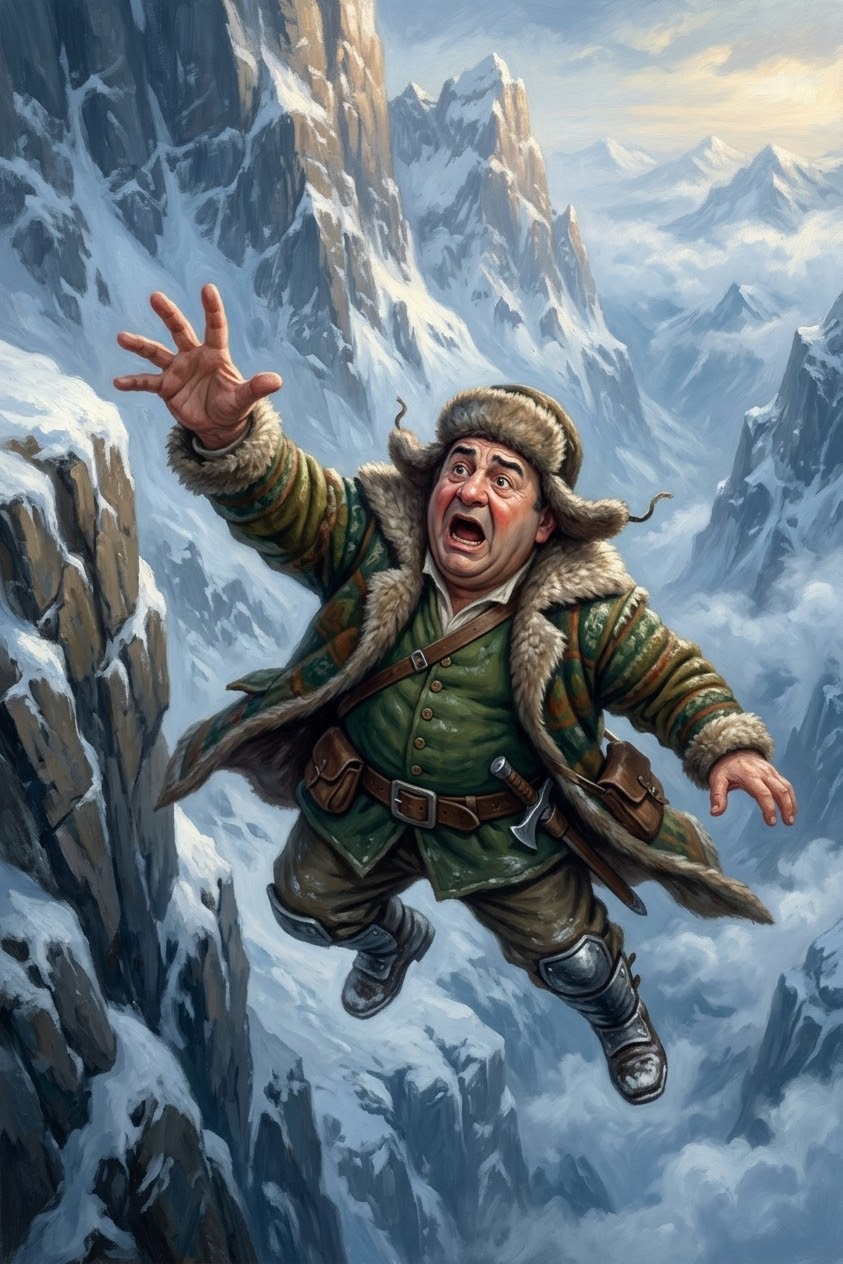
A wave of snow and debris crashed down onto the trail with blind fury. Most of the group managed to press themselves miraculously against the rock wall, but the white mass hit the rear of the column head-on, sweeping away Waldemar and Paolino and hurling them toward the abyss.
Waldemar, in an act born of pure survival instinct, drove his staff with desperate force into a fissure in the rock. The grip held, but the druid remained paralyzed with terror, suspended halfway, his feet kicking helplessly over the precipice.
But Paolino was in mortal danger. The halfling found no handhold; the snow dragged him away, and letting out a bloodcurdling scream, he tumbled straight into the void.
“PAOLINO!” Fredrich roared.
In that instant of pure adrenaline, pushing past all hesitation or trance symptoms, the soldier from Ostwald displayed superhuman reflexes and courage. Without a second’s hesitation, Fredrich threw himself face down on the lip of the ravine: with his left hand he gripped Waldemar’s staff desperately to anchor himself, while stretching his right out into the abyss.
Fredrich’s hand clamped onto Paolino’s wrist in mid-air just a split second before the halfling vanished into the fog of the crevasse.
The impact and weight of the half-man tore a cry of pain from Fredrich; his muscles strained to the breaking point, and his arm began to shake violently under the grueling exertion. “I… I can’t… I’m slipping!” Fredrich gasped, his teeth grit and his face red from strain, as his body began sliding on the icy ledge.
“Hold on, soldier!” Drumin’s voice boomed off the rock walls.
The dwarf and Anatoly surged forward. Drumin grabbed Fredrich by the belt with his iron hands, pulling him back with the force of an anvil, while Anatoly seized Waldemar by the shoulder, hauling him onto the ledge to safety. In a few seconds of sheer terror, through a joint effort, the group managed to pull both Paolino and the druid back onto the safe path, alive and sound.
The halfling collapsed onto the snow, his chest heaving frantically, staring at Fredrich with eyes wide from gratitude and shock.
“You… you caught me, holy hell!” Paolino stammered, his voice trembling terribly as he massaged his sore wrist. “And to think I took your gun away… By the gods, Fredrich, I owe you my life!”
Fredrich, lying flat on his back in the snow, merely nodded breathlessly, unable to speak from exhaustion: “We’re… we’re a team, aren’t we? Nobody falls as long as I can help it.”
After the incident, the caravan resumed its march at an agonizingly slow, almost claustrophobic pace. The terror that another avalanche might sweep them away gripped everyone’s spirit. To make matters dramatically worse, their supply of firewood—laboriously gathered before leaving the Forest of Spirits and loaded onto the pack horses—was now almost entirely exhausted. Without fire to warm themselves and melt snow for drinking water, the situation was deteriorating at a terrifying speed.
At last, however, the mountain gave way.
After yet another grueling climb along a razor-sharp ridge, at dawn on the fifth day of climbing, our travelers cleared the final pass. Before their exhausted, wide eyes stood no further peak; instead, an enormous, majestic frozen plateau opened up before them, swept by an icy wind but finally flat, stretching as far as the eye could see toward the horizon.
The group resumed their march along the river, venturing deeper into the frigid plateau. It was not long before Anatoly’s trained eyes picked up something on the haze-shrouded horizon.
“Stop,” Anatoly whispered, crouching down and gesturing for everyone to drop low. “At two o’clock… three mounted figures. They are watching us.”
Drumin and Fredrich gripped their weapons, squinting into the fog. The distance and cold mist made it impossible to tell whether they were humans, nomads, or something far more sinister. Shortly after, Fredrich knelt in the snow, examining a footprint and droppings left on the ground.
“Fresh wolf droppings… and they’re massive,” the soldier muttered, looking up with a grim grimace. “Those riders might not be riding ordinary horses…”
“Hobgoblin wolf riders…” Drumin spat on the ground with suppressed rage. “Vile scum. Keep your hands on your hilts.”
Unable to do much else in the open, the expedition pressed on at a cautious pace, constantly feeling those invisible eyes fixed on their backs.
After about half an hour of grueling marching, the trail led the heroes onto a rocky height. From this elevated position, the panorama of Chernozavtra finally opened before their eyes. But the scene revealed to their gaze caught everyone completely by surprise: the situation on the ground was infinitely more complex and layered than Prime Minister Dimitronov had led them to believe.
At the center of the valley ran the great river, which split to embrace a vast river island. At the exact center of this island stood the actual fortress of Chernozavtra: a rectangular structure enclosed by impressive walls with watchtowers at the corners.
Yet the citadel was not alone:
- On the island, around the fortress: A large camp of nomadic tents extended across the ground—a camp of Dolgan raiders, according to Anatoly. A multitude of yurts, campfires, and mounted warriors surrounded the stronghold, revealing that the local population or their nomadic Dolgan allies had settled there directly to protect (or besiege) the fort.
- The crossing: The only land access point to the island was a narrow wooden bridge/ford crossing the river’s icy waters, connecting the southern bank to the island.
- On the bank near our heroes: Right at the foot of the rocky cliff where our companions stood rose the massive and sprawling hobgoblin camp. The mercenaries’ settlement was ringed by pointed palisades and divided into well-defined sectors: to the left lay the wolf riders’ lair, explaining the tracks found earlier; at the center dominated a grand pavilion with fires and banners; and to the right, a thicket and a large livestock corral were visible.
The group hunkered down behind the rocks on the height, observing the political and military chessboard stretched out beneath them.
“Gods help us…” Paolino whispered, his eyes wide. “Dimitronov talked about ‘a couple of mercenaries’… but here we have an entire army of Hobgoblins camped on this side of the river, and an entire tribe of Dolgan nomads huddled on the island with Chernozavtra!”
“That damned Prime Minister sent us straight into a hornet’s nest,” Drumin snarled, glaring with contempt at the Hobgoblin banners fluttering in the camp below. “If we want to reach Anudil inside the fortress, we first need to figure out how to get through this greenskin camp and onto the island.”
Anatoly scanned the ford and the layout of the tents, calculating every single detail:
“The bridge is narrow and it’s the only way across. The Hobgoblins control the access from this side. If we make a wrong move, we’ll end up crushed between the mercenaries’ arrows and the Dolgans’ spears on the island. We need to decide how to present ourselves… assuming their scouts behind us haven’t already raised the alarm.”
Passano pochi giorni e la macchina organizzativa del primo ministro si rivela di un’efficienza spaventosa, per quanto inquietante. Con le sacche piene, i cavalli freschi sotto la sella e la benedizione formale della corona, il gruppo è pronto per lasciare la capitale e muovere verso est, alla volta di Chernozavtra.
Ad attenderli all’uscita delle mura vi è soltanto la steppa gelata, una distesa infinita e piatta di bianco e grigio che si srotola all’infinito sotto un cielo di piombo. Per circa cinque giorni di marcia, la monotonia del paesaggio è spezzata solo dai ritmi serrati del viaggio. Ogni sera, tuttavia, il gruppo riesce a trovare riparo in una stanitsa kislevita dal nome impronunciabile, trovando rifugio nei locali fusi tra legno e terra battuta che fungono da locande.
Giunti all’ultimo insediamento indicato sulla mappa data loro da Dimitronov — segnato con il nome di Deghov, un toponimo che ovviamente i contadini locali non riconoscono affatto, chiamando la loro terra in un idioma dialettale stretto — i nostri si preparano al tratto più insidioso. Davanti a loro si erge la macchia cupa e minacciosa della Foresta degli Spiriti. Per proseguire occorre risalire le acque parzialmente congelate del fiume Orso Nero, puntando dritti verso le moli imponenti dei Monti dei Confini del Mondo che svettano all’orizzonte.
Le montagne incutono un timore reverenziale in ciascuno di loro. Sono, de facto, il limite dell’orbe conosciuto, un bastione di roccia e ghiaccio che separa la civiltà dall’ignoto.
«Guardo quelle vette e sento solo il gelo che mi morde le viscere…» mormora Paolino, stringendosi nel mantello di pelliccia e sistemandosi la fondina della pistola. «Sembrano i denti di un mostro pronti a inghiottirci.»
«Per voi umani sarà pure un mostro,» interviene Drumin con un raro e amaro ghigno di soddisfazione, assestando il fascio di cinghie del suo zaino. «Ma per me è roccia vera. Finalmente ci lasciamo alle spalle questa melma di fango e alberi marci. Là sopra si respira aria di casa.»
Il capo villaggio di Deghov tenta in tutti i modi di dissuaderli dal prosieguo, parlando con gesti concitati di ombre che camminano e di spiriti che divorano chiunque s’addentri lungo l’Orso Nero.
«Niente da fare, anziano,» lo interrompe Anatoly con fredda determinazione, mentre la traduzione viene mormorata al resto della compagnia. «Abbiamo un compito da portare a termine. Dici che la foresta è maledetta? Ebbene, noi abbiamo già camminato nell’inferno e siamo ancora qui.»
Anatoly stima tre giorni di marcia per attraversare la fitta vegetazione. I nostri si immergono nel bosco con la guardia altissima e i nervi a fior di pelle; l’oscurità perenne tra i rami intrecciati ricorda a molti le foreste più pericolose dell’Impero. Fortunatamente, la disciplina e la prudenza ripagano: i turni di guardia doppi e i fuochi tenuti vivi fino all’alba sembrano scoraggiare qualsiasi presenza si aggiri tra le ombre.
Dopo otto giorni di viaggio in totale e ormai due mesi abbondanti trascorsi nelle spietate terre di Kislev, la fatica mentale inizia a farsi sentire in modo tangibile. La rigidità del meteo, il cibo essiccato e la dura realtà di quella terra forgiano gli animi, ma nessuno tentenna. All’alba del quarto giorno di foresta, gli alberi finalmente diradano e il gruppo spunta alle pendici dei primi rilievi, iniziando una salita che si rivela da subito estenuante.
Il fiume Orso Nero, unico punto di riferimento certo per raggiungere la seceduta Chernozavtra, si trasforma ben presto in un torrente di montagna impetuoso e incassato tra le pareti di roccia. Anatoly e Drumin si danno il cambio continuamente in testa alla colonna, alternando l’occhio del cacciatore di pianura all’istinto del nano per le vie d’alta quota. Più si sale vertiginosamente, più le temperature crollano drasticamente, al punto che il gruppo è costretto a spalmarsi denso grasso d’animale sulla pelle del viso e sulle mani per evitare che il freddo pungente causi piaghe da congelamento.
Poi, durante una notte a diverse centinaia di metri d’altitudine, accade un fatto che getta un’ombra ancor più cupa sulla spedizione.
Mancano poche ore all’alba. Fuori dalle tende il vento della montagna urla tra gli anfratti. Waldemar e Maximilian occupano il turno di guardia attorno a un braciere riparato. Improvvisamente, il lembo della tenda comune si solleva e Fredrich ne esce. Il soldato è a capo scoperto, completamente sveglio negli occhi ma privo di qualsiasi protezione contro il gelo mortale: indossa solo le tuniche da notte e cammina a piedi nudi sulla neve crostosa.
«Fredrich?» sussurra Waldemar, alzandosi di scatto con la torcia in mano. «Che diavolo stai facendo? Copriti!»
Il soldato non risponde. Lo sguardo fisso nel vuoto, la pelle già segnata da chiazze violacee per il freddo istantaneo, risponde con voce metallica, priva di inflessione:
«Devo… devo fare un bisogno a valle.»
E senza attendere replica, comincia a camminare dritto verso il precipizio.
«Fredrich, fermati!» ruggisce Maximilian, scattando in avanti. Il prete di Ulric lo raggiunge a falcate ampie e lo afferra con forza per le spalle, scuotendolo violentemente. «Svegliati, per il Lupo! Svegliati!»
Fredrich sussulta, spalancando gli occhi. Un brivido incontrollabile lo assale non appena la percezione del gelo gli ripiomba addosso in un colpo solo. Si guarda le mani nude, i piedi immersi nella neve, visibilmente sconvolto.
«Io… Maximilian? Waldemar?» balbetta Fredrich, coi denti che battono all’impazzata. «Che cosa… perché sono qui fuori? Ero… ero nella tenda un secondo fa…»
Mentre Waldemar sveglia rapidamente il resto del gruppo, Maximilian e il druido trascinano Fredrich dentro al riparo, avvolgendolo nelle coperte. Attorno al braciere, il confronto si fa subito serrato e privo di diplomazia.
«Non mi ricordo nulla, ve lo giuro!» si difende Fredrich, tremando sia per l’ipotermia che per la paura di ciò che gli sta accadendo. «Stavo sognando… o forse no. Sentivo solo una spinta a camminare!»
Waldemar scuote il capo, lo sguardo scuro e penetrante: «Non è un sogno, Fredrich. La contaminazione caotica che ti porti dentro sta avanzando. L’isolamento, il gelo e questa terra maledetta stanno accelerando il processo. Il tuo corpo obbedisce a impulsi che non sono più tuoi.»
«Se non sei padrone delle tue azioni, sei un pericolo per tutti noi,» interviene Paolino, facendosi avanti con il volto insolitamente serio. L’halfling allunga la mano verso il cinturone di Fredrich. «Consegnami la tua pistola, Fredrich. Subito. Non posso rischiare che ti svegli di notte e decida che la tua ‘esigenza’ sia sparare a uno di noi.»
Fredrich guarda i compagni uno a uno, vedendo nei loro occhi una dolorosa sfiducia. Con la testa bassa, sgancia lentamente la fondina e la porge a Paolino.
«Prendila,» mormora il soldato, sconfitto. «Forse… forse avete ragione voi.»
A quel punto, Maximilian si alza in piedi, torreggiando sul gruppo con la rigidità inflessibile dei servitori di Ulric. Guarda Fredrich con una freddezza che non gli appartiene, ma che rivela il peso tremendo del fardello che portano.
«Ascoltatemi bene tutti,» dice il giovane prete, con la voce incisa nel ferro. «Siamo arrivati fin qui per compiere un dovere. Dobbiamo trovare il Cardine delle Ere e chiudere questa storia. Se la mente di Fredrich dovesse cedere del tutto… non esiterò a fare ciò che va fatto. Non permetterò che questa corruzione impedisca la riuscita della missione. Costasse anche la vita a te, Fredrich. Spero che tu lo capisca.»
Nessuno parla. Fredrich annuisce in silenzio, stringendosi nelle coperte. La questione si chiude così, nell’oscurità della tenda, mentre fuori il vento di montagna continua a urlare tra le rocce dei Monti dei Confini del Mondo.
I giorni continuano a scorrere inesorabili e la spedizione avanza fatica dopo fatica, mentre le montagne sembrano non finire mai. Ogni volta che il gruppo guadagna con il sudore una cresta, sperando di scorgere finalmente la meta, si ritrova davanti a una cima ancora più alta e impervia, in un labirinto infinito di roccia e ghiaccio.
I sentieri si fanno via via più stretti, scavati sul ciglio di precipizi a picco su crepacci dal fondo nero e insondabile, dove un solo passo falso significa la morte.
Ed è proprio durante uno di questi tratti spaventosamente esposti che la tragedia sfiora la spedizione.
Un rumore sordo e sordo, come un ruggito sommesso che proviene dall’alto, fa vibrare la parete di roccia. «SLAVINA! TENETEVI!» urla Anatoly con quanto fiato ha in gola, piantando i ramponi nel ghiaccio e avventandosi contro le briglie dei cavalli.
Un’ondata di neve e detriti si abbatte con furia cieca sul sentiero. La maggior parte del gruppo riesce a schiacciarsi miracolosamente contro la parete rocciosa, ma la massa bianca investe in pieno le retrovie, travolgendo Waldemar e Paolino e scaraventandoli verso il baratro.
Waldemar, in un gesto dettato dal puro istinto di sopravvivenza, pianta con forza disperata il suo bastone in una crepa della roccia. La presa tiene, ma il druido rimane paralizzato dal terrore, sospeso a metà, con i piedi che annaspano a vuoto nel precipizio.
Ma è Paolino quello in pericolo mortale. L’halfling non trova alcun appiglio, la neve lo trascina via e, lanciando un urlo lacerante, vola dritto nel vuoto.
«PAOLINO!» ruggisce Fredrich.
In quel frangente di pura adrenalina, cancellando ogni titubanza o sintomo di trance, il soldato di Ostwald dimostra un riflesso e un coraggio sovrumani. Senza esitare un solo secondo, Fredrich si lancia a pancia in giù sul ciglio del burrone: con la mano sinistra si aggrappa disperatamente al bastone di Waldemar per ancorarsi, mentre allunga la destra verso l’abisso.
La mano di Fredrich serra al volo il polso di Paolino un istante prima che l’halfling svanisca nella nebbia del crepaccio.
L’impatto e il peso del mezz’uomo strappano un grido di dolore a Fredrich; i suoi muscoli si tendono fino al limite della rottura e il braccio inizia a tremare violentemente sotto lo sforzo disumano. «Non… non ce la faccio… scivolo!» rantola Fredrich, coi denti stretti e il volto rosso per lo sforzo, mentre il suo corpo inizia a slittare sul bordo ghiacciato.
«Tieni duro, soldato!» la voce di Drumin rimbomba tra le pareti di roccia.
Il nano ed Anatoly si scagliano in avanti. Drumin afferra Fredrich per la cintura con le sue mani d’acciaio, tirandolo indietro con la forza di un incudine, mentre Anatoly afferra per la spalla Waldemar, traendolo in salvo sulla cengia. In pochi secondi di puro terrore, compiendo uno sforzo corale, il gruppo riesce a riportare Paolino e il druido sul sentiero sicuro, sani e salvi.
L’halfling crolla sulla neve, il petto che si alza e si abbassa all’impazzata, guardando Fredrich con gli occhi sbarrati dalla gratitudine e dallo shock.
«Io… tu… mi hai preso, cazzo!» balbetta Paolino, la voce che trema spaventosamente mentre si massaggia il polso dolorante. «E io che ti avevo persino tolto la pistola… Per gli dei, Fredrich, ti devo la vita!»
Fredrich, disteso di schiena sulla neve, si limita ad annuire affannato, incapace di parlare per la fatica: «Siamo… siamo una squadra, no? Nessuno cade finché posso evitarlo.»
Dopo l’incidente, la carovana riprende la marcia a passo lentissimo, quasi claustrofobico. Il terrore che un’altra slavina possa spazzarli via attanaglia gli animi di tutti. A complicare drammaticamente le cose, la scorta di legna — raccolta a fatica prima di lasciare la Foresta degli Spiriti e caricata a basto sui cavalli — è ormai quasi del tutto esaurita. Senza fuoco per scaldarsi e sciogliere la neve per bere, la situazione sta deteriorando a una velocità spaventosa.
Ma la montagna, finalmente, cede.
Dopo l’ennesima ed estenuante salita lungo una cresta affilata come un rasoio, all’alba del quinto giorno di scalata, i nostri superano l’ultimo valico. Davanti ai loro occhi stanchi e sgranati non si erge l’ennesima vetta, ma si spalanca un enorme e maestoso altopiano congelato, battuto da un vento gelido ma finalmente pianeggiante, che si estende a perdita d’occhio verso l’orizzonte.
Il gruppo riprende la marcia lungo il fiume, inoltrandosi nel gelido altopiano. Non passa molto tempo prima che lo sguardo allenato di Anatoly capti qualcosa nell’orizzonte ovattato dalla foschia.
«Fermatevi,» sussurra Anatoly, accucciandosi e facendo cenno a tutti di abbassarsi. «A ore due… tre figure a cavallo. Ci stanno osservando.»
Drumin e Fredrich stringono le armi, scrutando nella nebbia. La distanza e il vapore freddo rendono impossibile capire se si tratti di uomini, nomadi o di qualcosa di ben più sinistro. Poco dopo, Fredrich si china sulla neve, esaminando un’impronta e dei resti lasciati sul terreno.
«Escrementi freschi di lupo… e sono enormi,» mormora il soldato, alzando lo sguardo con una smorfia cupa. «I cavalieri potrebbero non essere a cavallo di semplici cavalli…»
«Cavalca-lupi hobgoblin…» sputa Drumin a terra con rabbia repressa. «Gente di malaffare. Teniamo le mani sulle else.»
Non potendo fare molto altro in campo aperto, la spedizione prosegue a passo guardingo, sentendo costantemente quegli occhi invisibili puntati sulle loro spalle.
Dopo circa mezz’ora di marcia estenuante, il sentiero conduce gli eroi su un’altura rocciosa. Da questa posizione rialzata, finalmente, si apre davanti ai loro occhi il panorama di Chernozavtra. Ma la scena che si svela ai loro sguardi prende tutti completamente di sorpresa: la situazione sul campo è infinitamente più complessa e stratificata di quanto il primo ministro Dimitronov avesse fatto intendere.
Al centro della valle scorre il grande fiume che si divide abbracciando una vasta isola fluviale. Proprio al centro di questa isola sorge la fortezza vera e propria di Chernozavtra: una struttura rettangolare recintata da imponenti mura con torri d’avvistamento agli angoli.
Ma la cittadella non è sola:
- Sull’isola, attorno alla fortezza: Si estende un grande accampamento di tende nomadi, un campo di Dolgan,razziatori,secondo Anatoly. Una miriade di yurte, fuochi da campo e guerrieri a cavallo circondano la roccaforte, rivelando che la popolazione locale o i loro alleati nomadi Dolgan si sono stanziati direttamente a protezione (o assedio) del forte.
- Il passaggio: Unico punto di accesso terrestre all’isola è uno stretto ponte/guado in legno che attraversa le acque gelide del fiume, collegando la sponda sud all’isola.
- Sulla sponda vicina agli eroi: Proprio ai piedi della rupe rocciosa dove si trovano i nostri, si erge il massiccio ed esteso campo di hobgoblin . L’insediamento dei mercenari è cinto da palizzate appuntite e diviso in settori ben definiti: sulla sinistra si trova il covo dei cavalca-lupi, spiegando così le tracce trovate poco prima, al centro domina un grande padiglione centrale con fuochi e stendardi, e sulla destra si distinguono la boscaglia e un grande recinto per il bestiame .
Il gruppo si appiatta dietro le rocce dell’altura, osservando lo scacchiere politico e militare che si stende sotto di loro.
«Poveri noi…» mormora Paolino, sbarrando gli occhi. «Dimitronov parla di ‘un paio di mercenari’… ma qui c’è un intero esercito di Hobgoblin accampato da questo lato del fiume, e un’intera tribù di nomadi Dolgan abbarbicata sull’isola con Chernozavtra!»
«Quel maledetto primo ministro ci ha mandati dentro un ginepraio,» ringhia Drumin, osservando con disprezzo le bandiere degli Hobgoblin che sventolano nel campo sottostante. «Se vogliamo arrivare ad Anudil dentro la fortezza, dobbiamo prima capire come attraversare questo campo di pelleverde ed entrare nell’isola.»
Anatoly scruta il guado e la disposizione delle tende, calcolando ogni minimo dettaglio:
«Il ponte è stretto ed è l’unico passaggio. Gli Hobgoblin controllano l’accesso da questa sponda. Se ci muoviamo male, ci troveremo stritolati tra le frecce dei mercenari e le lance dei Dolgan sull’isola. Dobbiamo decidere come presentarci… sempre che i loro esploratori alle nostre spalle non abbiano già dato l’allarme.»


Leave a Reply