Upon reaching the village of Voltsara, a cluster of poor wooden hovels huddled against a dark, nameless forest, the welcome is far from warm. At the sight of the strangers, the women slam their window shutters shut with a frantic snap, tracing strange wards in the air toward Ursun to pray for his protection. At the same time, a handful of peasants and woodsmen armed as best they can—some with old pitchforks, others with heavy glares and brazen felling axes—gather in the middle of the village’s single muddy street, blocking the way and staring at the newcomers with obvious tension.
“Halt, strangers!” demands a thick-bearded man, tightening his grip on the handle of a hoe. “Who are you, and what do you seek in a place forgotten by Dazh like this?”
Dmitry urges his horse forward with a proud posture, letting his cloak sweep back to display his credentials.
“Lower those weapons,” Dmitry replies in the commanding tone typical of the Gospodar nobility. “I am Boyar Dmitry. We are here in an official capacity on behalf of Kislev City, sent to assist your boyar in resolving the scourge of the Beastmen once and for all.”
After a brief, hurried consultation in hushed tones, a couple of peasants rush off between the hovels. Minutes later they return accompanied by Maksim Sokolov, the local boyar, who regards the armed company with a mixture of relief and deep surprise. He had not expected the capital to send a group of foreigners and Imperials to his aid.
“I never would have believed Kislev cared so much about a handful of huts in the mist,” Sokolov begins, nodding in greeting without fully easing the tension. “May the power of the gods be with you; we need it desperately.”
The boyar leads the way to his hall, a large structure of squared logs warmed by a massive stone fireplace. Once inside, Sokolov generously offers his guests bowls of Kvas poured into brass horns, inviting them to warm themselves before explaining the situation.
“Attacks have been bloodying the forest for two months now,” the boyar explains, taking a long quaff from his cup. “Those paying the price are almost always charcoal burners and woodsmen working in the most isolated camps. We find their bodies dismembered and headless. We have no physicians here in Voltsara, but even to an untrained eye it is obvious this is not the work of simple beasts: they were butchered with edged weapons and deliberate brutality.”
Sokolov leans forward, lowering his voice as if the very walls of the hall might be listening.
“Our people—barely seventy souls left—are convinced that the blame for all of this lies with a single man: a sorcerer, if he can be called that, named Piotr Piotrevich. He is an individual of sinister repute who lives isolated in the forest and wants nothing to do with the village. The rumors surrounding him are endless: they say that twenty-some years ago he had a mutant son, a deformed creature he abandoned in secret among the trees instead of killing it as the law demands. The peasants have gotten it into their heads that the child has grown into an abomination and now leads the Beastmen against us.”
The boyar sighs, running a rough hand over his lined face.
“All manner of terrifying tales have blossomed around Piotr: dark rites, sacrifices, unproven infanticides. Being ignorant of the magical arts or dark secrets myself, I have refrained from formally accusing him without concrete proof. But the people are terrified and desperate; it is only a matter of time before the villagers grab torches and pitchforks to take justice into their own hands. If they were to lynch him, or if the hand of Chaos is truly at work here, I fear they would draw down a wrath upon Voltsara that this village could not survive. For now I am holding them back, but I am at my limit. In my view, the best course of action is to go to Piotr, speak with him, and uncover the truth with some degree of objectivity before rage blinds everyone.”
Sokolov’s assessment aligns with our heroes, who accept the task. Aware that the threat of the beasts could strike the village at any moment, the group decides to split up to optimize their resources and avoid unnecessary risks.
Maximilian and Dmitry will remain in Voltsara to organize its defense: they will use their military experience to coordinate the local men and build at least a makeshift palisade around the most exposed homes, in case the Beastmen grow more aggressive. Janna, still exhausted from days of hard travel, will stay at the boyar’s residence to recover her strength and serve as a magical sentry if needed.
The rest of the company prepares to venture among the bare trees of the forest on the trail of the enigmatic and feared Piotr Piotrevich.
The following morning, beneath a leaden sky that promises snow, the expedition sets out for the suspected sorcerer’s dwelling. Guiding them along the frost-bitten paths is Alexey, a local peasant. After about twenty minutes of forced marching in the agonizing silence of the forest, the man comes to a sudden halt, trembling visibly. With a hesitant finger, he points toward a small clearing: in the center, built atop a solitary, massive outcrop of rock, stands a peculiar hut made of roughly hewn timber. Thick smoke rises from a stone chimney, and a faint, hazy light shows through the gaps in the beams—an unmistakable sign that the place is inhabited.
“I… I stop here,” Alexey whispers, his voice cracked with terror. “From here on, you are on your own. May Ursun protect you.”
Without waiting for an answer, the peasant turns and vanishes quickly into the trees. Left alone, with Anatoly taking the lead, our travelers step into the clearing.
As they approach the base of the rocky outcrop, Waldemar’s sharp eye catches a crucial detail: carved directly into the ancient stone is a rune—a druidic symbol bound to the worship of Nature and the Old Faith. The pieces of the puzzle begin to fall into place: Piotr is neither a heretic nor a common Chaos sorcerer, but a druidic priest. Of course, this guarantees neither his sanity nor rules out some form of corruption, but it fundamentally changes the nature of their host.
Our heroes begin to ascend the crude staircase carved into the rock, hands resting firmly on the pommels of the swords at their belts and nerves on edge. They have climbed only a few steps when the door of the hut bursts open with violent force.
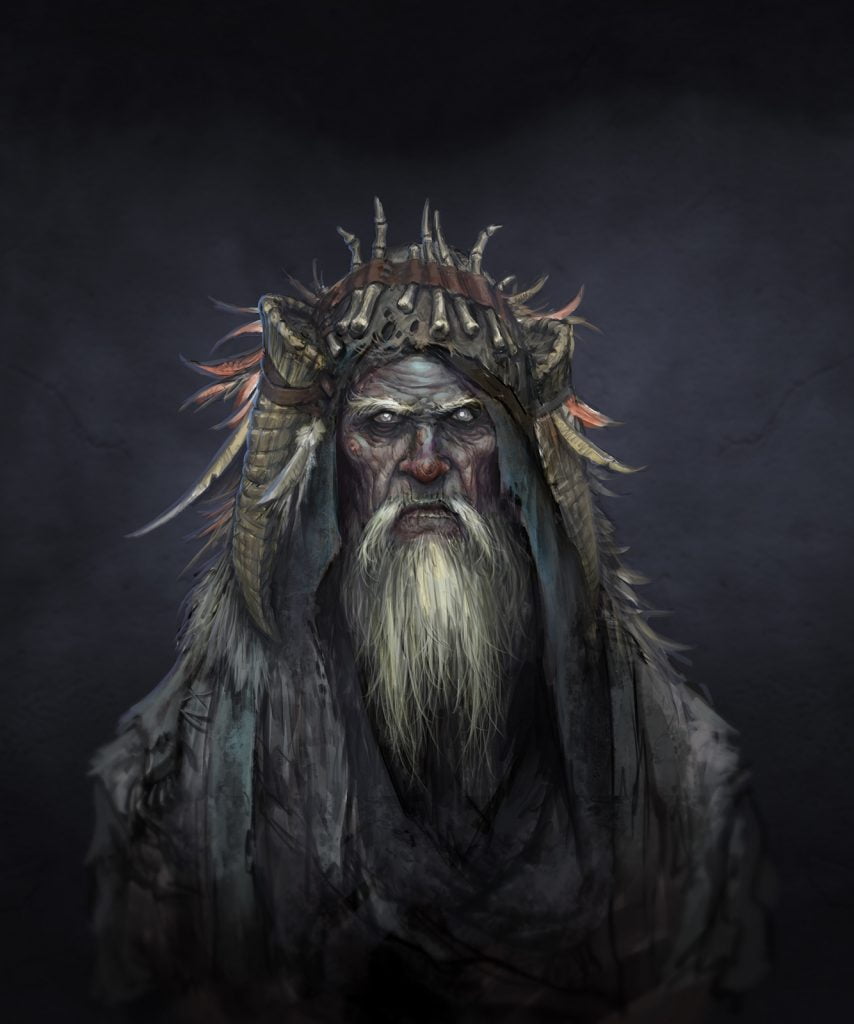
Upon the threshold appears the terrifying figure of an old man: caked in grime, draped in layers of foul-smelling animal pelts, his beard matted with mud and grease. He glares at them with two fierce, feline eyes before spitting on the ground and snarling in a thick, guttural Kislevite dialect:
“Have you come here to kill me, village scum?”
Paolino takes a step forward with his hands clearly visible, trying to defuse the situation. “No, old man. We are not here to spill your blood. We came regarding the Beastmen haunting the forest.”
Piotr bursts into a harsh, mirthless laugh that sounds like the cawing of a crow. “Beastmen? I have nothing to do with those filth-born beasts! As far as I’m concerned, they can burn all of Kislev to the ground and slaughter every last peasant, so long as they leave me and my land in peace. Here, in my clearing, far from men and their lies, I am safe!”
Waldemar sniffs the air and examines the flow of the winds of magic, confirming under his breath what he suspected: the clearing is a hallowed place, a natural sanctuary with enough power to screen the area and keep chaotic abominations at bay.
Attempting to appeal to his nature, the group pleads with him to lend his aid to end the slaughter at Voltsara, but the old man openly scoffs at the dead and the village’s tragedy. It is at this point that Waldemar steps forward directly:
“Piotr, listen to me. I am no witch hunter, nor am I ignorant of the steppes. I too am a devoto of the Old Faith—a druidic priest, just like you.”
At those words, the old man stops his rambling. He stares suspiciously at him, narrowing his eyes. “A druid? You? A greenhorn dressed like a townsman?” He makes a sharp gesture with his gnarled hand. “Come closer, boy. Let me see if you speak the truth, or if your tongue deserves to be ripped out.”
Waldemar climbs the final steps and extends his hands to him. When their palms touch, a palpable shiver runs through them both. The wind of Aethir bound to nature surges strong and pulsing between them, connecting their souls. But Waldemar is seized by a profound sense of shock: Piotr’s magical power is devastating, terrifyingly raw and vast. He is a priest of unimaginable arcane potential.
Piotr erupts once more into a mocking laugh, deriding “the greenhorn” after extracting the identity of his spirit animal with a few quick questions. Then, with a gruff nod of his head, he turns and grumbles: “Come inside, if you must.”
The interior of the house is, for all intents and purposes, the foul lair of a wild bear. There are no human furnishings: only the skinned carcasses of small animals, a bed of rotting straw and twigs in the corner, and a tiny hearth in the center—the sole faint trace of civilization. It is obvious that the druid has almost entirely abandoned his humanity, slipping day by day toward the feral essence of his spirit guide, the Bear.
Waldemar observes the scene with a mixture of bewilderment and grim admiration. Before him is the purity of faith pushed to the extreme: Piotr has sacrificed everything—hygiene, companionship, human warmth, dignity—in the name of the Old Faith, including himself. The young druid gazes into that abyss and wonders if he will ever possess the formidable willpower (or madness) required to push himself that far.
Sitting on the floor, Piotr begins to chew noisily on foul berries scooped straight off the dirty ground, almost completely ignoring Paolino’s attempts at rational conversation. To Paolino, Drumin, and the others, the old man is simply a raving, unredeemable lunatic.
Suddenly, however, Piotr stops chewing and fixes his gaze upon Waldemar once more with unsettling intensity.
“I will give you the means to find the Beastmen’s lair,” the old man utters with a lucid, unexpected firmness. “My son, Georgy… he knows where the beasts hide. He will lead you to them. But on one condition: not a single hair on his head shall be harmed. You must swear it to me.”
Waldemar hesitates, caught in a deep inner torment: the thought of protecting a mutant—a beast-man born of Chaos—revolts him. But knowing it is the only way to end the threat to Voltsara and press on with the hunt for Anadil, he accepts for the greater good. Paolino speaks the oath as well, while Drumin, ever the skeptical and unyielding dwarf, takes good care not to bind himself to such a vow, settling for a low, sullen grumble.
In that moment, the terrible moral tragedy of Piotr unfolds clearly before Waldemar’s eyes.
Decades earlier, while already walking the druidic path, the man had succumbed to temptation and fathered a child—an act not forbidden by the tenets of the Old Faith, but strongly discouraged for those seeking spiritual purity. In his long journey of ascension, Piotr had managed to strip away every tie to civilization, abandoning progress, vanity, and human contact to become one with wild nature. Yet a single, insurmountable obstacle prevented him from completing his metamorphosis and reaching the ultimate divine state: the inability to sever the umbilical cord of fatherhood.
Piotr was never able to “kill” that human part of himself that bound him inextricably to his son, who was born a mutant to make matters worse. Torn between the unyielding dogmas of the druidic faith and the visceral, paternal imperative to protect his child, the old man’s mind shattered. He is a broken man, condemned to live in an eternal, agonizing conflict between ascending into a feral spirit guide and remaining desperately human.
With the pact accepted, Piotr’s reaction is immediate and devoid of any warmth: with a harsh sweep of his arm, he shooes most of the party away like bothersome flies.
“Now get out of here, scum!” the old man roars, his voice vibrating with feline hostility. “You make me sick with your clean clothes and your town stench. Everyone out! Only the greenhorn stays. I must teach him how to speak to the spirits of this land if you truly want to settle this matter.”
Paolino and the others exchange a glance laden with apprehension. Leaving Waldemar alone in the foul lair of a clearly unstable druid, with a fractured mind and terrifying magical power, is a massive risk. But the young priest gives his companions a quick, reassuring nod, his gaze steady: he knows this ritual process is essential to completing their mission.
Shrugging their shoulders with a deep sense of unease weighing down their steps, the group reluctantly takes their leave. Retracing the frost-covered trail, they begin the trek back to Voltsara, leaving behind the rocky outcrop, the hallowed clearing, and the echo of the wooden door slamming shut with a heavy thud—isolating Waldemar in the presence of Piotr and his personal demons.
Raggiunto il villaggio di Voltsara, un ammasso di povere casupole in legno addossate a una foresta cupa e senza nome, l’accoglienza non è delle più calorose. Alla vista degli stranieri, le donne serrano con scatto nevrotico le imposte di casa, tracciando nell’aria strani segni di scongiuro rivolti a Ursun per propiziarsi la sua protezione. Contemporaneamente, un manipolo di contadini e boscaioli armati alla benemeglio — chi con vecchi forconi, chi con pesanti sguardi e sfrontate scuri da spacco — si raduna al centro dell’unica via fangosa, sbarrando la strada e fissando i nuovi arrivati con un nervosismo evidente.
«Fermatevi, stranieri!» intima un uomo dalla barba folta, stringendo il manico di una zappa. «Chi siete e cosa cercate in un posto dimenticato da Dahz come questo?»
Dmitry fa avanzare il proprio cavallo con un portamento fiero, facendo sventolare il mantello per mostrare le proprie credenziali.
«Abbassate quelle armi,» risponde Dmitry con la tipica voce stentorea della nobiltà Gospodara. «Sono il Boyaro Dmitry. Siamo qui in veste ufficiale per conto di Kislev,inviati a supporto del vostro boiardo per risolvere una volta per tutte la piaga degli Uomini Bestia.»
Dopo un breve e concitato consulto a bassa voce, un paio di contadini corre tra le casupole. Pochi minuti dopo ne riemergono accompagnando Maksim Sokolov, il boiardo locale, che osserva la compagine armata con un misto di sollievo e profonda sorpresa. Non si aspettava minimamente che la capitale gli mandasse in aiuto un gruppo composto da forestieri e imperiali.
«Non avrei mai creduto che a Kislev importasse tanto di un pugno di capanne nella nebbia,» esordisce Sokolov, facendo un cenno di saluto ma senza sciogliere del tutto la tensione. «Ma che le forze degli dei vi accompagnino, ne abbiamo disperatamente bisogno.»
Il boiardo fa strada verso la sua dimora, una grande struttura di tronchi squadrati scaldata da un imponente camino in muratura. Una volta all’interno, Sokolov offre generosamente ai suoi ospiti abbondante Kvas versato in corni d’ottone, invitandoli a scaldarsi prima di illustrare la situazione.
«Sono ormai due mesi che gli attacchi insanguinano la foresta,» spiega il boiardo, tracannando un lungo sorso dalla sua coppa. «A farne le spese sono quasi sempre carbonai e boscaioli che lavorano negli accampamenti più isolati. Troviamo i loro corpi smembrati e privi della testa. Non abbiamo medici qui a Voltsara, ma anche per un occhio profano è evidente che non si tratta di semplici belve: sono stati massacrati con armi da taglio e brutalità mirata.»
Sokolov si sporge in avanti, abbassando la voce come se le pareti stesse del villaggio potessero ascoltarlo.
«La nostra gente — poco più di settanta anime rimaste — è convinta che la colpa di tutto questo risieda in un solo uomo: uno stregone, se così si può chiamare, di nome Piotr Piotrevich. È un individuo dalla fama sinistra, che vive isolato nella foresta e non vuole avere nulla a che fare con il villaggio. Le voci attorno a lui si sprecano: dicono che una ventina d’anni fa ebbe un figlio mutante, una creatura deforme che abbandonò in gran segreto tra gli alberi invece di ucciderlo come legge imporrebbe. I contadini si sono messi in testa che quel bimbo sia cresciuto diventando un abominio e che ora guidi gli Uomini Bestia contro di noi.»
Il boiardo sospira, passandosi una mano ruvida sul volto rugoso.
«Attorno a Piotr sono fiorite storie di paura di ogni tipo: riti oscuri, sacrifici, infanticidi mai dimostrati. Io stesso, non intendendomi di arti magiche o di segreti oscuri, mi sono ben guardato dall’andare ad accusarlo formalmente senza prove concrete. Ma la gente è terrorizzata e disperata; è solo questione di tempo prima che i contadini prendano torce e forconi e vadano a farsi giustizia da soli. Se dovessero linciarlo o se davvero sotto c’è la mano del Chaos, temo che attirerebbero su Voltsara un’ira che questo villaggio non potrebbe sopravvivere. Per ora li sto trattenendo, ma sono al limite. Secondo me, la cosa migliore da fare è andare da Piotr, parlargli e capire la verità con un minimo di oggettività prima che la rabbia accechi tutti.»
L’analisi di Sokolov trova d’accordo i nostri, che accettano l’incarico. Consapevoli che la minaccia delle belve potrebbe abbattersi sul villaggio da un momento all’altro, il gruppo decide di dividersi per ottimizzare le risorse ed evitare inutili rischi.
Maximilian e Dmitry rimarranno a Voltsara per organizzare la difesa: sfrutteranno la loro esperienza militare per coordinare gli uomini del villaggio e costruire almeno una palizzata di emergenza attorno alle case più esposte, nel caso gli Uomini Bestia decidessero di farsi più aggressivi. Janna, ancora provata dai giorni di marcia, rimarrà alla dimora del boiardo per recuperare le forze ed eventualmente fare da presidio magico.
Il resto della compagine si prepara invece a inoltrarsi tra gli alberi spogli della foresta, sulle tracce dell’enigmatico e temuto Piotr Piotrevich.
La mattina seguente, sotto un cielo di piombo che promette neve, la spedizione parte verso la dimora del presunto stregone. A guidarli tra i sentieri battuti dalla brina c’è Alexey, un contadino del villaggio. Dopo circa venti minuti di marcia forzata nel silenzio angosciante della foresta, l’uomo si arresta d’impatto, tremando visibilmente. Indica con dito incerto una piccola radura: al centro, eretta sopra un solitario e massiccio sperone di roccia, sorge una singolare casupola in legno rozzamente piallato. Da un comignolo di pietra esce un fumo denso e dalle fessure delle travi traspare una debole luce caliginosa, segno inequivocabile che il luogo è abitato.
«Io… io mi fermo qui,» mormora Alexey con la voce spezzata dal terrore. «Da qui in avanti siete soli. Che Ursun vi protegga.»
Senza attendere risposta, il contadino si gira e scompare in fretta tra gli alberi. Rimanendo soli, con Anatoly a fare da battistrada, i nostri si inoltrano nella radura.
Mentre si avvicinano alla base dello sperone roccioso, l’occhio attento di Waldemar coglie un dettaglio fondamentale: incisa direttamente sulla pietra vetusta c’è un’antica runa, un simbolo druidico legato al culto della Natura e dell’Antica Fede. Le tessere del mosaico iniziano ad andare al loro posto: Piotr non è un eretico né un volgare stregone del Chaos, ma un sacerdote druidico. Certo, questo non garantisce la sua sanità mentale né esclude a priori una qualche forma di corruzione, ma cambia radicalmente la natura del loro interlocutore.
I nostri iniziano a risalire la scalinata grezza scavata nella roccia, le mani ben salde sui pomi delle spade in cintura e i nervi a fior di pelle. Hanno salito appena pochi gradini quando la porta della casupola si spalanca con un sbalzo violento.
Sulla soglia sbalza la figura di un vecchio spaventoso: ricoperto di sporcizia, strati di pelli animali maleodoranti e con una barba incrostata di fango e grasso. Li fissa con due occhi torvi e felini prima di sputare a terra e ringhiare in un kislevita strettissimo e vischioso:
«Siete venuti qui per ammazzarmi, feccia del villaggio?»
Paolino muove un passo avanti con le mani ben visibili, cercando di pacificare i toni. «No, vecchio. Non siamo qui per versare il tuo sangue. Siamo venuti per la questione degli Uomini Bestia che infestano la foresta.»
Piotr sbotta in una risata aspra e priva di allegria, come il gracidare di un corvo. «Gli Uomini Bestia? Non ho nulla a che fare con quelle bestie nate dalla feccia! Per quel che mi riguarda, possono radere al suolo l’intera Kislev e bruciare fino all’ultimo contadino, purché lascino in pace me e la mia terra. Qui, nella mia radura, lontano dagli uomini e dalle loro menzogne, io sono al sicuro!»
Waldemar annusa l’aria ed esamina il flusso dei venti magici, confermando sottovoce ai compagni quello che ha intuito: la radura è un luogo consacrato, un santuario naturale dotato di un potenziale in grado di schermare l’area e tenere a bada le abominazioni caotiche.
Tentando di fare leva sulla sua sensibilità, il gruppo lo prega di concedere un aiuto per porre fine alla strage di Voltsara, ma il vecchio si fa apertamente beffe dei morti e della tragedia del villaggio. È a quel punto che Waldemar interviene direttamente:
«Piotr, ascoltami. Non sono un cacciatore di streghe né un ignorante della steppa. Sono anch’io un devoto dell’Antica Fede, un prete druidico come te.»
A quelle parole, il vecchio arresta il suo vaniloquio. Lo fissa con sospetto, assottigliando gli occhi. «Un druido? Tu? Uno sbarbato vestito da cittadino?» fa un gesto perentorio con la mano rugosa. «Avvicinati, ragazzo. Fammi vedere se dici la verità o se la tua lingua merita di essere strappata.»
Waldemar sale gli ultimi gradini e gli tende le mani. Quando i due palmi si toccano, un brivido palpabile attraversa entrambi. Il vento dell’Aethir legato alla natura spira forte e pulsante tra di loro, mettendo in contatto le loro anime. Ma Waldemar viene colto da un profondo senso di shock: la potenza magica di Piotr è devastante, spaventosamente grezza e immensa. È un sacerdote dal potenziale arcano smisurato.
Piotr scoppia di nuovo in una risata di scherno, deridendo “lo sbarbato” dopo avergli strappato con poche domande l’identità del suo animale guida. Poi, con un cenno burbero della testa, si gira e borbotta: «Entrate, se proprio dovete.»
L’interno della casa è, a tutti gli effetti, la tana fetida di un orso selvaggio. Nessun arredo umano: solo carcasse di piccoli animali scuoiati, un giaciglio di paglia e sterpi imputriditi nell’angolo e un minuscolo focolare al centro, unico labile segno di civiltà. È evidente che il druido ha quasi del tutto abbandonato la propria umanità, scivolando giorno dopo giorno verso l’essenza ferina del suo spirito guida, l’Orso.
Waldemar osserva la scena con un misto di sbigottimento e macabra ammirazione. Davanti a lui c’è la purezza della fede portata all’estremo: Piotr ha sacrificato tutto — igiene, socialità, calore umano, dignità — nel nome dell’Antica Fede, compreso se stesso. Il giovane druido guarda quell’abisso e si chiede se avrà mai la tremenda forza di volontà (o la follia) necessaria per spingersi a tanto.
Sedutosi a terra, Piotr comincia a masticare con rumori disgustosi delle bacche fetide e ripescate direttamente dal pavimento sporco, ignorando quasi del tutto i tentativi di Paolino di instaurare un dialogo razionale. Per Paolino, Drumin e gli altri, il vecchio è semplicemente un pazzo furioso e irrecuperabile.
All’improvviso, però, Piotr ferma i suoi masticamenti e fissa di nuovo Waldemar con un’intensità inquietante.
«Ti darò gli strumenti per trovare la tana degli Uomini Bestia,» pronuncia il vecchio con una lucida e inaspettata fermezza. «Mio figlio, Georgy… lui sa dove si nascondono le belve. Vi condurrà da loro. Ma a una condizione: non gli verrà torto un singolo capello. Dovete giurarmelo.»
Waldemar esita, colto da un profondo travaglio interiore: l’idea di dover proteggere un mutante — un uomo bestia nato dal Chaos — gli fa ribrezzo. Ma sapendo che è l’unico modo per fermare la minaccia di Voltsara e proseguire la caccia ad Anadil, accetta per il bene superiore. Anche Paolino recita il giuramento, mentre Drumin, da buon nano scettico e inflessibile, si guarda bene dall’assumersi un simile impegno verbale, limitandosi a un borbottio cupo.
In quel momento, la tremenda tragedia morale di Piotr si dipana chiaramente davanti agli occhi di Waldemar.
Decenni prima, mentre era già incamminato sul sentiero del druidismo, l’uomo era caduto in tentazione e aveva avuto un figlio — un atto non vietato dai dogmi dell’Antica Fede, ma fortemente sconsigliato per chi cerca la purezza spirituale. Nel suo lungo percorso di ascensione, Piotr era riuscito a spogliarsi di ogni legame con la civiltà, abbandonando il progresso, la vanità e il contatto umano per diventare una cosa sola con la natura ferina. Ma un unico, insormontabile ostacolo gli ha impedito di completare la metamorfosi e raggiungere l’ultimo stadio divino: l’impossibilità di recidere il cordone ombelicale dell’essere padre.
Piotr non è mai stato in grado di “uccidere” quella parte umana che lo lega indissolubilmente a suo figlio, per giunta nato mutante. Divisa tra i dogmi inflessibili della fede druidica e l’imperativo viscerale e paterno di proteggere la sua creatura, la mente del vecchio è crollata. È un uomo frantumato, condannato a vivere in un eterno, agonizzante conflitto tra l’ascendere a spirito guida ferino e l’essere disperatamente umano.
Accettato il patto, la reazione di Piotr è immediata e priva di qualunque calore: con un gesto brusco del braccio scaccia la maggior parte della compagine come si scacciano le mosche fastidiose.
«Ora fuori di qui, feccia!» ruggisce il vecchio, la voce che vibra di un’ostilità felina. «Mi fate vomitare con i vostri panni puliti e la vostra puzza di città. Fuori tutti! Solo lo sbarbato rimane. A lui devo insegnare come parlare agli spiriti di questa terra, se davvero volete chiudere questa faccenda.»
Paolino e gli altri si scambiano un’occhiata carica di apprensione. Lasciare Waldemar da solo nella tana fetida di un druido chiaramente instabile, con la mente spaccata in due e una potenza magica spaventosa, è un rischio enorme. Ma il giovane sacerdote fa un breve cenno di intesa ai compagni, rassicurandoli con uno sguardo fermo: sa che questo passaggio rituale è indispensabile per portare a termine la missione.
Facendo spallucce e con un senso di profonda inquietudine ad appesantirgli i passi, il gruppo si congeda a malincuore. Imboccando a ritroso la pista segnata dalla brina, iniziano la marcia di rientro verso Voltsara, lasciandosi alle spalle lo sperone di roccia, la radura consacrata e l’eco della porta di legno che si richiude con un colpo secco, isolando Waldemar al cospetto di Piotr e dei suoi demoni personali.


Leave a Reply