Locked in the suffocating darkness of the prison carriage, our heroes feel the heavy rolling of the wheels on the cobblestones grow increasingly steep as they climb the slopes of the great rock of Middenheim toward the Palace District. The indignant protests of Paolino and Waldemar—who attempt in vain to assert their innocence by shouting at the barred slats—avail them nothing, and even less useful are Drumin’s furious attempts to shatter his chains with headbutts and shoulder thrusts, which earn him only bruises and the disgusted laughter of the escort guards.
Having crossed the massive iron gate of the central palace, the carriage grinds to a halt in the inner courtyard. Here, the five are dumped out like sacks of coal. Unceremoniously prodded by the militiamen’s pikes, they are thrown into the dungeons and locked inside a damp, dark, and terrifyingly cold cell, where their only contact with the outside world is the constant dripping of water on the gray stone walls.
For at least two days, absolute silence envelops their imprisonment. No one appears for an interrogation, and no one brings them any food worthy of the name, save for a few crusts of moldy bread and freezing water. In the squalor of that stone tomb, the companions rapidly lose all track of time. The hours stretch out, the cold penetrates their bones, and the mental exhaustion threatens to break even the toughest temperaments.
Then, at the dawn of the third day, just as despair is about to take complete hold, the heavy latch of the cell screeches with a sinister sound.
The door swings open. Into the dim light of the dungeon step two elegant figures, escorted by two elite militia guards who stand rigid and silent at attention. Standing before the prisoners are Karl-Heinz Wasmeier and Joachim Höflich. Their appearance is impeccable, in stark contrast to the stench of the cell.
Wasmeier takes a step forward. His gaze is no longer that of the worried ally from the day before, but is cold and sharp as a guillotine. He fixes his eyes directly on Fredrich and, with a smile laced with pure venom, breaks the silence:
“So, Kastor Lieberung… did you really think you could make a fool of me?”
Fredrich is caught entirely off guard. That name, that cursed name that has haunted him since the beginning of his journey, echoes off the cell walls like a death sentence. He tries to protest, stammering excuses, swearing he is not the person they think, that he is only Fredrich. But Wasmeier silences him with a sharp gesture of his gloved hand.
Disregarding the presence of the two guards behind him—who are clearly not simple soldiers, but trusted members of the conspiracy—the Law Lord begins to spew accusations with terrifying lucidity. He accuses Kastor/Fredrich of betraying the cause, of being a double-crossing agent whose only desire is to sacrifice the entire cabal and the city itself to Tzeentch, the Great Changer, to win his divine favor.
With diabolical composure, Wasmeier lists how he intends to frame them, laying the blame for every single atrocity that has occurred in Middenheim at their feet:
The murder of Reiner Ehrlich and his young niece: at this detail, our heroes finally connect the last, tragic piece of the puzzle. The child was the burden Ehrlich was being held by the throat with, and now she has been brutally murdered to shut his mouth forever.
Chancellor Sparsam’s addiction: framed as the work of the group’s illicit drug trafficking.
The blackmail of the Ar-Ulric: whose compromising letters will be planted and “discovered” among the prisoners’ personal belongings.
In short, Wasmeier has decided to use Fredrich and his companions as the perfect scapegoats—a band of heretical fanatics, murderers, and conspirators come from the outside to sow chaos.
“There won’t even be need for a trial,” Wasmeier whispers, drawing closer to the bars. “I have already prepared everything. It will be the Graf himself, devastated by such horror, who will sign your immediate death warrant. You will be executed before the city can even pronounce your real names.”
Waldemar, clenching his fists until his knuckles bleed, spits on the floor: “The Graf will never believe such a setup! He is no fool, he will demand to see us, to hear us!”
At that, Joachim Höflich steps forward, letting slip a low, vibrating laugh that is entirely inhuman.
Under the wide, terrified eyes of our heroes, the body of the second Law Lord begins to warp. His noble features melt like wax in the sun; bones crack and reposition themselves with dry, sickening noises; his hair thins and turns white, while his posture curves slightly, taking on a majesty weathered by years.
In a few, endless seconds of pure magical horror, the man before them vanishes. In his place stands Graf Boris Todbringer, perfect in every single detail: the same scar over his eye, the same proud posture, even the exact same deep, weary timber of voice.
A Doppelganger.
The spitting image of the ruler of Middenheim stares at the prisoners with a mocking smile. Now, in the darkness of that damp cell, the massive and monstrous design of the conspirators stands revealed in all its terrifying clarity: the real Graf has already been replaced, or will be shortly. The cultists of Chaos do not merely want to destroy Middenheim with violence; they want to rule it from within, guiding the city and the entire Empire toward a slow, quiet, and inevitable ruin.
Abandoned once more in the darkness and freezing cold of the cell, with the heavy creaking of the iron door echoing like a tombstone over their lives, our heroes surrender to the blackest despair. The conspirators’ plot is flawless, unassailable, and they are nothing but sacrificial pawns marked for the executioner.
Another full day of silence and fasting passes, the second to last before the end of the carnival. Then, in the late afternoon, the heavy footsteps of a guard stop outside the cell, accompanying a figure wrapped in a heavy black robe, his face completely hidden beneath a deep, dark cowl: a priest of Morr, arrived to administer the last rites and recite the prayers for the condemned.
The guard steps away a few paces down the corridor, leaving the priest with the appropriate privacy for the dying. As soon as the soldier is out of earshot, the priest approaches the bars and slowly lifts his hood. Beneath the black fabric, our heroes immediately recognize the sharp features of Quintus, the agent of the Grau Mantel.
Whispering feverishly so as not to be overheard, Quintus demands to know everything. With bated breath, the companions recount the harrowing truth: Wasmeier’s betrayal, Ehrlich’s murder pinned on them, and, above all, the existence of the Doppelganger poised to replace the sovereign.
The Imperial Secret Service agent nods, his face set in a mask of absolute gravity:
“This explains everything,” Quintus whispers. “My men have noticed strange and sudden guard changes near the Graf’s private apartments. The most loyal soldiers are being reassigned, replaced by new faces… or by men who answer only to Wasmeier.”
Piecing the details together in the precious few minutes available, the picture forms with terrifying precision: Wasmeier intends to carry out the final substitution of Graf Boris Todbringer during the fireworks display on the final night of the Carnival, exploiting the noise, the lights, and the distraction of the entire city to pull off the coup d’état without raising suspicion.
The dungeons are impenetrable, and a breakout by force is out of the question. But Quintus has a plan. A mad, extreme, and in all likelihood fatal plan, but the only and final track left to prevent catastrophe.
Reaching into an inner pocket of his ceremonial robe, the agent pulls out a few blackish sticks with a sweetish, pungent scent. Drumin and Waldemar, experts in herbs and poisons, immediately recognize Belladonna root.
“If ingested in the right doses, this root induces a state of deep coma, slowing the heartbeat and breathing until they are imperceptible,” Quintus explains in a steady but tense voice. “To the eyes of the guards and the imperial physician, you will appear dead, claimed by the cold or a sudden fever. As is protocol for condemned prisoners who die before execution, your bodies will be taken out of the cells and transferred directly to the subterranean morgue of the Temple of Morr.”
Quintus pauses, looking them in the eye one by one:
“There, you will awaken, likely just a few hours before midnight on the final day of the carnival. I will do everything in my power to ensure you find weapons waiting for you. From there, you will reach the Graf’s villa by crossing the outer courtyard, utilizing the shadows of the night. You will storm the royal residence, fighting your way in with your swords, and save Graf Boris from the Doppelganger and Wasmeier. The chances of surviving are abysmal, but if we do not do this, Middenheim will fall.”
The companions’ gazes lock across the dimness of the cell. No one speaks for a moment. The prospect of ingesting a lethal poison, trusting in a controlled awakening in a morgue, is terrifying. Yet, there is no choice. No one backs down. One by one, the five take the black sticks and chew them, swallowing the bitter taste of the belladonna.
Quintus nods solemnly, pulls the hood back over his face, and calls the guard back in a hushed tone, reciting a final, mock blessing in classical tongue before disappearing down the corridor.
Within two hours, the potent poison begins to take effect. The companions’ vision blurs, their limbs grow heavy as lead, and the cell’s freezing cold seems to suddenly vanish, replaced by an invincible numbness. One after another, our heroes collapse onto the stone floor. Their heartbeats slow to a stop; their breath fades away.
Death—apparent, yet indistinguishable from the real thing—descends upon the cell of the condemned. The plan has begun.
The ice that wrapped their limbs slowly begins to thaw, replaced by a burning shiver that travels up their spines. The first to open his eyes, coughing and desperately gasping for air, is Waldemar, followed closely by the others. They look around, struggling to focus. There is no candle lit, no comforting whisper. Quintus is not there.
Groping blindly among the stone dissecting tables and the pungent smell of funeral incense, the companions find a rough canvas sheet in a dark corner. Beneath it, hidden as best as could be managed, are their clothes and, most importantly, their swords.
Cautiously ascending the stone stairs that lead out of the temple’s depths, the companions pick the lock of a reinforced wooden door that opens onto the back of the complex, adjacent to the palace’s great wardroom square.
As they crack the door open, the freezing night air whips their faces. Outside, the wardroom square appears unusually deserted, almost spectral. Torches in the braziers cast long, dancing shadows on the stone walls, but there is no sign of a patrol. The quiet, however, is merely an illusion.
Carried on the wind, a distant but immense rumble can be heard from the crowds celebrating in the streets of Middenheim. And then, suddenly, a sharp whistle pierces the sky, followed by a detonation that rattles the glass of the high windows: a shower of red and green sparks lights up the clouds above the city. The fireworks have begun. The night of the final day of Carnival is here, and with it, the hour of the Doppelganger.
“We are alone. We must move, and quickly,” Fredrich whispers, clutching his sword hilt but thinking of the crossbows and firearms that might have balanced the coming clash.
Exploiting the roar of the fireworks and the long shadows cast by the bastions, the five move swiftly. It is Drumin who leads the way. The dwarf, accustomed to a lifetime of navigating subterranean tunnels and the narrowest passages, displays an almost supernatural ability to read the darkness. He slips from one corner of the wardroom square to another, calculating the rotation times of the sentries’ lanterns with mathematical precision. The companions follow him like ghosts, dodging two patrols by a hair’s breadth, until they reach the foot of the steep stone stairs leading to the Graf’s villa.
Waiting for them on the portico are two elite guards. They do not wear the colors of the regular militia, but rather the black and gold liveries of the select corps, now transparently in Wasmeier’s service. The moment our heroes’ silhouettes emerge from the stairs, the soldiers ask no questions: they draw their short swords and lung forward with murderous ferocity.
The clash is lightning-fast and brutal. Waldemar, still weakened by the wound from the previous night, tries to keep the first assailant at bay with the reach of his spear. But Wasmeier’s soldier is a professional: with a swift sweep of his shield, he deflects the weapon’s point and leaps forward, driving a thrust straight at the druid’s chest. At the exact same instant, the second guard pounces on Paolino. The halfling, stripped of his beloved pistols, tries to dodge backward, but the space is tight; the soldier’s blade cleaves the air and grazes his shoulder, sending him crashing to the ground, the tip of the enemy’s sword already raised for the coup de grâce.
Death for both is a matter of milliseconds, but the veterans’ reaction is devastating:
Wolfgang throws himself between Waldemar and demise. With a roar, he parries the enemy blade mere inches from the druid’s heart and, riding the momentum, drives his own sword straight into the guard’s throat. Hot blood splatters onto the marble as the man gurgles and collapses to the floor.
Drumin, meanwhile, executes a sidestep worthy of a wild boar. His heavy axe intercepts the sword that was about to impale Paolino, snapping it clean at the hilt. Before the soldier can comprehend what has happened, the dwarven blade swings upward in an ascending arc, shattering his jaw and ending his life on the spot.
Without pausing to catch their breath, Wolfgang flings himself against the massive studded oak entrance door. With a kick of unprecedented violence, leveraging his entire weight and the drive of his armor, he shatters the lock. The door crashes inward with a tremendous crack, echoing through the villa’s vast foyer.
Inside, the foyer is opulent, illuminated by large silver candelabras, but the atmosphere is ghostly. Three guards of the conspiracy, alerted by the din outside, are already deployed in a fan-shape with their swords drawn, their faces tense and ruthless.
“Intruders! Cut them down!” yells the one in the center, lunging forward.
The tight space of the entryway instantly transforms into a meat grinder of steel and screams. The three soldiers attempt to exploit their immediate numerical advantage on the threshold, but our heroes do not yield an inch.
The first guard collides directly with Drumin. The dwarf absorbs the impact, pivots on his short, massive legs, and strikes the opponent’s knee, crushing it; as the man falls screaming, Drumin buries his axe into his skull with a clean, methodical blow.
The other two guards engage in a fierce duel with Wolfgang and Fredrich. One of the soldiers attempts a low feint to catch Wolfgang off guard, but the veteran anticipates the move: he slips to the side and, with a fluid and merciless motion, hacks off the man’s right hand. The soldier’s sword clatters to the floor alongside the severed limb, followed a heartbeat later by the man’s body, finished by a thrust to the heart.
The last one remaining, terrified by the speed with which his comrades were butchered, tries to retreat toward the grand staircase to sound the alarm. Fredrich, however, gives him no time. In a burst of rage built up over days of imprisonment and false accusations, he catches him from behind and runs him through, his blade piercing straight through the man’s back. The soldier slumps onto the first steps of red velvet, staining them with a scarlet trail.
Taking the grand stairs at a breakneck pace, the five companions leave the trail of blood and the velvet steps behind to venture into the corridors of the upper floor. Guided by the muffled sound of shouting and clashing metal, they reach the double doors of the private apartments. With a coordinated shoulder barge from Wolfgang and Drumin, the doors burst open violently, revealing the room that opens onto the grand panoramic balcony.
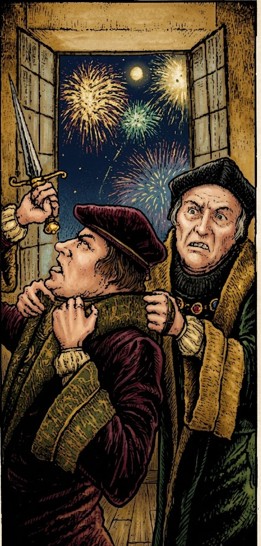
The scene inside is surreal and grotesque. On the fine floor, locked in a desperate struggle for life and death, are two Graf Boris Todbringers. They are identical in every wrinkle, scar, and vestment, so much so that it is impossible to tell who is trying to strangle whom. A short distance away, watching the scene with cold detachment, are Karl-Heinz Wasmeier, an emaciated young man busy chanting arcane formulas, and a deadly, elegant woman: Frau Kenner.
The moment the door crashes open, Wasmeier spins around. A mixture of disbelief and blind fury paints itself across his eyes.
“YOU AGAIN! CURSE YOU!” he roars, pointing a finger trembling with rage at Fredrich. “KILL THEM! KILL THEM ALL!”
Before our heroes can even take a step, Wasmeier raises his hands to the heavens, channeling the raw power of the Great Mutator. Three darts of pure, shifting, distorted energy—colored fuchsia and acid blue—streak through the room targeted at Fredrich and Drumin. The mutation spells strike the two square in the chest. For a terrifying instant, Fredrich’s flesh seems to turn liquid and Drumin’s bones creak under the pressure of unnatural growths. But by sheer luck, sustained by a core of steel and desperate willpower, both manage to resist the cellular collapse, rejecting the touch of Chaos with a cry of pain.
At the exact same moment, Frau Kenner springs forward like a panther. She draws two long, lightning-fast daggers, moving with superhuman, acrobatic grace. With impressive speed, the woman manages to hold off Wolfgang, Waldemar, and Fredrich all at once. Her blades deflect Wolfgang’s heavy swings, slip past the reach of Waldemar’s spear, and force Fredrich onto the defensive, unable to counterattack. She is a dancing fury who seems invincible.
Meanwhile, the third man continues chanting his arcane formulas to unleash a second, devastating spell. But he did not account for the dwarf. Ignoring the lingering pain of the averted mutation, Drumin flings himself at him like a battering ram. The dwarf’s sword cleaves the air with a tremendous whistle and crashes down upon the youth’s shoulder, shattering his collarbone and ribs, silencing his heretical chant instantly. The mage crumples to the floor, dead before he even hits the ground.
Despite the young mage’s death, the situation remains critical. Frau Kenner is slowly gaining the upper hand, pushing the three companions into the corner of the room. Fredrich, gasping for breath and with his blade chipped, realizes the fight is turning for the worse. There is no more room for morals or fear.
Closing his eyes, Fredrich digs deep into his own soul, reaching for that dark, pulsing stain residing within: the gift of Chaos received from his spiritual fusion with Etelka Herzen. An unspeakable shiver runs through his veins. When he reopens his eyes, his pupils are wide and glassy. He extends his hand toward Frau Kenner and unleashes a stream of mutogenic energy nearly identical to the one Wasmeier cast moments before.
The arcane bolt strikes the woman dead-on. Frau Kenner lets out an agonizing shriek as her skin begins to bubble, paralyzing her with pain and breaking her lethal dance. That split second of distraction and agony is all Wolfgang needs: with a rotational sweep of immense power, the veteran swings his sword in a perfect arc, cleanly decapitating the woman. Frau Kenner’s head rolls onto the carpet as her body collapses lifelessly.
As the woman falls, Waldemar runs straight toward the two Grafs locked in combat on the floor, shoving his spear between them to act as a lever and separate them before they kill one another.
At that same moment, Wasmeier, seeing himself stripped of his protectors, tries to retreat toward the balcony to escape. But his path is barred by Drumin. The dwarf, his eyes bloodshot and his mind saturated with the rage built up in that damp cell, lunges at the Law Lord. Wasmeier does not have time to utter a single syllable: Drumin’s sword strikes him repeatedly with a methodical, devastating brutality, cutting him down and killing him almost instantly on the floor of his own conspiracy.
Fredrich, laboriously regaining control of himself after tapping into that forbidden magic, staggers toward the two bodies Waldemar has managed to separate. One of the men stands up clutching his throat, ordering the guards to attack; the other stares at him with eyes full of pure, human terror. Without hesitation, guided by a primal instinct that brooks no argument, Fredrich makes a dash and drives his sword into the chest of one of the two Grafs.
The blade plunges deep, killing him.
Right at that moment, from the large open windows leading to the balcony, an immense roar shakes the room. Outside, the sky is painted in a thousand glittering colors: the final and most grand fireworks display of the Carnival has begun. The shouts of joy, songs, and applause of the celebrating crowd rise from the streets of Middenheim, completely drowning out the sounds of the carnage and the combat that has just ended.
The roar of the fireworks outside has not even finished echoing through the villa’s corridors when the heavy door of the balcony room is beaten down for the second time. The hinges snap under a devastating force.
Through the threshold pours a river of steel and blued plate armor. They are the Knights Panther, the elite knights of the Graf’s personal guard, with their large feline crests and shields raised, followed by a host of light-armored militiamen. Leading them with drawn sword and an eagle gaze burning with wrath is Ulrich Schutzmann himself, the Commander of the City Watch.
Before them lies a scene of butchery: the imperial salon is devastated, strewn with dismembered bodies, blood soaking the precious tapestries, and at the center, our heroes still armed and panting beside the corpse of the false Graf and that of Karl-Heinz Wasmeier.
“Regicide! Treason!” thunders Schutzmann’s brassy voice, drowning out even the detonations of the fireworks that intermittently light up the room. “Knights, protect the sovereign and cut down those heretic dogs! No mercy!”
The Templars charge at the characters like an avalanche of iron. Wolfgang tries to raise his hands in surrender, while Paolino and Fredrich scream at the top of their lungs, pointing to the body on the floor.
“Look at the corpse! It was a mutant, a doppelganger! Wasmeier was the traitor!” Fredrich screams, his voice cracking from exertion and the terror of being hacked to pieces on the spot.
“We were the ones who saved the Graf! Ask him!” Paolino echoes, but his words are drowned out by the clashing armor and the angry shouts of the soldiers. For the Knights Panther and Schutzmann, the scene speaks for itself: five fugitives, escaped from the prisons after assassinating a Law Lord, have forced their way into the sovereign’s private chambers, leaving a trail of dead guards behind them and brandishing bloody blades against the court.
A knight strikes Wolfgang with his shield, sending him crashing to the floor; three others corner Drumin in a vice of halberds, forcing him to drop his sword to avoid being impaled. The Graf, still in shock, pale and trembling against the wall, is immediately surrounded and escorted out by a cord of guards, unable or too weak to utter a single word.
As the soldiers brutally shove him to the ground to chain his wrists, Waldemar ends up on his knees right beside the body of the Graf killed by Fredrich. With one last, desperate reflex, the druid reaches out his gloved hand and touches the still-warm flesh of the corpse.
Activating his magical sensitivity, Waldemar lets his senses slip: the one lying on the ground is indeed the Doppelganger. The weave of mutogenic magic that held it together is unraveling; the human being they saved, whom the Templars are carrying to safety, is, without a shadow of a doubt, the true Graf Boris Todbringer.
Middenheim is saved. The Chaos conspiracy’s coup d’état has been thwarted at the most crucial moment.
But as the cold iron chains clamp violently around the wrists of Waldemar and his companions, dragging them away amidst the kicks and insults of the soldiers, the irony of that triumph reveals itself in all its tragic harshness. No one seems willing to listen to them. Wasmeier is dead, the evidence of the blackmail is buried under mounds of lies, and the word of five fugitives holds no value against the bureaucracy of a wounded city.
Under the lights of the fireworks that continue to paint the sky of Middenheim in festive colors, the iron doors of the deep dungeons swing open once more for our heroes. This time, waiting for them in the dark, is not the promise of an escape, but the looming shadow of an even darker, inescapable fate…
Chiusi nell’oscurità soffocante della carrozza prigione, i nostri eroi sentono il rollio pesante delle ruote sul selciato farsi sempre più ripido, arrampicandosi lungo le pendenze della grande roccia di Middenheim verso il Distretto del Palazzo. A nulla valgono le proteste indignate di Paolino e Waldemar, che tentano invano di far valere la propria innocenza urlando contro le feritoie sbarrate, e ancora meno servono i furiosi tentativi di Drumin di scardinare le catene a testate e spallate, che gli procurano solo lividi e il riso schifato delle guardie di scorta.
Varcato il massiccio cancello di ferro del palazzo centrale, la carrozza si arresta nella corte interna. Qui, i cinque vengono scaricati come sacchi di carbone. Senza troppe cerimonie, spinti dalle picche dei miliziani, vengono gettati nei sotterranei e rinchiusi all’interno di una cella umida, buia e spaventosamente fredda, dove l’unico contatto con il mondo esterno è il gocciolio costante dell’acqua sulle pareti di pietra grigia.
Per almeno due giorni, il silenzio più assoluto avvolge la loro prigionia. Nessuno si presenta per un interrogatorio, nessuno porta loro del cibo degno di questo nome, se non qualche crosta di pane ammuffito e dell’acqua gelida. Nello squallore di quella tomba di pietra, i compagni perdono rapidamente il senso del tempo. Le ore si dilatano, il freddo penetra nelle ossa e la stanchezza mentale rischia di piegare anche i temperamenti più duri.
Poi, all’alba del terzo giorno, quando ormai la disperazione sta per prendere il sopravvento, il pesante chiavistello della cella stride con un rumore sinistro.
La porta si spalanca. Nella penombra della prigione entrano due figure eleganti, scortate da due guardie d’élite della milizia che rimangono rigide e silenziose sull’attenti. Davanti ai prigionieri si stagliano Karl-Heinz Wasmeier e Joachim Höflich. Il loro aspetto è impeccabile, in netto contrasto con il fetore della cella.
Wasmeier fa un passo avanti. Il suo sguardo non è più quello del preoccupato alleato del giorno prima, ma è freddo e tagliente come una ghigliottina. Punta gli occhi direttamente su Fredrich e, con un sorriso intriso di puro veleno, rompe il silenzio:
“Allora, Kastor Lieberung… pensavi davvero di poterti fare gioco di me?”
Fredrich viene colto totalmente di sorpresa. Quel nome, quel maledetto nome che lo perseguita sin dall’inizio del suo viaggio, risuona tra le pareti della cella come una condanna. Tenta di ribattere, balbettando scuse, giurando di non essere la persona che credono, di essere solo Fredrich. Ma Wasmeier lo zittisce con un gesto secco della mano guantata.
Incurante della presenza delle due guardie alle sue spalle—che palesemente non sono semplici soldati, ma membri fidati della congiura—il Signore della Legge inizia a vomitare accuse con spaventosa lucidità. Accusa Kastor/Fredrich di aver tradito la causa, di essere un agente doppiogiochista desideroso solo di sacrificare l’intera cabala e la città stessa a Tzeentch, il Grande Mutatore, per ottenerne i favori divini.
Con flemma diabolica, Wasmeier elenca come intende incastrarli, addossando loro la colpa di ogni singola nefandezza avvenuta a Middenheim:
• L’omicidio di Reiner Ehrlich e della sua piccola nipote: a questo dettaglio, i nostri collegano finalmente l’ultimo, tragico tassello. Era la bambina il fardello che teneva Ehrlich per la gola, ed ora è stata barbaramente assassinata per chiudergli la bocca per sempre.
• La dipendenza del Cancelliere Sparsam: indicata come opera dei loschi traffici di droga del gruppo.
• Il ricatto all’Ar-Ulric: le cui lettere compromettenti verranno fatte ritrovare tra gli effetti personali dei prigionieri.
In sintesi, Wasmeier ha deciso di usare Fredrich e i suoi compagni come il perfetto capro espiatorio. Un gruppo di fanatici eretici, assassini e cospiratori venuti da fuori per seminare il caos.
“Non ci sarà nemmeno bisogno di un processo,” sussurra Wasmeier, avvicinandosi alle sbarre. “Ho già preparato ogni cosa. Sarà il Graf in persona, sconvolto da tale orrore, a firmare la vostra condanna a morte immediata. Sarete giustiziati prima che la città possa anche solo pronunciare i vostri veri nomi.”
Waldemar, stringendo i pugni fino a farsi sanguinare le nocche, sputa a terra: “Il Graf non crederà mai a una simile montatura! Non è un folle, pretenderà di vederci, di ascoltarci!”
A quel punto, Joachim Höflich fa un passo avanti, lasciandosi sfuggire una risata sommessa e vibrante, che non ha nulla di umano.
Sotto gli occhi sbarrati e terrorizzati dei nostri eroi, il corpo del secondo Signore della Legge inizia a deformarsi. I suoi lineamenti nobili si sciolgono come cera al sole; le ossa scricchiolano e si riposizionano con rumori secchi e disgustosi; i capelli si diradano e imbiancano, mentre la statura si curva leggermente, assumendo una maestosità logorata dagli anni.
In pochi, interminabili secondi di puro orrore magico, l’uomo davanti a loro svanisce. Al suo posto vi è Graf Boris Todbringer, perfetto in ogni minimo dettaglio: la stessa cicatrice sull’occhio, la stessa postura fiera, persino lo stesso identico timbro di voce profondo e stanco.
Un Doppelganger.
La copia esatta del sovrano di Middenheim fissa i prigionieri con un sorriso beffardo. Ora, nell’oscurità di quella cella umida, l’immenso e mostruoso disegno dei cospiratori si palesa in tutta la sua terrificante chiarezza: il vero Graf è già stato sostituito, o lo sarà a breve. I cultisti del Caos non vogliono solo distruggere Middenheim con la violenza; vogliono governarla dall’interno, guidando la città e l’intero Impero verso una lenta, discreta e inevitabile rovina.
Abbandonati nuovamente nel buio e nel gelo della cella, con il pesante cigolio della porta di ferro che risuona come una pietra tombale sulle loro vite, i nostri eroi si abbandonano alla disperazione più nera. Il disegno dei cospiratori è perfetto, inattaccabile, e loro sono solo pedine sacrificali destinate al boia.
Passa un altro giorno intero di silenzio e digiuno, il penultimo prima della fine del carnevale. Poi, nel tardo pomeriggio, i passi pesanti di una guardia si arrestano davanti alla cella, accompagnando una figura avvolta in una pesante tunica nera e con il volto completamente celato da un profondo cappuccio scuro: un sacerdote di Morr, giunto per amministrare l’estrema unzione e recitare le preghiere per i condannati a morte.
La guardia si allontana di qualche passo lungo il corridoio, lasciando al religioso la giusta riservatezza con i morituri. Non appena il soldato è fuori portata d’orecchio, il prete si avvicina alle sbarre e solleva lentamente il cappuccio. Sotto il tessuto nero, i nostri riconoscono immediatamente i tratti affilati di Quintus, l’agente dei Grau Mantel.
Sussurrando febbrilmente per non farsi sentire, Quintus esige di sapere ogni cosa. Con il fiato sospeso, i compagni gli riferiscono l’agghiacciante verità: il tradimento di Wasmeier, l’omicidio di Ehrlich imputato a loro e, soprattutto, l’esistenza del Doppelganger pronto a sostituire il sovrano.
L’agente dei Servizi Segreti imperiali annuisce, il volto teso in una maschera di pura gravità:
“Questo spiega tutto,” sussurra Quintus. “I miei uomini hanno notato strani e improvvisi cambi di guardia nei pressi degli appartamenti privati del Graf. I soldati più fedeli vengono riassegnati, sostituiti da volti nuovi… o da uomini che rispondono solo a Wasmeier.”
Collegando i dettagli nei pochissimi minuti a disposizione, il quadro si delinea con terrificante precisione: Wasmeier intende compiere la sostituzione definitiva del Graf Boris Todbringer durante la notte dei fuochi d’artificio, l’evento conclusivo dell’ultimo giorno di Carnevale, sfruttando il frastuono, le luci e la distrazione dell’intera città per consumare il colpo di Stato senza destare sospetti.
Le prigioni sono impenetrabili e un’evasione di forza è fuori discussione. Ma Quintus ha un piano. Un piano folle, estremo e con ogni probabilità fatale, ma l’unico e ultimo binario percorribile per evitare la catastrofe.
Infilando la mano in una tasca interna della tunica da cerimonia, l’agente ne estrae alcuni bastoncini nerastri, dall’odore dolciastro e pungente. Drumin e Waldemar, esperti di erbe e veleni, riconoscono immediatamente la radice di Belladonna.
“Se ingerita nelle giuste dosi, questa radice induce uno stato di coma profondo, rallentando il battito cardiaco e il respiro fino a renderli impercettibili,” spiega Quintus con voce ferma ma tesa. “Agli occhi delle guardie e del cerusico imperiale risulterete morti, stroncati dal freddo o da una febbre improvvisa. Come da protocollo per i condannati deceduti prima dell’esecuzione, i vostri corpi verranno portati fuori dalle celle e trasferiti direttamente all’obitorio sotterraneo del tempio di Morr.”
Quintus fa una pausa, guardandoli uno a uno negli occhi:
“Lì vi risveglierete probabilmente a poche ore dalla mezzanotte dell’ultimo giorno di carnevale.Farò di tutto per farvi trovare armi. Da li raggiungerete la villa del Graf attraversando la corte esterna sfruttando le ombre della notte.. Farete irruzione nella residenza reale facendovi strada con le spade e salverete il Graf Boris dal Doppelganger e da Wasmeier. Le probabilità di sopravvivere sono misere, ma se non lo facciamo, Middenheim cadrà.”
Lo sguardo dei compagni attraversa la penombra della cella. Nessuno parla per qualche istante. La prospettiva di ingerire un veleno letale fidandosi di un risveglio controllato in un obitorio è spaventosa. Eppure, non c’è scelta. Nessuno si tira indietro. Uno alla volta, i cinque afferrano i bastoncini neri e li masticano, deglutendo il sapore amaro della belladonna.
Quintus annuisce solennemente, si rimette il cappuccio sul volto e richiama la guardia con un tono sommesso, recitando un’ultima, finta benedizione in lingua classica prima di allontanarsi lungo il corridoio.
Nell’arco di due ore, il potente veleno inizia a fare effetto. La vista dei compagni si appanna, le membra diventano pesanti come piombo e il gelo della cella sembra improvvisamente svanire, sostituito da un torpore invincibile. Uno dopo l’altro, i nostri eroi si accasciano sul pavimento di pietra. I battiti rallentano fino a fermarsi, il respiro si spegne.
La morte, apparente ma indistinguibile da quella reale, cala sulla cella dei condannati. Il piano ha inizio.
Il gelo che avvolgeva le loro membra inizia a diradarsi lentamente, sostituito da un brivido bruciante che risale lungo la spina dorsale. Il primo a riaprire gli occhi, tossendo e cercando disperatamente aria, è Waldemar, seguito a ruota dagli altri. Si guardano intorno, faticando a mettere a fuoco. Non c’è nessuna candela accesa, nessun sussurro di conforto. Quintus non c’è.
. Muovendosi a tentoni tra i tavoli anatomici di pietra e l’odore pungente di incenso funebre, i compagni trovano un telo ruvido in un angolo buio. Sotto di esso, nascosti alla bell’e meglio, ci sono i loro vestiti e, soprattutto, le loro spade.
Salite con cautela le scale di pietra che conducono fuori dai sotterranei del tempio, i compagni forzano la serratura di una porta di legno rinforzata che si apre sul retro del complesso, a ridosso della grande piazza d’armi del palazzo.
Spalancato lo spiraglio, l’aria gelida della notte sferza i loro volti. All’esterno, la piazza d’armi si presenta insolitamente deserta, quasi spettrale. Le torce nei bracieri proiettano ombre lunghe e danzanti sulle mura di pietra, ma non si vede l’ombra di una ronda. La quiete, tuttavia, è solo un’illusione.
Nell’aria, rimbombante e cupo, si avverte il boato distante ma immenso della folla che festeggia nelle strade di Middenheim. E poi, all’improvviso, un fischio acuto squarcia il cielo, seguito da una detonazione che fa tremare i vetri delle finestre alte: una pioggia di scintille rosse e verdi illumina a giorno le nubi sopra la città. I fuochi d’artificio sono iniziati. La notte dell’ultimo giorno di Carnevale è giunta, e con essa l’ora del Doppelganger.
“Siamo soli. Dobbiamo muoverci, e alla svelta,” sussurra Fredrich, stringendo l’elsa della spada ma pensando alle balestre e alle armi da fuoco che avrebbero potuto bilanciare lo scontro imminente.
Sfruttando il frastuono dei fuochi d’artificio e le ombre lunghe proiettate dai bastioni, i cinque si muovono rapidi. È Drumin a guidare la fila. il nano, abituato da una vita a muoversi nei cunicoli sotterranei e nei passaggi più angusti, mostra un’abilità quasi soprannaturale nel leggere l’oscurità. Scivola da un angolo all’altro della piazza d’armi, calcolando i tempi di rotazione delle lanterne delle sentinelle con precisione matematica. I compagni lo seguono come spettri, schivando due pattuglie per un soffio, fino a raggiungere l’imbocco delle ripide scale di pietra che conducono alla villa del Graf.
Ad attenderli sul porticato ci sono due guardie d’élite. Non indossano i colori della normale milizia, ma le livree nere e oro dei corpi scelti, ormai palesemente al servizio di Wasmeier. Non appena le sagome dei nostri emergono dalle scale, i soldati non fanno domande: sguainano le spade corte e si lanciano all’attacco con ferocia assassina.
Lo scontro è fulmineo e brutale. Waldemar, ancora indebolito dalla ferita della notte precedente, tenta di tenere a bada il primo assalitore con l’allungo della sua lancia. Ma il soldato di Wasmeier è un professionista: con un colpo secco dello scudo devia la punta dell’arma e balza in avanti, sferrando un affondo dritto al petto del druido. Nello stesso istante, la seconda guardia piomba su Paolino. L’halfling, privo delle sue amate pistole, tenta di schivare all’indietro, ma lo spazio è stretto; la lama del soldato fende l’aria e lo colpisce di striscio alla spalla, facendolo rovinare a terra, con la punta della spada nemica già sollevata per il colpo di grazia.
La morte per i due è questione di millesimi di secondo, ma la reazione dei veterani è devastante:
• Wolfgang si frappone tra Waldemar e la morte. Con un ruggito, devia la lama nemica a pochi centimetri dal cuore del druido e, sfruttando lo slancio, affonda la sua spada dritta nella gola della guardia. Il sangue sprizza caldo sul marmo, mentre l’uomo rantola e stramazza al suolo.
• Drumin, nel frattempo, compie un balzo laterale degno di un cinghiale infuriato. La sua ascia pesante intercetta la spada che stava per trafiggere Paolino, spezzandola di netto all’altezza dell’elsa. Prima che il soldato possa comprendere cosa sia accaduto, la lama nanica compie un arco ascendente, spaccandogli la mascella e ponendo fine alla sua vita sul colpo.
Senza fermarsi a riprendere fiato, Wolfgang si scaglia contro il massiccio portone d’ingresso in legno di quercia borchiato. Con un calcio di inaudita violenza, sfruttando tutto il suo peso e la spinta dell’armatura, scardina la serratura. Il portone si spalanca verso l’interno con un fragore tremendo, rimbombando nell’ampio atrio della villa.
All’interno, l’atrio è sfarzoso, illuminato da grandi candelabri d’argento, ma l’atmosfera è spettrale. Tre guardie della congiura, allertate dal baccano all’esterno, sono già schierate a ventaglio con le spade pronte, i volti tesi e spietati.
“Intrusi! Abbatteteli!” urla quello al centro, lanciandosi in avanti.
Lo spazio ristretto dell’ingresso si trasforma immediatamente in un tritacarne di acciaio e urla. I tre soldati tentano di sfruttare la superiorità numerica immediata sulla soglia, ma i nostri non arretrano di un millimetro.
La prima guardia si scontra direttamente con Drumin. Il nano incassa l’impatto, fa perno sulle gambe corte e massicce e colpisce il ginocchio dell’avversario, frantumandoglielo; mentre l’uomo cade urlando, Drumin gli pianta l’ascia nel cranio con un colpo secco e metodico.
Le altre due guardie ingaggiano un duello serrato con Wolfgang e Fredrich. Uno dei soldati tenta una finta bassa per sorprendere Wolfgang, ma il veterano anticipa la mossa: schiva lateralmente e, con un movimento fluido e spietato, gli mozza la mano destra. La spada del soldato cade sul pavimento insieme all’arto amputato, seguita un attimo dopo dal corpo dell’uomo, finito da un fendente al cuore.
L’ultimo rimasto, terrorizzato dalla rapidità con cui i suoi compagni sono stati fatti a pezzi, tenta di arretrare verso lo scalone monumentale per dare l’allarme. Fredrich, tuttavia, non gliene dà il tempo. Con uno scatto d’ira accumulato in giorni di prigionia e accuse ingiuste, lo raggiunge alle spalle e gli passa la lama da parte a parte, trapassandogli la schiena. Il soldato si accascia sui primi gradini di velluto rosso, macchiandoli di un brivido scarlatto.
Salendo le scale monumentali a rotta di collo, i cinque compagni lasciano alle spalle la scia di sangue e i gradini di velluto per avventurarsi nei corridoi del piano superiore. Guidati dal rumore soffocato di urla e metallo, raggiungono le porte doppie degli appartamenti privati. Con una spallata coordinata di Wolfgang e Drumin, i battenti si spalancano con violenza, rivelando la stanza che dà sul grande balcone panoramico.
La scena all’interno è surreale e grottesca. Sul pavimento pregiato, avvinghiati in una lotta disperata alla vita e alla morte, ci sono due Graf Boris Todbringer. Sono identici in ogni ruga, cicatrice e paramento, tanto che è impossibile capire chi stia tentando di strangolare chi. Poco distante, ad assistere alla scena con freddo distacco, ci sono Karl-Heinz Wasmeier, un giovane uomo dall’aria emaciata intento a salmodiare formule arcane, e una donna letale ed elegante: Frau Kenner.
Non appena la porta si abbatte, Wasmeier si volta. Nei suoi occhi si dipinge un misto di incredulità e furia cieca.
“ANCORA TU! MALEDETTO!” ruggisce, puntando il dito tremante d’ira contro Fredrich. “UCCIDETELI! UCCIDETELI TUTTI!”
Prima ancora che i nostri possano fare un passo, Wasmeier solleva le mani al cielo, evocando il potere grezzo del Grande Mutatore. Tre dardi di pura energia cangiante e distorta, color fucsia e azzurro acido, sfrecciano nella stanza diretti a Fredrich e Drumin. Gli incantesimi di mutazione colpiscono i due in pieno petto. Per un istante terrificante, la carne di Fredrich sembra farsi liquida e le ossa di Drumin scricchiolano sotto la spinta di innaturali escrescenze. Ma per pura fortuna, sorretti da una fibra d’acciaio e da una disperata forza di volontà, entrambi riescono a resistere al collasso cellulare, rigettando il tocco del Caos con un grido di dolore.
Nello stesso momento, Frau Kenner si lancia in avanti come una pantera. Sguaina due pugnali lunghi e fulminei, muovendosi con una grazia acrobatica sovrumana. Con una rapidità impressionante, la donna riesce a tenere testa contemporaneamente a Wolfgang, Waldemar e Fredrich. Le sue lame deviano i fendenti pesanti di Wolfgang, schivano l’allungo della lama di Waldemar e costringono Fredrich sulla difensiva, impossibilitato a contrattaccare. È una furia danzante che sembra imbattibile.
Nel frattempo, il terzo uomo continua a salmodiare formule arcane per lanciare un secondo, devastante incantesimo. Ma non ha fatto i conti con il nano. Ignorando il dolore della mutazione sventata, Drumin si scaglia contro di lui come un ariete. La spada del nano fende l’aria con un fischio tremendo e si abbatte sulla spalla del giovane, spaccando clavicola e costole e spegnendo la sua cantilena eretica sul colpo. Il mago stramazza al suolo, morto prima ancora di toccare terra.
Nonostante la morte del giovane mago, la situazione resta critica. Frau Kenner sta lentamente prendendo il sopravvento, spingendo i tre compagni verso l’angolo della stanza. Fredrich, con il respiro affannoso e la lama scheggiata, capisce che lo scontro sta andando per il peggio. Non c’è più spazio per la morale o la paura.
Chiudendo gli occhi, Fredrich scava nel profondo della propria anima, andando a toccare quella macchia nera e pulsante che vi risiede: il dono del Caos ricevuto dalla fusione spirituale con Etelka Herzen. Un brivido indicibile gli attraversa le vene. Quando riapre gli occhi, le sue pupille sono sbarrate e lucide. Distende la mano verso Frau Kenner e rilascia un flusso di energia mutogena del tutto simile a quello scagliato poco prima da Wasmeier.
Il dardo arcano colpisce in pieno la donna. Frau Kenner emette un grido straziante mentre la sua pelle inizia a ribollire, paralizzandola dal dolore e spezzando la sua danza letale. Quella frazione di secondo di distrazione e agonia è tutto ciò che serve a Wolfgang: con un fendente rotatorio di inaudita potenza, il veterano fa compiere alla sua spada un arco perfetto, decapitando netta la donna. La testa di Frau Kenner rotola sul tappeto mentre il corpo crolla inanimato.
Mentre la donna cade, Waldemar corre dritto verso i due Graf avvinghiati sul pavimento, inserendosi tra di loro con la lancia per fare leva e separarli prima che si uccidano a vicenda.
Nello stesso istante, Wasmeier, vistosi privato dei suoi protettori, tenta di arretrare verso il balcone per fuggire. Ma la via gli è sbarrata da Drumin. Il nano, gli occhi iniettati di sangue e la mente satura della furia accumulata in quella cella umida, si scaglia sul Signore della Legge. Wasmeier non ha il tempo di pronunciare una sola sillaba: la spada di Drumin lo colpisce ripetutamente con una brutalità metodica e devastante, abbattendolo e uccidendolo quasi sul colpo sul pavimento della sua stessa congiura.
Fredrich, riprendendo faticosamente il controllo di sé dopo aver attinto a quella magia proibita, barcolla verso i due corpi che Waldemar è riuscito a dividere. Uno dei due uomini si alza tenendosi la gola, ordinando alle guardie di attaccare; l’altro lo fissa con occhi colmi di puro terrore umano. Senza esitare, guidato da un istinto primordiale che non ammette repliche, Fredrich compie uno scatto e pianta la spada nel petto di uno dei due Graf.
La lama penetra in profondità,uccidendolo.
Proprio in quel momento, dalle grandi finestre spalancate sul balcone, un boato immenso scuote la stanza. Fuori, il cielo si tinge di mille colori sfavillanti: l’ultimo e più grandioso spettacolo dei fuochi d’artificio del Carnevale è iniziato. Le grida di giubilo, i canti e gli applausi della folla festante salgono dalle strade di Middenheim, coprendo del tutto i rumori della carneficina e dello scontro appena terminato.
Il boato dei fuochi d’artificio all’esterno non ha ancora finito di echeggiare nei corridoi della villa che il pesante portone della stanza del balcone viene abbattuto per la seconda volta. I cardini cedono di schianto sotto una spinta devastante.
Dalla soglia irrompe un fiume d’acciaio e piastre azzurrate. Sono i Templari della Pantera, i cavalieri d’élite della guardia personale del Graf, con i grandi cimieri felini e gli scudi imbracciati, seguiti da una schiera di miliziani in armatura leggera. A guidarli, con la spada sguainata e lo sguardo d’aquila infuocato d’ira, c’è Ulrich Schutzmann in persona, il Comandante della Vigilanza cittadina.
Davanti a loro si presenta uno scenario da macello: il salone imperiale è devastato, cosparso di corpi smembrati, sangue che impregna i preziosi arazzi e, al centro, i nostri eroi ancora armati e ansimanti accanto al cadavere del finto Graf e a quello di Karl-Heinz Wasmeier.
“Regicidio! Tradimento!” tuona la voce d’ottone di Schutzmann, sovrastando persino le detonazioni dei fuochi d’artificio che illuminano la stanza a intermittenza. “Cavalieri, proteggete il sovrano e abbattete quei cani eretici! Nessuna pietà!”
I Templari si avventano sui personaggi come una valanga di ferro. Wolfgang tenta di sollevare le mani in segno di resa, mentre Paolino e Fredrich gridano a squarciagola, indicando il corpo sul pavimento.
“Guardate il cadavere! Era un mutante, un doppelganger! Wasmeier era il traditore!” urla Fredrich, con la voce rotta dallo sforzo e dal terrore di essere fatto a pezzi sul posto.
“Siamo stati noi a salvare il Graf! Chiedetelo a lui!” gli fa eco Paolino, ma le sue parole vengono soffocate dal clangore delle armature e dalle grida di rabbia dei soldati. Per i Templari della Pantera e per Schutzmann, la scena parla da sola: cinque fuggitivi, evasi dalle prigioni dopo aver assassinato un Signore della Legge, sono penetrati con la forza nelle stanze private del sovrano, lasciando dietro di sé una scia di guardie morte e brandendo lame insanguinate contro la corte.
Un cavaliere colpisce Wolfgang con lo scudo, facendolo rovinare a terra; altri tre stringono Drumin in una morsa di alabarde, costringendolo a gettare la spada per non essere infilzato. Il Graf, ancora sotto shock, pallido e tremante contro la parete, viene immediatamente circondato e scortato all’esterno da un cordone di guardie, incapace o troppo debole per proferire parola
Mentre i soldati lo spingono brutalmente al suolo per incatenargli i polsi, Waldemar finisce ginocchioni proprio accanto al corpo del Graf ucciso da Fredrich. Con un ultimo, disperato riflesso, il druido allunga la mano guantata e tocca la carne ancora tiepida del cadavere.
Attivando la sua sensibilità magica, Waldemar lascia che i suoi sensi scivolino : quello che giace a terra è effettivamente il Doppelganger. La trama di magia mutogena che lo teneva in piedi si sta sfaldando; l’essere umano che hanno salvato e che i Templari stanno portando al sicuro è, senza ombra di dubbio, il vero Graf Boris Todbringer.
Middenheim è salva. Il colpo di Stato della congiura del Caos è stato sventato nel momento più cruciale.
Ma mentre le catene di ferro freddo si serrano con violenza attorno ai polsi di Waldemar e dei suoi compagni, trascinandoli via tra i calci e gli insulti dei soldati, l’ironia di quel trionfo si rivela in tutta la sua tragica durezza. Nessuno sembra intenzionato ad ascoltarli. Wasmeier è morto, le prove del ricatto sono sepolte sotto cumuli di menzogne e la parola di cinque fuggiaschi non ha alcun valore contro la burocrazia di una città ferita.
Sotto le luci dei fuochi d’artificio che continuano a colorare a festa il cielo di Middenheim, per i nostri eroi si riaprono le porte di ferro delle prigioni sotterranee. Questa volta, ad attenderli nell’oscurità, non c’è la promessa di una fuga, ma l’ombra opprimente di un destino ancora più oscuro e senza via d’uscita..


Leave a Reply