Having regained their strength in Unterbaum, the group stands at a crossroads of destiny. Three potential paths lie before them: stay on the trail of the Witch Hunter to save Martha, head north to Middenheim to strike at the inner circle of the Tzeentch cult, or finish the game in the Reikland by heading to Wittgendorf in search of Etelka and Gottard.
The decision is a difficult one, but in the end, duty prevails: they choose to hunt down Etelka and Gottard. Before facing the horror, however, the group decides on a tactical stop in Kemperbad. Among the markets of the Free City, they purchase medicinal herbs, antidotes, and heavy equipment, preparing for what they feel will be a mortal struggle with the witch of Nuln.
During their time in the city, Waldemar tries to gather more information about the Wittgensteins, but he is met with a wall of silence and downcast eyes. The entire county seems to have chosen absolute isolationism. No one knows anything about Wittgendorf, save for one sinister constant: it is an unhealthy area, a place to be avoided like the plague.
Finally, after a few days of preparation, the group resumes their voyage, sailing down the Reik toward Nuln. Around noon, as they enter the borders of the Barony of Wittgenstein, the atmosphere changes drastically. The waters of the Reik, which had already appeared murky weeks before, have here become fetid and yellowish, covered by a shiny, slimy film that looks like the excretion of a diseased organism. The trees along the banks are skeletal, their branches twisted in unnatural agony. Waldemar feels a deep nausea: the corruption of the surrounding nature is such that the druid somatizes the pain, feeling the world’s life force flickering out beneath his feet. It is evident to all that the power of the meteorite is at its peak here.
Landing at an isolated pier, half-devoured by rotting vegetation that seems to want to swallow the sodden wood, the group looks up. Towering above them, perched on a spur of dark rock dominating the river, stands Castle Wittgenstein.
The castle resembles none of the glorious Imperial fortresses. It is a mass of dark, angular stone that looks as if it were vomited from the earth itself rather than built by human hands. Its walls are covered in blackish mold and vines that, instead of being green, are the color of clotted blood. The towers, asymmetrical and with roofs as sharp as talons, claw at the perpetually leaden sky. A sickly mist, thick and with a vague scent of ozone and decomposition, surrounds the base of the fortress, making it difficult to tell where the rock ends and the masonry begins. The windows are like empty eye sockets, and the entire structure exudes a sense of oppression that makes one’s limbs tremble.
The group decides to wait, taking cover among the remains of a dying woodland grove to observe the movements of the fortress.
Fredrich: “I see movement on the walls. Up there, near the watchtower… and there, in the inner courtyard.”
Wolfgang: “How many?”
Fredrich: “Few. Far too few for a castle of this size. They look like thin silhouettes, with stiff movements. But it’s not uninhabited…”
Drumin: (Clutching the handle of his hammer) “Few or many, that place reeks of dark magic from a mile away. If the witch is in there, we need to get in before she finishes distilling her poison.”
Waldemar: (With a gasp of pain, pressing his hand to his chest) “We must hurry. The earth here is screaming… and its cries are tearing my heart apart.”
The group remains in wait, concealed by the fog, planning their infiltration as the shadow of the castle stretches over them like a shroud.
Following the narrow path that leads from the pier into the thick of the forest, the group walks for about half an hour until they reach a dilapidated village. Wittgendorf is the very image of despair. It is a crumbling jumble of buildings that seem to support one another only by sheer inertia. At the center, a small Church of Sigmar stands as a broken warning: the roof has collapsed, the stones are blackened by an old fire, and the windows are blind sockets staring into the void. Some houses are clearly abandoned, their cracked walls revealing empty interiors; others have heavy wooden planks nailed over the windows, as if the inhabitants wanted to keep out not just the light, but the entire world.
As soon as they cross the town limits, the group is swamped. Not by monsters, but by a swarm of beggars reduced to human shadows. They have hollowed faces, glassy eyes, and obvious physical deformities: limbs of different lengths, skin growths, extra fingers. They beg for food with hoarse voices. Waldemar, moved by a compassion that has not yet reckoned with the ferocity of this place, pulls out a travel ration. But he doesn’t have time to break it.
In an instant, pity turns to chaos. The beggars hurl themselves at him like ravenous wolves. Waldemar only manages to stay on his feet thanks to a lightning reflex, while a brutal melee explodes around him as the beggars fight, scratch, and bite each other in the mud for a piece of dry bread. Horrified, the heroes flee from that degrading scene, pushing further into streets oozing with sewage.
Further on, near a well in a ramshackle square, they see a woman. She is sitting on the ground, weeping desperately, clutching a bundle to her chest. Waldemar and Drumin, hoping to find a shred of humanity, approach her. Wolfgang, meanwhile, slips into a shadow between two houses, vanishing from sight to act as a sentry.
The woman looks up, her face streaked with tears. “Help me… please. My baby is sick. Doctor Rosseaux says he can do nothing, but you… you come from outside…”
Waldemar leans down to look into the bundle, followed by Drumin. What they see freezes their blood. The infant is not human. Its skin is a sickly grey, translucent like wet parchment, and a huge black spider seems to be emerging from its mouth, in symbiosis with it. The face is a tangle of distorted features. It is too much, truly too much.
Drumin recoils in primal terror, cursing loudly in Khazalid: “Umgi-Krut! Grungni protect us from this blasphemy!” Waldemar, whose connection to nature is too deep to withstand such a distortion of life, collapses to the ground in a faint. The woman, terrified by their reaction, flees clutching the bundle and huddles inside a house, barring the door.
Fredrich rushes to Waldemar’s aid, waking him with two sharp slaps. When the young druid opens his eyes, Fredrich notices with horror that a lock of his hair has suddenly turned white as snow: the indelible mark of the shock he suffered. While Waldemar tries to stand, a group of ragged men runs across the street chasing a two-headed sheep that bleats in unison. They brandish rusty knives, determined to devour the poor mutated beast.
“This place is beyond redemption,” Wolfgang whispers from the shadows.
Supporting Waldemar, the group continues to the square of the abandoned church, where the creaking sign of an inn promises shelter. The interior is simple but, by Wittgendorf standards, almost clean. The innkeeper, Herbert, welcomes them with a weary look. He avoids offering them the wine that two other patrons—lost in a dull stupor with evident nervous tics—are drinking. Instead, he pours them some Bretonnian gin.
Fredrich, however, notices the label on the wine bottles: “Wittgenstein Beste.” It is the sweetened must, Etelka’s poison. “Doctor Rosseaux provides it,” Herbert explains in a low voice. “He says it’s a panacea for the ills that afflict us. At least it makes them forget the hunger and the pain.”
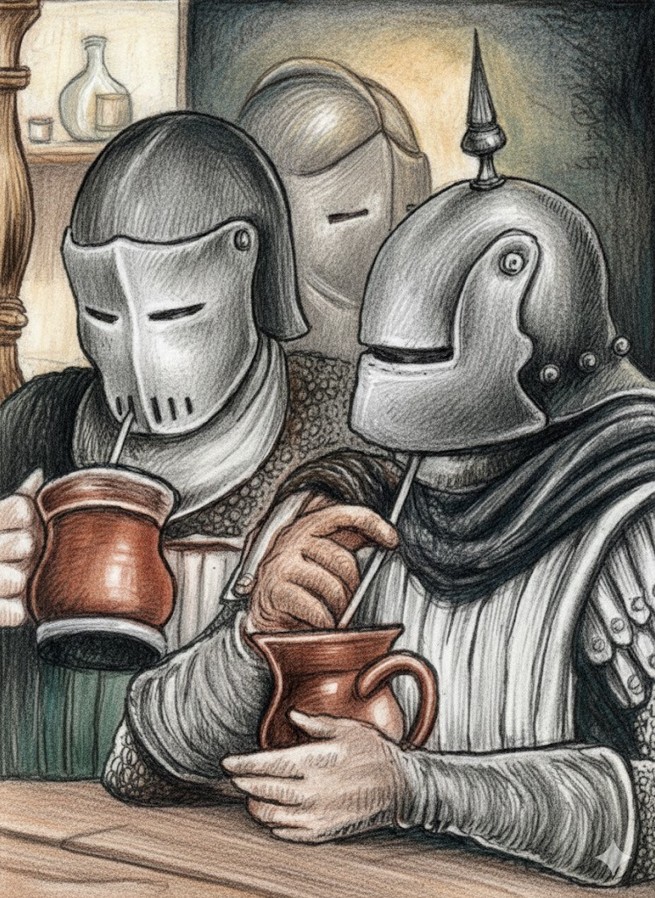
They don’t even have time to wet their lips with the gin before the door is kicked open with violence. Five guards enter, imposing figures completely covered in rusted chainmail armor. Their faces are hidden behind closed visors, and with them comes a sweet, revolting stench of rotting meat. With contemptuous gestures, they approach the bar. Instead of removing their helmets, they use metal straws poked through the slits in their visors to suck up their beer.
The leader, a man who introduces himself as Sergeant Kratz, sizes up the heroes with arrogance. “Travelers, eh? In a place like this? Who are you and what do you seek?” Without waiting for a convincing answer, Kratz slams his steel gauntlet onto the wooden counter. “There’s a residence tax in Wittgendorf. Ten gold crowns a head. Pay now, or be deemed vagabonds and spies.”
The amount is absurd. The group’s refusal is immediate, and the tension in the room rises to a breaking point. A “Mexican standoff” ensues: hands move to sword hilts and hammer grips. Herbert tries to intervene to calm things down, but Kratz silences him with a vulgar insult, his eyes never leaving the group.
Fredrich, trying to play it smart, claims they are looking for work. Kratz smiles under his helmet, a metallic and unpleasant sound. “Work? There’s always a need for strong arms at the castle… Come with me and we’ll talk to those in charge.” Fredrich even offers a song to ease the nerves, but the offer falls on deaf ears. However, when Fredrich casually mentions the Berebelli—Joaquin’s ship, Waldemar’s friend—something changes. The guards exchange a quick look behind their visors. There is a moment of unnatural silence: that name has sparked a sudden and sinister interest in them.
The situation, however, remains deadlocked. “Pay the ten crowns,” Kratz snarls, “or follow us to the castle. Now.”
Wolfgang observes the guards’ posture: despite the smell of rot, they move with impeccable coordination. They are professional soldiers, trained and ready to kill at the slightest signal. The heroes’ nerves are stretched like violin strings…
Recuperate le forze a Unterbaum, il gruppo si ritrova davanti a un bivio del destino. Le potenziali strade da prendere sono tre: inseguire il Cacciatore di Streghe per strappargli Martha, dirigersi a nord verso Middenheim per colpire il cuore del Circolo Interno del culto di Tzeentch, o chiudere una volta per tutte la partita nel Reikland puntando verso Wittgendorf.
La decisione è sofferta, ma alla fine prevale il senso del dovere: si sceglie di dare la caccia a Etelka e Gottard. Prima di affrontare l’orrore, però, il gruppo decide per una sosta tattica a Kemperbad. Tra i mercati della città libera, acquistano erbe officinali, antidoti ed equipaggiamento pesante, preparandosi a quello che sentono sarà uno scontro mortale con la strega di Nuln.
Nel tempo trascorso in città, Waldemar prova a raccogliere informazioni sui Wittgestein, ma si scontra con un muro di silenzio e sguardi bassi. L’intera contea sembra aver scelto un isolazionismo assoluto. Nessuno sa nulla di Wittgendorf, salvo un’unica, sinistra costante: è un’area malsana, un luogo da evitare come la peste.
Finalmente, dopo qualche giorno di preparativi, il gruppo riprende la navigazione scendendo il Reik in direzione Nuln. Intorno a mezzogiorno, quando entrano nei confini della baronia di Wittgestein, l’atmosfera cambia drasticamente. Le acque del Reik, che già apparivano torbide settimane prima, qui sono diventate fetide e giallastre, coperte da una patina lucida e limacciosa che sembra l’escrezione di un organismo malato. Gli alberi lungo le rive sono scheletrici, i rami contorti in angosce innaturali. Waldemar avverte una nausea profonda: la corruzione della natura circostante è tale che il druido ne somatizza il dolore, sentendo la linfa vitale del mondo spegnersi sotto i suoi piedi. È evidente che qui il potere del meteorite è al suo apice.
Approdati a un molo isolato, seminascosto da una vegetazione marcescente che sembra voler divorare il legno fradicio, il gruppo alza lo sguardo. Sopra di loro, abbarbicato su uno sperone di roccia scura che domina il fiume, si erge il Castello dei Wittgestein.
Il castello non somiglia a nessuna delle gloriose fortezze imperiali. È una massa di pietra scura e angolosa che sembra essere stata vomitata dalla terra stessa piuttosto che costruita da mani umane. Le sue mura sono coperte da una muffa nerastra e rampicanti che, invece di essere verdi, hanno il colore del sangue rappreso. Le torri, asimmetriche e dai tetti aguzzi come artigli, graffiano il cielo perennemente plumbeo. Una foschia malsana, densa e dal vago odore di ozono e decomposizione, circonda la base della fortezza, rendendo difficile distinguere dove finisca la roccia e dove inizi la muratura. Le finestre sono come orbite vuote, e l’intera struttura emana un senso di oppressione che fa tremare le membra.
Il gruppo decide di attendere, appostandosi tra i resti di una macchia boscosa morente per osservare i movimenti della fortezza.
Fredrich: “Vedo movimento sulle mura. Lassù, vicino alla torre di guardia… e lì, nel cortile interno.”
Wolfgang: “Quanti sono?”
Fredrich: “Pochi. Troppo pochi per un castello di queste dimensioni. Sembrano sagome magre, dai movimenti rigidi. Ma non è disabitato…a.”
Drumin: (Stringendo l’impugnatura del martello) “Pochi o tanti, quel posto puzza di magia nera lontano un miglio. Se la strega è lì dentro, dobbiamo entrare prima che finisca di distillare il suo veleno.”
Waldemar: (Con un sussulto di dolore, premendosi la mano sul petto) “Dobbiamo fare in fretta. La terra qui sta urlando… e le sue grida mi stanno lacerando il cuore.”
Il gruppo rimane in attesa, celato dalla nebbia, pianificando l’infiltrazione mentre l’ombra del castello si allunga su di loro come un sudario.
Seguendo lo stradellino che scende dal molo verso il fitto della foresta, il gruppo cammina per circa mezz’ora. L’aria si fa sempre più pesante, satura di un odore di muffa e ristagno, finché tra gli alberi malati non emergono le prime sagome di Wittgendorf.
Il villaggio è l’immagine stessa della disperazione. È un ammasso fatiscente di edifici che sembrano sorreggersi l’un l’altro solo per inerzia. Al centro, una chiesetta di Sigmar svetta come un monito infranto: il tetto è crollato, le pietre sono annerite da un vecchio incendio e le vetrate sono orbite cieche spalancate sul vuoto. Molte case sono palesemente abbandonate, i muri crepati che rivelano interni spogli; altre hanno pesanti assi di legno inchiodate alle finestre, come se gli abitanti volessero tenere fuori non solo la luce, ma il mondo intero.
Non appena varcano il limitare dell’abitato, il gruppo viene assalito. Non da mostri, ma da un nugolo di mendicanti ridotti a ombre umane. Hanno volti scavati, occhi vitrei e deformità fisiche evidenti: arti di lunghezze diverse, escrescenze cutanee, dita in soprannumero. Implorano cibo con voci roche. Waldemar, mosso da una compassione che ancora non ha fatto i conti con la ferocia di questo luogo, estrae una razione di viaggio. Ma non ha il tempo di spezzarla.
In un istante, la pietà si trasforma in caos. I barboni gli si lanciano addosso come lupi famelici. Waldemar riesce a non cadere solo grazie a un riflesso fulmineo, mentre intorno a lui esplode una mischia brutale: i mendicanti si picchiano, si graffiano e si mordono nel fango per un tozzo di pane secco. Inorriditi, gli eroi scappano da quella scena degradante, inoltrandosi tra le strade che trasudano liquami.
Più avanti, nei pressi di un pozzo in una piazzetta fatiscente, vedono una donna. È seduta a terra e piange disperatamente, stringendo a sé un fagotto. Waldemar e Drumin, sperando di trovare ancora un briciolo di umanità, le si avvicinano. Wolfgang, invece, scivola in un cono d’ombra tra due case, scomparendo alla vista per fare da sentinella.
La donna solleva lo sguardo, il volto rigato dalle lacrime. “Aiutatemi… vi prego. Il mio bambino è malato. Il Dottor Rosseaux dice che non può far nulla, ma voi… voi venite da fuori…”
Waldemar si china per guardare nel fagotto, seguito da Drumin. Ciò che vedono gela loro il sangue. Il neonato non è umano. La sua pelle è di un grigio malsano, traslucida come pergamena bagnata, e dalla bocca sembra uscire un enorme ragno nero,in simbiosi con esso. Il volto è un groviglio di lineamenti distorti. E’ troppo,davvero troppo.
Drumin indietreggia in preda a un terrore ancestrale, imprecando ad alta voce in Khazalid: “Umgi-Krut! Grungni ci protegga da questa blasfemia!” Waldemar, la cui connessione con la natura è troppo profonda per sopportare una tale distorsione della vita, crolla a terra svenuto. La donna, terrorizzata dalla reazione dei due, scappa stringendo il fagotto e si rintana in una casa, sbarrando la porta.
Fredrich corre in aiuto di Waldemar, svegliandolo con due sonori ceffoni. Quando il giovane druido riapre gli occhi, Fredrich nota con orrore che una ciocca dei suoi capelli è diventata improvvisamente bianca come la neve: il segno indelebile dello shock subito. Mentre Waldemar prova a rialzarsi, un gruppo di uomini laceri attraversa la strada correndo dietro a una pecora con due teste che belano all’unisono. Brandiscono coltelli arrugginiti, decisi a divorare quella povera bestia mutata.
“Questo posto è oltre ogni redenzione,” sussurra Wolfgang dall’ombra.
Sostenendo Waldemar, il gruppo prosegue fino alla piazza della chiesa abbandonata, dove l’insegna cigolante di una locanda promette un riparo. L’interno è semplice ma, per gli standard di Wittgendorf, quasi pulito. Il locandiere, Herbert, li accoglie con uno sguardo stanco. Evita di offrire loro il vino che altri due avventori, persi in un torpore ebete e con tic nervosi evidenti, stanno bevendo. Al loro posto, spilla del gin bretone.
Fredrich, però, nota l’etichetta sulle bottiglie di vino: “Wittgenstein Beste”. È il mosto edulcorato, il veleno di Etelka. “Lo fornisce il Dottor Rosseaux,” spiega Herbert con un filo di voce. “Dice che è una panacea per i mali che ci affliggono. Almeno fa dimenticare la fame e il dolore.”
Non hanno nemmeno il tempo di bagnarsi le labbra con il gin che la porta viene spalancata con violenza. Entrano cinque guardie, figure imponenti completamente coperte da armature in maglia di ferro arrugginita. I loro volti sono celati dietro celate chiuse, e con loro entra un odore dolciastro e rivoltante di carne in putrefazione. Con una gestualità sprezzante, si avvicinano al bancone. Invece di togliersi l’elmo, usano delle cannuccie di metallo infilate nelle fessure della visiera per succhiare la birra.
Il capo, un uomo che si presenta come il Sergente Kratz, squadra gli eroi con arroganza. “Viaggiatori, eh? In un posto simile? Chi siete e cosa cercate?” Senza attendere una risposta convincente, Kratz batte il guanto d’acciaio sul legno del bancone. “C’è una tassa di soggiorno a Wittgendorf. Dieci corone d’oro a testa. Pagate ora o verrete considerati vagabondi e spie.”
La cifra è assurda. Il rifiuto del gruppo è immediato e la tensione nella stanza sale fino a spezzarsi. Si crea uno stallo alla messicana: le mani corrono alle impugnature delle spade e alle else dei martelli. Herbert tenta di intervenire per calmare gli animi, ma Kratz lo zittisce con un insulto volgare, senza staccare gli occhi dal gruppo.
Fredrich, cercando di giocare d’astuzia, dichiara che sono in cerca di lavoro. Kratz sorride sotto l’elmo, un suono metallico e sgradevole. “Lavoro? Al castello c’è sempre bisogno di braccia forti…. Venite con me e parleremo con chi di dovere.” Fredrich offre persino una canzone per distendere i nervi, ma l’offerta cade nel vuoto. Tuttavia, quando Fredrich menziona casualmente la Berebelli, la nave di Joaquin,l’amico di Waldemar, qualcosa cambia. Le guardie si scambiano uno sguardo rapido dietro le visiere. C’è un istante di silenzio innaturale: quel nome ha acceso in loro un interesse improvviso e sinistro.
La situazione, però, non si sblocca. “Pagate le dieci corone,” ringhia Kratz, “o seguiteci al castello. Ora.”
Wolfgang osserva la postura delle guardie: nonostante il puzzo di marcio, si muovono con una coordinazione impeccabile. Sono soldati professionisti, addestrati e pronti a uccidere al minimo segnale. I nervi degli eroi sono tesi come corde di violino …


Leave a Reply