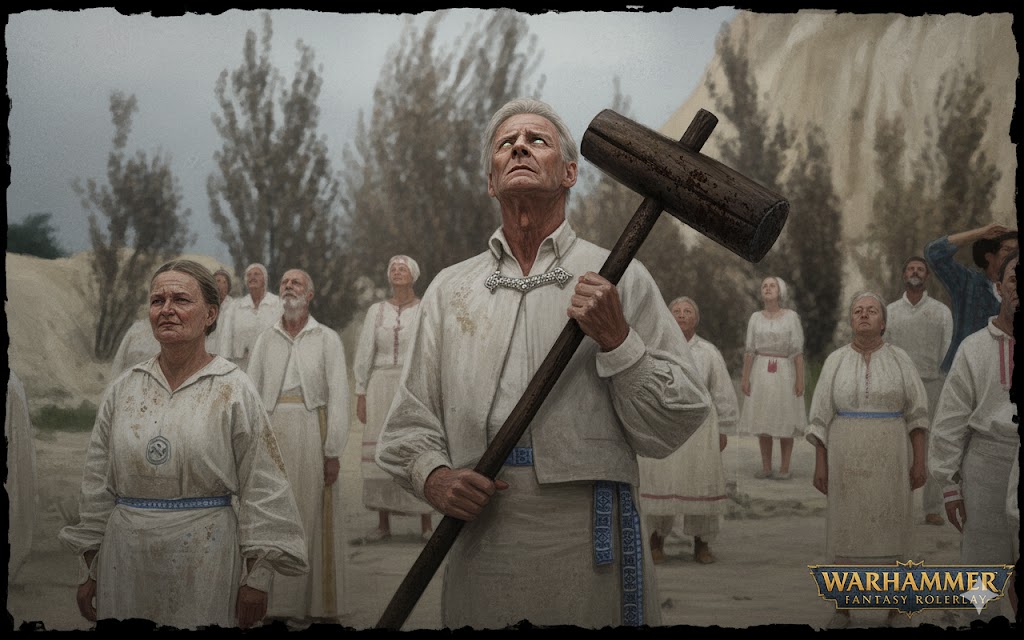
Arriving at the village, the group is greeted by Martha, an attractive woman in her forties who, offering them spiced water, welcomes them to Sephiron, the name of the Druidic community-village. The woman gives a brief presentation of the village and the imminent rite that is about to be celebrated around the cross in the center.
Fredrich notices that the Druidic symbol is engraved on the top of the cross, once again identical to the mark of the men who destroyed Auerswald shortly before his departure. He grips his sword hilt, with a familiar rage that simmers beneath the surface.
While chatting with the visitors, Martha explains how things work in Sephiron. The head of the Druidic cult is called Magnus and is also the founder of Sephiron, the first (it is hoped) of many Druidic communities intended to revive the Ancient Faith. Looking around, the adventurers notice that most of the adherents are young and good-looking, and that there are no children.
Martha accompanies the heroes to a communal house, inviting them to stop for the imminent rite and to stay in Sephiron for as long as they wish. There are only two rules: violence is not accepted in any form, and one cannot consume meat in public.
Wolfgang: “But how do you manage with the Beastmen who infest the area?”
Martha: (Her smile tightens slightly) “Firstly, I do not appreciate the word ‘Beastmen,’ I find it offensive and misleading. Secondly, the power of the Ancient Faith, just as it is healing the territory around here, is also succeeding in keeping them at a safe distance. No attacks have ever occurred since the community has existed.”
The woman takes her leave, not before casting a lingering glance of interest toward Fredrich, who is caught off guard.
Closed inside the small wooden house, the group obviously does not trust Martha and the ‘Sephirites’ in general in the slightest. Deciding nonetheless to dig deeper into this matter, also motivated by the need to understand where Etelka Herzen might be, the group decides to stay in the village.
A few hours of rest later, the group goes out and approaches the cross, where garlands and flowers seem to have been placed at the base. The entire community gathers and to the sound of drums begins a dance that culminates in a kind of ring-around-the-rosy around the cross.
Both Paolino and Fredrich feel the impulse to participate. Martha, who is already dancing, invites Fredrich, and he joins, followed shortly after by the Halfling. The air is festive, and the two perceive a long-forgotten sense of primordial freedom. Even Waldemar and the others who do not participate in the dance are nonetheless captivated by the syncopated beat of the drums, which seem to recall the heartbeat of the earth, perceiving a sense of relief themselves.
The only two elderly people, if one can call them that, in their fifties, are present. They seem to be the protagonists of the celebration, wearing garlands on their heads and invited to dance.
The dance ends as soon as a man wearing a floral mask representing an aged man covered in flowers appears. The drums fall silent, and the mysterious figure approaches the two elderly people, blessing them both with a gesture of his hand. Both happy, they clasp hands, a sign of a sentimental relationship between them, and the rite ends as it began.
While the crowd is busy preparing two kinds of floral litters, the man with the mask approaches the group, closely followed by Martha. He removes it, revealing himself as Magnus, Waldemar’s father.
At the sight of his father, Waldemar has a burst of anger and tries to throw a punch at him, slipping miserably on the mud.
Magnus: (He responds to the gesture with a calm) “I expected it and I deserve it.”
Raising his arms to stop the crowd ready to intervene to quell the quarrel, Magnus says that everything is fine and that it is absolutely right that if Waldemar wants to punch him, he has every right to do so because he has many faults towards his son. Restrained by his companions, Waldemar has a heated argument with his father about his abandonment.
The man, with evident understanding of his son’s anger, but also an unnatural coldness, accepts all the blame placed on him. However, he claims to be a very different person now, thanks precisely to the call of the Ancient Faith. Waldemar does not believe him, but is silenced by his companions who have more urgent questions.
Wolfgang: “Enough, Waldemar! Sir, we are looking for a woman named Etelka Herzen. A sorceress.”
The name is not new to Magnus, but he claims not to know her. The group speaks in an atmosphere of evident tension, with Magnus refusing the group’s invitation to talk “inside the house.”
Magnus: “It is evident that things could get out of hand with all those weapons you have on you,” he says, pointing at them.
Again accepting his son’s insults, the man does nothing but take his leave of the group because he has an important function to follow. Naturally, the invitation is extended to anyone who wants to participate. Martha follows Magnus silently, casting a glance at Fredrich.
After a quick consultation, Fredrich decides to follow the cult leader with Waldemar to understand more about this “heresy of the Ancient Faith.” A procession of white-clad faithful moves away from the village, transporting the two smiling elderly people on the two floral litters, as if they were personalities. Something does not add up for the two adventurers following, but by now they have decided to observe and, in silence, follow them at the tail end of the procession.
After a couple of kilometers, the procession arrives in front of a cliff. Here, the two elderly people are helped down from the litters and climb autonomously onto the cliff, about ten meters high. Smiling, they share a final kiss and, hand in hand, jump into the void in front of the crowd, which stands in respectful silence.
Shattering on the ground, the woman dies instantly, while the man groans, in the throes of the last spasms of life. A man comes out of the crowd with a large wooden hammer and smashes the elderly man’s head with three blows, putting an end to his suffering. Waldemar and Fredrich are left petrified.
The crowd, with composure, collects the bodies of the two and, in respectful silence, transports the remains to the nearby bank of the Stir reservoir, where they are placed on floral rafts and allowed to drift away.
Martha, perceiving Fredrich’s unease, approaches the man. The woman explains that this was the “Rite of Rebirth.” The two elderly people chose the moment of their end consciously and no one forced them in any way. Their death is also the celebration of two new lives, two babies who are about to be born in the village. It is a rite, in fact, of rebirth, where death is a voluntary act and is welcomed as the final step in uniting with the rhythm of the earth. Martha concludes by praying Fredrich not to judge them as mad, but to try to open his mind. She, converted in Altdorf by Magnus himself, accepted all this and is “reborn” into the Sephirite cult, finally finding balance and her place in the Old World.
Fredrich is silent and nods slowly.
The procession returns and, after a few hours, a communal dinner is offered, in which the entire village, including the guests, participates. In the meantime, however, returning from the procession, Fredrich and Waldemar rush to their travel companions to tell them what happened.
Paolino: (Visibly pale) “We must leave as fast as possible! I prefer the company of Beastmen to that of these raving lunatics!”
Divided, the group decides to attend the dinner and see how the situation unfolds. At dinner, two couples are present whose wives are a few months pregnant. Martha, sitting near Fredrich and the others, explains that the newborns will be taken into custody by Magnus, who will baptize them at the stone circle further north, near the vineyard. The children will not return there because they are not the children of the couple, but of the entire community. Magnus, as a father, will oversee their growth in the name of the community.
Once again, the heroes exchange perplexed glances, certain that there is much more beneath the surface…
Arrivati al villaggio, il gruppo viene accolto da Martha, un’attraente donna sulla quarantina che, offrendo loro acqua speziata, dà il benvenuto a Sephiron, nome della comunità-villaggio druidica. La donna fa una breve presentazione del villaggio e dell’imminente rito che sta per essere celebrato attorno alla croce al centro.
Fredrich nota che sulla sommità della croce è inciso il simbolo dei druidi, ancora una volta identico al simbolo degli uomini che distrussero Auerswald poco prima della sua partenza. Stringe l’elsa della spada, con una rabbia familiare che gli ribolle sottopelle.
Mentre chiacchiera con i visitatori, Martha spiega come funzionano le cose a Sephiron. Il capo del culto druidico si chiama Magnus ed è anche il fondatore di Sephiron, la prima (si spera) di tante comunità druidiche destinate a rilanciare l’Antica Fede. Guardandosi intorno, gli avventurieri notano che la maggior parte dei fedeli sono giovani di bell’aspetto e che non ci sono bambini.
Martha accompagna gli eroi in una casa comune, invitandoli a fermarsi per l’imminente rito e a sostare a Sephiron per tutto il tempo che desiderano. Ci sono solo due regole: la violenza non è accettata in nessuna forma e non si può consumare carne in pubblico.
Wolfgang: “Ma come fate con gli Uomini Bestia che infestano l’area?”
Martha: (Il suo sorriso si increspa leggermente) “In primis, non apprezzo la parola ‘Uomini Bestia’, la trovo offensiva e fuorviante. In secundis, il potere dell’Antica Fede, proprio come sta curando il territorio qui attorno, sta anche riuscendo a tenerli a distanza di sicurezza. Non si sono verificati mai attacchi da quando esiste la comunità.”
La donna si congeda non prima di aver lanciato uno sguardo di persistente interesse verso Fredrich, preso in contropiede.
Chiusi nella casetta di legno, il gruppo ovviamente non si fida minimamente di Martha e dei “Sapheriti” in generale. Decisi comunque a scavare a fondo in questa faccenda, complice anche il fatto di capire dove possa essere Etelka Herzen, il gruppo decide di sostare nel villaggio.
Qualche ora di riposo dopo, il gruppo esce e si avvicina alla croce, dove ghirlande e fiori sembrano essere stati apposti alla base. Tutta la comunità si riunisce e al suono di tamburi inizia una danza che culmina in una specie di girotondo attorno alla croce.
Sia Paolino che Fredrich sentono l’impulso a partecipare. Martha, che sta già danzando, invita Fredrich, e questi si unisce, seguito poco dopo dall’Halfling. L’aria è di festa, e i due percepiscono un senso di libertà primordiale da tempo dimenticato. Anche Waldemar e gli altri che non partecipano alla danza si fanno comunque ammaliare dal battito sincopato dei tamburi, che sembrano ricordare il battito del cuore della terra, percependo anche loro un senso di sollievo.
Gli unici due anziani, se così si possono definire, sulla cinquantina, sono presenti. Sembrano essere i protagonisti della festa, con ghirlande in testa e invitati a ballare.
La danza termina non appena un uomo con una maschera floreale che rappresenta un anziano ricoperto di fiori si manifesta. I tamburi si tacciono, e la misteriosa figura si avvicina ai due anziani, benedicendoli entrambi con un gesto della mano. Entrambi felici, si stringono la mano, segno di un rapporto sentimentale tra loro, e il rito termina così come è iniziato.
Mentre la folla si adopera per preparare due specie di baldacchini floreali, l’uomo con la maschera si avvicina al gruppo, seguito da vicino da Martha. Se la toglie, rivelandosi come Magnus, il padre di Waldemar.
Alla vista di suo padre, Waldemar ha uno scatto d’ira e prova a sferrargli un pugno, scivolando miseramente sul fango.
Magnus: (Con calma, senza scomporsi) “Me lo aspettavo e me lo merito.”
Alzando le braccia per fermare la folla pronta a intervenire per sedare la rissa, Magnus dice che va tutto bene e che è assolutamente giusto che, se Waldemar vuole tirargli un pugno, ha tutto il diritto di farlo poiché ha molte colpe nei confronti del figlio. Trattenuto dai compagni, Waldemar ha un acceso diverbio con il padre riguardo al suo abbandono.
Waldemar: (Scosso dalla rabbia) “Ci hai abbandonati! Hai lasciato che la Mamma morisse da sola per questa… questa sciocchezza dell’Antica Fede! E ti fai chiamare Druido?”
Magnus: “La tua rabbia è giusta, figlio mio. Accetto le mie colpe. Ma io sono una persona molto diversa ora, grazie appunto alla chiamata dell’Antica Fede. Ho trovato la mia vera via.”
Waldemar non gli crede, ma viene zittito dai compagni che hanno domande più urgenti.
Wolfgang: “Basta, Waldemar! Signore, stiamo cercando una donna di nome Etelka Herzen. Una maga.”
Il nome non è nuovo a Magnus, ma egli sostiene di non conoscerla. Il gruppo parla in un clima di evidente tensione, con Magnus che rifiuta l’invito da parte del gruppo ad andare a parlare “in casa”.
Magnus: “È evidente che le cose possano scapparci di mano con tutte quelle armi che avete addosso,” dice, indicandole.
Accettando nuovamente le offese del figlio, l’uomo non fa altro che congedarsi dal gruppo poiché ha un’importante funzione da seguire. Naturalmente, l’invito è esteso a chiunque voglia partecipare. Martha segue Magnus in silenzio, lanciando un’occhiata a Fredrich.
Dopo un rapido consulto, Fredrich decide di seguire il capo del culto con Waldemar per capire di più su questa “eresia dell’Antica Fede.”
Una processione di fedeli vestiti di bianco si allontana dal villaggio, trasportando sui due baldacchini floreali i due anziani sorridenti, come se fossero personalità importanti. Qualcosa non quadra ai due avventurieri al seguito, ma ormai hanno deciso di osservare e, in silenzio, li seguono in coda a tutti.
Dopo un paio di chilometri, la processione arriva davanti a una rupe. Qui, i due anziani vengono fatti scendere dai baldacchini e salgono autonomamente sulla rupe, a una decina di metri d’altezza. Sorridenti, si danno un ultimo bacio e, mano nella mano, saltano nel vuoto davanti alla folla in rispettoso silenzio.
Sfracellandosi a terra, la donna muore sul colpo, mentre l’uomo rantola, in preda agli ultimi spasmi di vita. Dalla folla esce un uomo con un grosso martello di legno che con tre colpi sfracella la testa dell’anziano, ponendo fine alle sue sofferenze. Waldemar e Fredrich restano pietrificati.
La folla, con compostezza, raccoglie i corpi dei due e, in rispettoso silenzio, trasporta le salme alla vicina sponda del bacino idrico dello Stir, dove vengono adagiati su zattere floreali e lasciati alla deriva.
Martha, percependo il disagio di Fredrich, si avvicina all’uomo. La donna spiega che quello si è trattato del “Rito della Rinascita.” I due anziani hanno scelto consapevolmente il momento della loro fine e nessuno li ha obbligati in nessuna maniera. La loro morte è però anche la celebrazione di due nuove vite, due neonati che stanno per nascere al villaggio. È un rito, appunto, di rinascita, dove la morte è un atto volontario ed accolto come ultimo passo nell’unione al ritmo della terra. Martha conclude pregando Fredrich di non giudicarli dei folli, ma di provare ad aprire la mente. Ella, convertita ad Altdorf da Magnus stesso, ha accettato tutto ciò ed è “rinata” nel culto sapherita, trovando finalmente un equilibrio e il proprio posto nel Vecchio Mondo.
Fredrich tace e annuisce lentamente.
La processione rientra e, dopo qualche ora, viene offerta la cena comune, a cui partecipa tutto il villaggio, inclusi gli ospiti. Nel frattempo, però, rientrati dalla processione, Fredrich e Waldemar si fiondano dai propri compagni di viaggio per raccontare l’accaduto.
Paolino: (Visibilmente pallido) “Dobbiamo andarcene il più in fretta possibile! Preferisco la compagnia degli Uomini Bestia a quella di questi pazzi scatenati!”
Spaccati, si decide di partecipare alla cena e vedere come evolve la situazione. Alla cena, sono presenti due coppie le cui donne hanno il pancione di qualche mese. Martha, seduta vicino a Fredrich e agli altri, spiega che i nuovi nascituri saranno presi in custodia da Magnus, il quale li battezzerà al circolo di pietre più a nord, vicino alla vigna. Lì, i figli non torneranno al villaggio poiché non sono figli della coppia, ma dell’intera comunità. Magnus, come padre, si occuperà della loro crescita nel nome della comunità.
Ancora una volta, gli eroi si guardano perplessi, certi che sotto ci sia molto di più…


Leave a Reply