ITA
La carrozza, ormai una bestia fradicia e sferragliante, si avvicina finalmente alla Porta Nord di Altdorf, mettendosi in fila dietro a tutti coloro che attendono il pagamento della tassa d’ingresso. La colonna è un quadro vivente degli strati sociali medio-bassi dell’Impero: contadini rugosi che stringono magre provviste, apprendisti con visi freschi e occhi spalancati di meraviglia, mercanti stanchi che mercanteggiano ancor prima di raggiungere il cancello, e l’occasionale artigiano corpulento, mani ancora macchiate di sporcizia. Tra di essi, una manciata di barboni, emaciati e disperati, si aggira tra la folla, le loro suppliche inghiottite dal frastuono delle ruote e dal mormorio della gente. Una piccola baraccopoli si aggrappa alla base delle mura della città, un insieme di ripari improvvisati per coloro che sono troppo poveri o indesiderati per ottenere l’ingresso.
Appollaiato precariamente su un barile capovolto, un uomo emaciato, completamente nudo se non per scarabocchi a carboncino che gli adornano la pelle, gesticola selvaggiamente. “La fine è vicina!” strilla, la sua voce roca per la febbre della profezia, “L’ira di Sigmar sta scendendo! Pentitevi, peccatori, perché il Grande Ratto Cornuto festeggia stanotte!” Prima che possa elaborare ulteriormente, due guardie cittadine corpulente, le loro espressioni annoiate, gli piombano addosso con i manganelli. Riceve un colpo brutale, i suoi occhi si incrociano per un istante con quelli di Wolfgang, un sussurro agghiacciante gli sfugge dalle labbra mentre cade: “La fine è vicina!”.
Finalmente, la carrozza si muove in avanti fino al punto di controllo. Due corone d’oro a testa vengono estratte, un duro colpo alle già scarse economie del gruppo. Armi e armature vengono gettate senza cerimonie in un grande barile, un numero consegnato in cambio. “Niente armi entro le mura della città!” ringhia la guardia, la sua voce priva di simpatia.
Alla fine, passano sotto l’enorme arco. La Via del Re si dispiega davanti a loro, un’arteria brulicante che pulsa della vita caotica di Altdorf. Il sole al tramonto tinge di grigio il cielo denso di fumo, dipingendo la scena in sfumature di arancio e grigio. È un viale soffocante, rumoroso, vivo con il ronzio incessante di mille voci, lo strepito degli zoccoli e le grida dei venditori ambulanti. L’aria è pesante con l’odore di birra a buon mercato, corpi non lavati e il fetore sempre presente dei rifiuti della città. Ogni superficie sembra essere coperta da uno strato di sporcizia, e la calca di corpi è soffocante.
Raggiunta Konigsplatz, una vasta e caotica piazza, scendono, afferrando i loro pochi bagagli. La confusione offusca i loro volti mentre assorbono la cacofonia e il marasma generale. Solo Wolfgang sembra possedere un senso di orientamento in mezzo al pandemonio. “La cosa migliore,” grida sopra il frastuono, “è dirigerci verso la Einehundert Taverne Strasse. Lì troveremo sicuramente qualche tipo di alloggio a buon prezzo.”
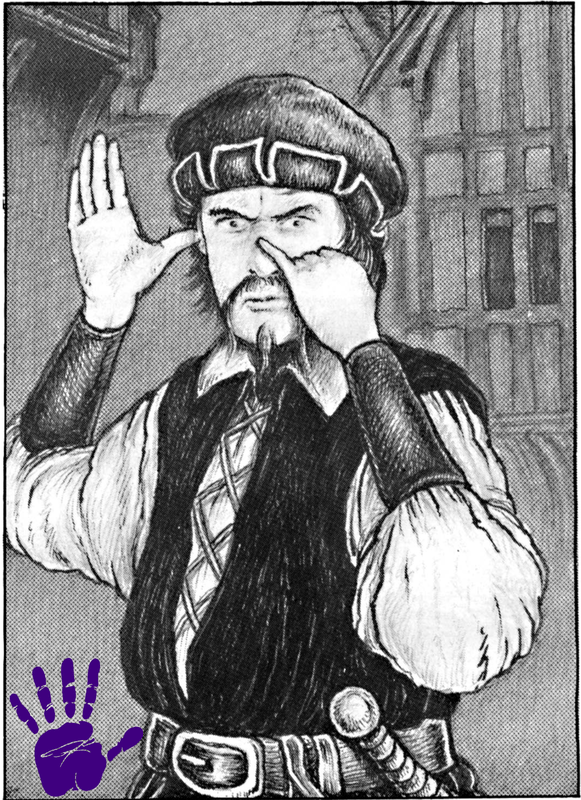
Proprio mentre si preparano a navigare tra la folla, l’attenzione di Paolino viene catturata da due figure dall’altra parte della piazza. I due stanno compiendo un gesto strano, quasi teatrale, le loro mani si muovono in modo preciso e deliberato. Un uomo tiene la mano sinistra con il palmo rivolto verso di sé, il pollice ripiegato, mentre la mano destra, con le dita arricciate a pugno, batte due volte sul dorso della mano sinistra, poi due volte sul lato dell’indice sinistro. L’altro uomo ripete il gesto esattamente. È un segnale, distinto e intenzionale, che si fa strada attraverso il caos.Il gruppo si guarda attorno, un silenzio perplesso cala tra loro. Nessuno, nemmeno Fredrich con i suoi anni di vagabondaggio, riconosce il segno segreto. I due uomini, dall’altra parte della piazza, insistono, ripetendo il gesto. I loro sguardi, penetranti e carichi di un’attesa palpabile, esigono una risposta adeguata. Fredrich, forse per istinto o forse per un malcelato desiderio di non sfigurare, replica il gesto come meglio può, imitandoli con la sua stessa mano. Ma dall’altra parte, la reazione è tutt’altro che positiva. I due figuri, con un’espressione che si indurisce sul volto, scivolano via nel dedalo di un vicolo malsano e svaniscono nella calca.
Non capendo appieno cosa sia successo, e con un senso di disagio che si annida nel petto, il gruppo si stringe attorno a Wolfgang. Lui è l’unico cittadino tra loro, l’unico a conoscere le strade di Altdorf come le sue tasche. “Meglio di qui,” dice, indicando una strada laterale, “la Einehundert Taverne Strasse.”
E così, si addentrano nella Via delle Cento Taverne. È un’esplosione di vita, un turbinio di suoni e odori che avvolge i sensi. Le taverne si affollano su entrambi i lati della strada, le loro finestre sporche riverberano una luce giallastra e invitante nel crepuscolo che avanza. Dalle porte spalancate, il chiasso di risate sguaiate, canti stonati e cozzi di boccali si riversa sulla strada. Ubriachi barcollano sui selciati irregolari, le voci rauche che si levano in discussioni senza senso. Guardie, stanche e con le armature ammaccate, si appoggiano ai muri esterni delle taverne, bevendo una birra rapida prima di riprendere il loro turno.
L’aria è densa di fumo e di un miscuglio indefinibile di sudore, birra versata e cibi fritti. È un ambiente visceralmente umano, vibrante e pulsante di energia. Per Wolfgang, questo è il battito del cuore della sua città, familiare e rassicurante nel suo caos. Ma per gli altri, per Paolino, Fredrich, Drumin e Waldemar, è un mondo alieno, un groviglio di corpi e rumori che li avvolge, al tempo stesso accogliente nel suo calore grezzo e stranamente minaccioso nella sua impetuosità. Il contrasto con la quiete spettrale della Drakenwald e l’orrore del mutante è stridente, un brusco risveglio alla cruda realtà della vita in una città imperiale.
Pochi passi ancora, e la cacofonia della Einehundert Taverne Strasse viene squarciata da una voce profonda, eppure incredibilmente potente, che rimbomba tra i muri anneriti degli edifici. “Per la barba di Sigmar, Waldemar!” grida, la sorpresa evidente nella sua intonazione. Da un’ombra emerge una figura imponente: un uomo enorme, il ventre prominente come una botte ben stagionata, braccia forti e nodose, mani che sembrano capaci di stritolare la testa di Paolino come un guscio d’uovo. Il suo volto, incorniciato da una barba rossa e riccia, è solcato da rughe che raccontano storie di sole, vento e fatica. È Joseph Quartjin, il barcaiolo.
“Waldemar Grassammeln, sei davvero tu?” esclama Joseph, il tono un misto di stupore e affetto. Un rapporto quasi paterno traspare dalle sue parole e dal modo in cui stringe l’amico. È il cognome, “Grassammeln”, che infine accende una lampadina nella mente di Fredrich. Una punta di ricordi, come schegge di vetro. “Grassammeln,” mormora, gli occhi che si sgranano leggermente. “C’era un Grassammeln che creava un sacco di problemi ad Auerswald.” Ricorda un uomo dissoluto, promiscuo, che si era inimicato mezza città. Un mezzo santone, sì, ma il pensiero comune era che la sua pseudo-spiritualità servisse solo a portarsi a letto le mogli altrui. Cacciato dalla città, le notizie su di lui si erano fatte vaghe e inconsistenti.
Joseph, senza perdere un istante, accoglie gli amici di Waldemar con un’esuberanza che rasenta la volgarità, trattandoli come vecchi compagni di bevute. “Venite, venite! La fortuna è con voi! Una bottiglia di vino… a testa!” grida, già trascinandoli verso l’ingresso de “Il Peccatore”, una taverna la cui insegna sbiadita raffigura un demone sorridente che regge un boccale.
All’interno de “Il Peccatore”, il gruppo può finalmente rilassarsi, e a spese di Joseph per giunta. Si mangia, si beve… e si beve davvero tanto. Wolfgang, con il suo solito entusiasmo sfrenato, non conosce limiti e ben presto si vomita sulle scarpe, crollando svenuto sul tavolo, il suo viso immerso in un lago di vino rovesciato. Anche Drumin, sebbene più taciturno, non regge le quantità impressionanti che Joseph riesce a scolare. Inizia a straparlare in Khazalid, la sua voce profonda che si mischia ai canti sguaiati degli altri avventori.
A mezzanotte, tra urla, risate e canti improvvisati, Joseph li trascina tutti fuori dalla taverna, puntando dritto verso la Berebelli, la sua barca ancorata lungo il Reik. Venuto a conoscenza della magra situazione economica di Waldemar e dei suoi compagni, Joseph si rivela generoso. “Avete un posto dove dormire, miei cari, sulla mia nave!” annuncia con un gran sorriso, “A patto che non mi ci vomitiate sopra, intesi?”
Joseph non tace mai. Mentre li scorta verso la nave, le sue parole si riversano come un fiume in piena, mescolando chiacchiere da osteria con sussurri inquietanti sulle voci di strada. “Si dice in giro,” borbotta, “che i nobili di Altdorf si crogiolino nella corruzione come i vermi nella carne marcia. E le famiglie più in vista? Sentite questa, si narra di incesti così profondi che i loro figli nascono con tre occhi e la pelle squamosa! Oh sì, il sangue nobile è spesso più denso di quello dei contadini, ma anche più malato, ve lo dico io!”
Mentre si sistemano sui sacchi di grano e le balle di merci, Joseph rivela il motivo del suo viaggio. “Sono diretto a Bogenhafen,” spiega, la voce un po’ più calma, “a consegnare un carico di vino pregiato. Un affare, ve lo assicuro, un affare pulito come la pelle di un bambino… o quasi.” La Berebelli, con il suo carico prezioso e i suoi passeggeri improvvisati, riposa tranquilla sotto il cielo stellato di Altdorf, pronta a riprendere il suo viaggio al primo chiarore dell’alba.
Il mattino seguente, il gruppo si sveglia in uno stato che definire “pietoso” sarebbe un eufemismo. La sbornia della sera precedente ha lasciato i suoi segni: teste martellanti, stomaci in subbuglio e una generale sensazione di malessere che avvolge tutti. Dalla coperta della Berebelli, però, uno spettacolo imponente cattura la loro attenzione e li distrae per un attimo dal proprio torpore. L’Ostlander Brücke, il doppio ponte levatoio, si innalza maestoso, un prodigio di ingegneria che permette alle navi più grandi di Altdorf di navigare il Reik. È un miracolo tecnologico, un simbolo della potenza imperiale che impressiona tutti, anche nelle loro condizioni precarie.
Mentre discutono fiaccamente sul da farsi – forse un altro boccale per smorzare l’emicrania, o forse cercare un po’ di cibo solido – una voce profonda e calma, eppure incredibilmente risoluta, squarcia l’aria mattutina. “Kastor?” chiama, con un tono che è amichevole ma non ammette repliche.
Un uomo si avvicina. Ha lunghi capelli scuri che gli incorniciano un viso dai lineamenti affilati e uno sguardo penetrante, quasi predatore. Una cotta di maglia lucida risplende sotto il suo mantello scuro, e una spada pende minacciosa al suo fianco. Dietro il drappeggio della cappa, si intravedono distintamente una pistola balestra e un paio di manette di ferro, dettagli che confermano le peggiori paure.
Fredrich, che sente il sangue gelarsi nelle vene al richiamo di quel nome, risponde, la voce un filo tremante. Non sa perché, ma il brivido di terrore che gli corre lungo la schiena gli dice di seguire quell’uomo. Gli altri, ancora storditi dalla sbornia e forse un po’ intontiti dalla scena, rimangono a guardare dal ponte della Berebelli, immobili come statue.
L’uomo non si presenta, non un nome, non una parola su chi lo abbia mandato. Ma le sue parole sono come una lama gelida puntata al cuore di Fredrich. “Kastor,” ripete, il nome che ormai risuona come un monito, “sono venuto a prenderti per portarti a Middenheim.” Non è una domanda, è una sentenza. Il suo fare è quello di un cacciatore di taglie, ma la sua professionalità è inquietante. “Voglio un lavoro pulito,” continua, “senza spargimenti di sangue.” Poi, il colpo di grazia. “Ti do ventiquattro ore per sistemare i tuoi affari in città, prima di lasciarla con me per raggiungere la città del Lupo… con le buone.” Una pausa eloquente. “Viceversa,” la voce si fa un sussurro che gela il sangue, “non avrò il minimo problema a farti uscire dalla Porta Nord dentro una bara.”
Fredrich tenta di argomentare, di trovare una scappatoia, ma le parole gli si annodano in gola. L’uomo è irremovibile, la sua espressione imperturbabile, la sua voce suona come una sentenza inappellabile. La doppia identità di Fredrich, che finora era stata un peso, ora inizia a diventare una morsa letale. Il cacciatore di taglie si volta e si dilegua nella folla, lasciando dietro di sé solo la memoria delle sue parole: “Ventiquattro ore.”
Fredrich torna tremante sulla Berebelli, il viso pallido e gli occhi sbarrati. La notizia del suo “doppio” e della minaccia incombente getta il gruppo in una discussione accesa. Le loro deboli alleanze vengono messe a dura prova. Dovrebbero approfittare di Joseph e della sua nave per raggiungere Bogenhafen? Ma per cosa? Per scappare dalla minaccia, o per tentare di reclamare l’eredità che spetterebbe a Kastor? Wolfgang, pragmatico come sempre, propone di nascondersi in città, per poi tentare un’uscita via terra da qualche parte, evitando sia il cacciatore di taglie che il viaggio fluviale.
Le differenze emergono, i legami deboli tra i membri del gruppo si evidenziano. Fredrich, con un guizzo di astuzia, decide di giocare la sua carta vincente. “Vi propongo un quinto dell’eredità,” dice, cercando di far sembrare la sua voce più ferma di quanto non sia, “se mi seguirete a Bogenhafen.” Il denaro, o la promessa di esso, è un incentivo potente. Tutti accettano, anche Wolfgang, che tentenna fino all’ultimo, ma alla fine il richiamo della ricchezza ha la meglio sulla sua prudenza.
In quel momento, Joseph si sveglia, stiracchiandosi con un gran sbadiglio. Con un gesto del tutto naturale e privo di qualsiasi inibizione, espleta i suoi bisogni in un secchio lì vicino. Mentre si pulisce, Waldemar nota la carta che Joseph sta usando e, con un’espressione di enorme disgusto, la recupera. Nonostante il ribrezzo, i suoi occhi scorrono sulle parole scritte: è un documento ufficiale, forse un annuncio, o una pergamena di qualche tipo. La curiosità vince sul fastidio, e Waldemar inizia a leggere, la fronte corrugata.Waldemar, con un misto di disgusto e curiosità, finisce di decifrare il foglio accartocciato. “Ascoltate questo,” annuncia, la voce ancora un po’ strascicata dalla sbornia, “Il Consiglio e i Borghesi di Bögenhafen annunciano che la grande apertura dell’annuale Schaffenfest si terrà sul prato cittadino questo Giorno di Mitterfrühl. La fiera durerà per tre giorni durante le ore di luce, con la graziosa autorizzazione di Sua Eccellenza Graf Wilhelm von Saponatheim e Sua Grazia Granduca Leopold di Middenland. Si terrà una Grande Giostra tra i Cavalieri e gli Scudieri di entrambe le casate. Tutto questo in aggiunta alle consuete attrazioni del nostro famoso Mercato del Bestiame e della più grande Fiera Itinerante del Reikland. Stampato da Schulz e Friedman, Bögenhafen.”
Il gruppo si scambia sguardi perplessi, poi tutti fanno spallucce. Una fiera. Bello, certo, ma al momento la loro priorità è ben altra. Iniziano a dividersi i compiti con una ritrovata urgenza, la minaccia del cacciatore di taglie che incombe su Fredrich è uno sprone sufficiente. Devono permettere alla Berebelli di lasciare i cancelli fluviali e la dogana prima che vengano chiusi con il calare del sole.
Drumin, con la sua forza silenziosa, si unisce ai portatori, aiutando a caricare le pesanti botti di vino sulla nave. I suoi muscoli si tendono sotto lo sforzo, e il barcaiolo lo ringrazia con un cenno del capo. Nel frattempo, Waldemar ne approfitta per fare una copia della carta nautica fluviale che aveva notato nella stanza dove avevano dormito. La sua mente, nonostante l’ubriacatura, è acuta, e sa che una mappa è un bene prezioso.
Joseph, sudato e indaffarato, spiega la rotta. “La strada migliore, miei prodi, è quella di sfruttare il canale di Weissbruck. Magari una notte in una locanda di fiume, lì, per poi raggiungere la città di Weissbruck.” Indica sulla mappa un punto. “Lì, dopo aver pagato la tassa del canale, una notte in città per riposare le ossa, e poi giù per il fiume Bogen fino a Bögenhafen. Sette giorni di viaggio, all’incirca.”
Fredrich, ansioso di lasciare Altdorf il prima possibile, insiste per partire appena possono. Joseph sbuffa, un po’ per il caldo, un po’ per la fretta inaspettata, ma acconsente. È una giornata di duro lavoro per tutti. Fredrich, con una determinazione quasi febbrile, spende un patrimonio in provviste, accumulando pane, formaggio, carne secca e birra a sufficienza per il viaggio. Wolfgang, nel frattempo, scruta il molo con occhi acuti, cercando eventuali spie del cacciatore di taglie. Tutti sono sicuri che ce ne siano, la sensazione di essere osservati è palpabile, ma la folla è troppo densa per capire chi stia guardando dove. Paolino, con la sua parlantina e il suo innato talento per svicolare, riesce a fuggire la fatica, scomparendo e riapparendo con una scusa o l’altra, mentre il resto del gruppo si spacca la schiena.
Al tramonto, finalmente, l’ultima botte di vino è a bordo. Stanchi ma con un senso di sollievo, Joseph libera la Berebelli dal molo. Con un ultimo grido di addio alla caotica Altdorf, la nave si dirige lentamente verso ovest, le sue vele gonfie dal vento leggero, puntando verso il canale di Weissbruck. Il viaggio verso Bögenhafen è iniziato, e con esso, l’incertezza del futuro e l’ombra del passato che continua a inseguire Fredrich.
Alla dogana di Altdorf, con una sorpresa quasi incredula, i viaggiatori recuperano il barile con il loro equipaggiamento. Le armi e le armature, che credevano perdute chissà dove tra la burocrazia cittadina, tornano in loro possesso, un piccolo raggio di fortuna in un’impresa sempre più rischiosa. Joseph, con la sua consueta efficienza, sbriga le ultime carte necessarie per lasciare la città, e in poche ore la tentacolare capitale scompare alle loro spalle, inghiottita dall’oscurità crescente.
La notte si fa profonda e il paesaggio circostante si trasforma in una foresta inospitale, le cui ombre sembrano allungarsi minacciose. Joseph, l’allegro barcaiolo diurno, cambia improvvisamente atteggiamento. Diventa silenzioso e guardinghi, i suoi occhi che scrutano l’oscurità con un’attenzione tesa. “Nessuno naviga di notte,” mormora, la sua voce ora grave, “non è saggio. Sarebbe stato meglio dormire in locanda.”
Fredrich, la cui ansia è un fuoco che lo consuma, prega il barcaiolo di non fermarsi. Il tempo stringe, la minaccia del cacciatore di taglie è una spada di Damocle. Si accordano per calare l’ancora in un’ansa del canale, a poche ore di navigazione da Altdorf, un compromesso tra la prudenza di Joseph e la disperazione di Fredrich. Lì, non c’è anima viva, solo i rumori inquietanti della foresta, e nel buio pesto, Joseph non si fida a proseguire. Si decidono i turni di guardia a coppie, e la notte passa, fortunatamente, senza spiacevoli sorprese.
I tre giorni di navigazione del canale scorrono veloci, scanditi dal ritmo regolare dei remi e dal fruscio dell’acqua. Incontrano sporadicamente altre navi mercantili, sagome scure che scivolano via nell’acqua, scambiando brevi saluti o cenni con i loro capitani. Non una strada in vista lungo i bordi del canale, solo la fitta vegetazione. Molte locande con moli privati si affacciano sull’acqua, le loro luci invitanti, ma il gruppo continua a dormire sulla Berebelli, risparmiando le magre finanze per ciò che li attende.
Finalmente, all’alba del terzo giorno, giungono a Weissbruck. Joseph, con un sospiro di sollievo, si appoggia al timone, e con una voce che si fa nostalgica, quasi reverente, inizia a raccontare la storia della città:
“Ah, Weissbruck! Non lasciatevi ingannare dalle sue dimensioni, miei amici. È una piccola perla, sì, ma strategicamente cruciale nel Reikland, proprio dove il Canale di Weissbruck si getta nel fiume Bögen. Un tempo, era solo un misero villaggio di pescatori, con qualche capanna e poco più. Ma poi, arrivarono i Gruber. Una famiglia, gente in gamba, ve lo dico io! Furono loro, con i profitti sudati delle loro miniere di carbone e ferro dalle colline di Skaag, a tirar fuori i quattrini per costruire questo canale, nel 2426 dell’Anno Imperiale. E non furono manovalanza qualsiasi a farlo, no! Ingegneri nani, gente che sa il fatto suo con la pietra e il ferro!
Ora, le miniere si sono esaurite, è vero, ma Weissbruck è rimasta. È diventata un nodo commerciale di prim’ordine, un crocevia fluviale dove le merci si incontrano e si scambiano. Magazzini che scoppiano di carbone, lana, ferro grezzo e vino, tutto proveniente da posti come Bögenhafen, Altdorf e Carroburg. Ci vivono circa 300 anime, governate da un tale Barone Barhold Gruber, un uomo che sa il fatto suo, dicono.Non è tutto rose e fiori, ovviamente. Ci sono molti ex minatori disoccupati che affollano le taverne, cercando un lavoro o semplicemente affogando i loro dispiaceri nel vino. Ma la sua posizione e il suo passato, beh, la rendono un luogo di tutto rispetto nel cuore dell’Impero.”
Questa volta, Joseph Quartjin non accetta compromessi. “Miei cari,” dichiara, sbarcando con un balzo che fa gemere la passerella, “la Berebelli può aspettare. Ho bisogno di sgranchirmi le gambe, di aria di terra ferma, e la mia gola grida vendetta per la sobrietà forzata! Dobbiamo caricare acqua dolce, e io… io mi faccio una notte a Weissbruck, tra vino e donne, come un vero uomo!”
Il gruppo, pur se stanco, non si fa pregare. Alcuni ne approfittano subito per i propri scopi. Waldemar, il cui sguardo si era perso più volte verso il verde cupo della Drakenwald, si allontana un poco dalla città, addentrandosi nella prima frangia di foresta, in cerca di erbe rare e preziose, un’antica abitudine che lo ricollega alla terra. Paolino, sempre a caccia di qualche corona d’oro facile, decide di tentare la fortuna con uno spettacolo improvvisato per le strade di Weissbruck, ma il suo talento per la recitazione sembra incontrare scarso successo con il pubblico locale, più avvezzo alle burle dei minatori ubriachi che alle sue astuzie. Drumin, invece, l’opportunista silenzioso, approfitta della ricchezza commerciale e dei materiali disponibili a Weissbruck. La sua mente pratica lo porta a recuperare zolfo e salnitro, con lo scopo di produrre polvere da sparo da rivendere, un mestiere che conosce bene e che promette facili guadagni.
Wolfgang e Fredrich, tuttavia, non abbandonano la Berebelli. Si allontanano solo di una settantina di metri, sufficienti per concedersi qualche boccale in una locanda affacciata sul molo, ma mantengono la nave costantemente sotto controllo. Joseph, con la fiducia tipica del Reiklander, ha affidato la sua amata barca al gruppo, concedendo loro di dormirci sopra a patto che facciano la guardia alla nave e al prezioso carico.
Nel pomeriggio, mentre il sole inizia a calare, Fredrich e Wolfgang notano un uomo che gira intorno alla barca. Non si avvicina direttamente, ma il suo incedere è troppo attento, i suoi occhi troppo curiosi, come se volesse accertarsi che nessuno sia a bordo. Un brutto segno, pensano i due, l’allarme che si accende nella loro mente. Dopo un po’, l’uomo si allontana e si perde per le strade affollate di Weissbruck, con Fredrich e Wolfgang impossibilitati a seguirlo per non lasciare la Berebelli incustodita. Il presagio, però, rimane, un’ombra inquietante.
La notte cala, e tutti, tranne Joseph che si gode la sua serata libertina, cenano assieme, consumando le provviste acquistate da Fredrich. Poi, si riprendono i turni di guardia, un rito notturno che si è consolidato rapidamente. A Drumin spetta il turno centrale, nelle ore più buie, quelle in cui i pensieri si fanno più pesanti e l’oscurità sembra celare ogni pericolo. Il nano si affida all’ascia da legna di Joseph, appoggiata a portata di mano, come unica difesa contro l’ignoto.
Le ore passano, la città si quieta, il brusio delle taverne si affievolisce in un mormorio. Nel cuore della notte, un rumore improvviso attira l’attenzione del nano. Non è il fruscio del vento o il grido di un animale notturno, ma qualcosa che ha colpito la nave. Sporgendosi cautamente oltre il bordo, Drumin vede una piccola lancia che si avvicina furtiva, con alcuni uomini a bordo. Sono armati, e uno di loro stringe in mano una molotov accesa, la fiamma che danza macabra nel buio pesto!
La vita, ancora una volta, ha preso l’ennesima direzione casuale, un capriccio degli dei che si divertono a muovere le nostre pedine su una scacchiera invisibile. Siamo diretti a Bögenhafen, una città il cui nome ora risuona di una promessa ambigua: eredità o condanna? Le porte di Weissbruck, che abbiamo appena superato, sono state la nostra fuga, un respiro rubato al cacciatore di taglie che ci insegue, un destino beffardo che sembra volerci a tutti i costi. E ora, mentre la Berebelli solca le acque, non posso fare a meno di chiedermi: cosa ci attende dietro la prossima curva del fiume?– Tratto da ” Il nemico dentro ” , anonimo, Stamperie Krofulzh – Rauchen , Nuln, 2514.
ENG
The carriage, by now a sodden and rattling beast, finally approaches Altdorf’s North Gate, joining the queue of all those awaiting payment of the entrance fee. The column is a living tableau of the Empire’s lower and middle social strata: wrinkled peasants clutching meager provisions, fresh-faced apprentices with wide, wondering eyes, tired merchants haggling even before reaching the gate, and the occasional burly artisan, hands still stained with grime. Among them, a handful of emaciated and desperate beggars weave through the crowd, their pleas swallowed by the rumble of wheels and the murmur of the people. A small shantytown clings to the base of the city walls, a collection of makeshift shelters for those too poor or undesirable to gain entry.
Perched precariously on an overturned barrel, an emaciated man, completely naked except for charcoal scribbles adorning his skin, gesticulates wildly. “The end is near!” he shrieks, his voice hoarse with the fever of prophecy, “Sigmar’s wrath is descending! Repent, ye sinners, for the Great Horned Rat celebrates tonight!” Before he can elaborate further, two burly city guards, their expressions bored, descend upon him with truncheons. He takes a brutal blow, his eyes briefly locking with Wolfgang’s, a chilling whisper escaping his lips as he falls: “The end is near!”
Finally, the carriage moves forward to the checkpoint. Two gold crowns per head are extracted, a hard blow to the group’s already meager finances. Weapons and armor are unceremoniously tossed into a large barrel, a number tag handed over in exchange. “No arms within the city walls!” snarls the guard, his voice devoid of sympathy.
At last, they pass under the enormous archway. The King’s Way unfolds before them, a teeming artery pulsating with the chaotic life of Altdorf. The setting sun dyes the smoke-filled sky gray, painting the scene in shades of orange and gray. It is a suffocating, noisy avenue, alive with the incessant hum of a thousand voices, the clatter of hooves, and the shouts of street vendors. The air is heavy with the smell of cheap beer, unwashed bodies, and the ever-present stench of the city’s refuse. Every surface seems to be covered in a layer of dirt, and the crush of bodies is stifling.
Reaching Konigsplatz, a vast and chaotic square, they disembark, grabbing their few bags. Confusion clouds their faces as they absorb the cacophony and general chaos. Only Wolfgang seems to possess a sense of direction amidst the pandemonium. “The best thing,” he shouts over the din, “is to head towards Einehundert Taverne Strasse. We’ll surely find some cheap accommodation there.”
Just as they prepare to navigate through the crowd, Paolino’s attention is caught by two figures on the other side of the square. The two are performing a strange, almost theatrical gesture, their hands moving in a precise and deliberate way. One man holds his left hand with the palm facing him, thumb tucked in, while his right hand, with fingers curled into a fist, taps twice on the back of his left hand, then twice on the side of his left index finger. The other man repeats the gesture exactly. It is a distinct and intentional signal, cutting through the chaos. The group looks around, a perplexed silence falling among them. No one, not even Fredrich with his years of wandering, recognizes the secret sign. The two men, on the other side of the square, insist, repeating the gesture. Their gazes, penetrating and full of palpable anticipation, demand an appropriate response. Fredrich, perhaps by instinct or perhaps from a poorly concealed desire not to look foolish, replicates the gesture as best he can, imitating them with his own hand. But on the other side, the reaction is far from positive. The two figures, their faces hardening, slip away into the maze of an unhealthy alley and disappear into the crowd.
Not fully understanding what happened, and with a sense of unease nesting in their chests, the group huddles around Wolfgang. He is the only city dweller among them, the only one who knows the streets of Altdorf like the back of his hand. “Better this way,” he says, pointing to a side street, “to Einehundert Taverne Strasse.”
And so, they delve into the Street of a Hundred Taverns. It is an explosion of life, a whirlwind of sounds and smells that engulfs the senses. Taverns crowd both sides of the street, their dirty windows reflecting a yellowish, inviting light in the advancing twilight. From the open doors, the clamor of boisterous laughter, off-key singing, and clinking tankards spills onto the street. Drunks stumble on the uneven cobblestones, their hoarse voices rising in nonsensical arguments. Guards, tired and with dented armor, lean against the outer walls of the taverns, drinking a quick beer before resuming their shift.
The air is thick with smoke and an indefinable mixture of sweat, spilled beer, and fried foods. It is a viscerally human environment, vibrant and pulsating with energy. For Wolfgang, this is the heartbeat of his city, familiar and comforting in its chaos. But for the others, for Paolino, Fredrich, Drumin, and Waldemar, it is an alien world, a tangle of bodies and noises that engulfs them, at once welcoming in its raw warmth and strangely menacing in its impetuosity. The contrast with the spectral quiet of the Drakenwald and the horror of the mutant is striking, a rude awakening to the harsh reality of life in an imperial city.
A few more steps, and the cacophony of Einehundert Taverne Strasse is shattered by a deep, yet incredibly powerful voice that echoes between the blackened walls of the buildings. “By Sigmar’s beard, Waldemar!” it shouts, surprise evident in its tone. From a shadow emerges an imposing figure: an enormous man, his belly prominent like a well-aged barrel, strong, gnarled arms, hands that seem capable of crushing Paolino’s head like an eggshell. His face, framed by a dark, curly beard, is furrowed with wrinkles that tell stories of sun, wind, and toil. This is Joseph Quartjin, the boatman.
“Waldemar Grassammeln, is that truly you?” exclaims Joseph, his tone a mixture of astonishment and affection. An almost paternal relationship shines through his words and the way he embraces his friend. It is the surname, “Grassammeln,” that finally sparks a memory in Fredrich’s mind. A flicker of recollections, like glass shards. “Grassammeln,” he mutters, his eyes widening slightly. “There was a Grassammeln who caused a lot of trouble in Auerswald.” He recalls a dissolute, promiscuous man who had alienated half the town. A half-saint, yes, but the common belief was that his pseudo-spirituality served only to bed other men’s wives. Driven from the town, news of him had become vague and inconsistent.
Joseph, without losing a moment, welcomes Waldemar’s friends with an exuberance bordering on vulgarity, treating them like old drinking companions. “Come, come! Fortune is with you! A bottle of wine… each!” he shouts, already dragging them towards the entrance of “The Sinner,” a tavern whose faded sign depicts a smiling demon holding a tankard.
Inside “The Sinner,” the group can finally relax, and at Joseph’s expense to boot. They eat, they drink… and they drink a lot. Wolfgang, with his usual unrestrained enthusiasm, knows no limits and soon vomits on his shoes, collapsing unconscious on the table, his face submerged in a puddle of spilled wine. Drumin, though more taciturn, cannot handle the impressive quantities Joseph manages to down. He begins to babble in Khazalid, his deep voice mixing with the drunken songs of the other patrons.
At midnight, amidst shouts, laughter, and improvised songs, Joseph drags them all out of the tavern, heading straight for the Berebelli, his boat moored along the Reik. Having learned of the meager financial situation of Waldemar and his companions, Joseph proves generous. “You have a place to sleep, my dears, on my boat!” he announces with a big smile, “As long as you don’t vomit on it, understood?”
Joseph never stops talking. As he escorts them to the boat, his words pour out like a rushing river, mixing tavern gossip with disturbing whispers about street rumors. “They say around here,” he mutters, “that Altdorf’s nobles wallow in corruption like worms in rotten meat. And the most prominent families? Hear this, it’s rumored of incest so deep that their children are born with three eyes and scaly skin! Oh yes, noble blood is often thicker than a peasant’s, but also sicker, I tell you!”
As they settle among the sacks of grain and bales of goods, Joseph reveals the reason for his journey. “I’m heading to Bogenhafen,” he explains, his voice a little calmer, “to deliver a cargo of fine wine. A deal, I assure you, a clean deal as a baby’s skin… or almost.” The Berebelli, with its precious cargo and its impromptu passengers, rests quietly under Altdorf’s starry sky, ready to resume its journey at the first light of dawn.
The next morning, the group wakes up in a state that “pitiful” would be an understatement. The previous night’s hangover has left its marks: pounding heads, churning stomachs, and a general feeling of malaise that engulfs everyone. From the deck of the Berebelli, however, an impressive sight catches their attention and momentarily distracts them from their stupor. The Ostlander Brücke, the double drawbridge, rises majestically, a marvel of engineering that allows Altdorf’s largest ships to navigate the Reik. It is a technological miracle, a symbol of imperial power that impresses everyone, even in their precarious condition.
As they weakly discuss what to do – perhaps another tankard to dull the headache, or perhaps some solid food – a deep, calm, yet incredibly resolute voice slices through the morning air. “Kastor?” it calls, with a tone that is friendly but allows no refusal.
A man approaches. He has long dark hair framing a face with sharp features and a penetrating, almost predatory gaze. A shining chainmail gleams beneath his dark cloak, and a sword hangs menacingly at his side. Behind the drape of his cloak, a crossbow pistol and a pair of iron manacles are distinctly visible, details that confirm the worst fears.
Fredrich, feeling his blood run cold at the sound of that name, replies, his voice a little shaky. He doesn’t know why, but the shiver of terror running down his spine tells him to follow that man. The others, still dazed by the hangover and perhaps a little stunned by the scene, remain watching from the Berebelli‘s deck, motionless as statues.
The man does not introduce himself, not a name, not a word about who sent him. But his words are like a cold blade pointed at Fredrich’s heart. “Kastor,” he repeats, the name now resounding as a warning, “I’ve come to take you to Middenheim.” It is not a question; it is a sentence. His demeanor is that of a bounty hunter, but his professionalism is unsettling. “I want a clean job,” he continues, “no bloodshed.” Then, the coup de grâce. “I’ll give you twenty-four hours to settle your affairs in the city, before leaving it with me to reach the city of the Wolf… willingly.” An eloquent pause. “Otherwise,” his voice becomes a blood-chilling whisper, “I’ll have no problem taking you out the North Gate in a coffin.”
Fredrich tries to argue, to find a loophole, but the words get tangled in his throat. The man is unyielding, his expression imperturbable, his voice sounding like an unappealable sentence. Fredrich’s double identity, which had been a burden until now, begins to become a deadly vice. The bounty hunter turns and disappears into the crowd, leaving behind only the memory of his words: “Twenty-four hours.”
Fredrich returns trembling to the Berebelli, his face pale and his eyes wide. The news of his “double” and the impending threat throws the group into a heated discussion. Their weak alliances are put to the test. Should they take advantage of Joseph and his ship to reach Bogenhafen? But for what? To escape the threat, or to try to claim the inheritance that would belong to Kastor? Wolfgang, pragmatic as ever, proposes to hide in the city, and then attempt an exit by land somewhere, avoiding both the bounty hunter and the river journey.
Differences emerge, the weak ties between the group members become apparent. Fredrich, with a flash of cunning, decides to play his trump card. “I propose a fifth of the inheritance,” he says, trying to make his voice sound firmer than it is, “if you follow me to Bogenhafen.” Money, or the promise of it, is a powerful incentive. Everyone accepts, even Wolfgang, who hesitates until the last, but in the end, the lure of wealth overcomes his prudence.
At that moment, Joseph wakes up, stretching with a big yawn. With a completely natural and uninhibited gesture, he relieves himself in a bucket nearby. As he cleans himself, Waldemar notices the paper Joseph is using and, with an expression of immense disgust, retrieves it. Despite the revulsion, his eyes scan the written words: it is an official document, perhaps an announcement, or some kind of parchment. Curiosity overcomes discomfort, and Waldemar begins to read, his brow furrowed. Waldemar, with a mixture of disgust and curiosity, finishes deciphering the crumpled sheet. “Listen to this,” he announces, his voice still a little slurred from the hangover, “The Council and Burgesses of Bögenhafen announce that the grand opening of the annual Schaffenfest will be held on the town common this Mitterfrühl Day. The fair will last for three days during daylight hours, with the gracious permission of His Excellency Graf Wilhelm von Saponatheim and His Grace Grand Duke Leopold of Middenland. A Grand Joust will be held between the Knights and Squires of both houses. All this in addition to the usual attractions of our famous Cattle Market and the largest Traveling Fair in the Reikland. Printed by Schulz and Friedman, Bögenhafen.”
The group exchanges perplexed glances, then everyone shrugs. A fair. Nice, sure, but at the moment their priority is quite different. They begin to divide tasks with a newfound urgency; the threat of the bounty hunter looming over Fredrich is enough incentive. They must allow the Berebelli to clear the river gates and customs before they are closed at sunset.
Drumin, with his silent strength, joins the porters, helping to load the heavy wine barrels onto the ship. His muscles strain under the effort, and the boatman thanks him with a nod of his head. Meanwhile, Waldemar takes the opportunity to make a copy of the river navigation chart he had noticed in the room where they had slept. His mind, despite the hangover, is sharp, and he knows a map is a valuable asset.
Joseph, sweaty and busy, explains the route. “The best way, my brave friends, is to use the Weissbruck Canal. Maybe a night in a riverside inn there, and then on to the town of Weissbruck.” He points to a spot on the map. “There, after paying the canal toll, a night in town to rest your bones, and then down the Bogen River to Bögenhafen. About seven days’ journey, more or less.”
Fredrich, anxious to leave Altdorf as soon as possible, insists on departing immediately. Joseph grumbles, partly from the heat, partly from the unexpected hurry, but he agrees. It’s a day of hard work for everyone. Fredrich, with an almost feverish determination, spends a fortune on provisions, stocking up on enough bread, cheese, dried meat, and beer for the trip. Wolfgang, meanwhile, scans the dock with keen eyes, looking for any spies of the bounty hunter. Everyone is sure there are some, the feeling of being watched is palpable, but the crowd is too dense to tell who is watching whom. Paolino, with his smooth talk and innate talent for slipping away, manages to avoid the hard labor, disappearing and reappearing with one excuse or another, while the rest of the group breaks their backs.
At sunset, finally, the last barrel of wine is on board. Tired but with a sense of relief, Joseph frees the Berebelli from the dock. With a final farewell shout to chaotic Altdorf, the ship slowly heads west, its sails filled by the light wind, pointing towards the Weissbruck Canal. The journey to Bögenhafen has begun, and with it, the uncertainty of the future and the shadow of the past that continues to pursue Fredrich.
At the Altdorf customs, with almost incredulous surprise, the travelers retrieve the barrel with their equipment. The weapons and armor, which they believed lost somewhere in the city’s bureaucracy, are back in their possession, a small stroke of luck in an increasingly risky endeavor. Joseph, with his usual efficiency, handles the last remaining paperwork to leave the city, and within a few hours, the sprawling capital disappears behind them, swallowed by the growing darkness.
The night deepens, and the surrounding landscape transforms into an inhospitable forest, its shadows seemingly lengthening ominously. Joseph, the cheerful daytime boatman, suddenly changes his demeanor. He becomes silent and watchful, his eyes scanning the darkness with tense attention. “No one sails at night,” he murmurs, his voice now grave, “it’s not wise. It would have been better to sleep in an inn.”
Fredrich, whose anxiety is a consuming fire, begs the boatman not to stop. Time is short; the bounty hunter’s threat is a sword of Damocles. They agree to drop anchor in a bend of the canal, a few hours’ sail from Altdorf, a compromise between Joseph’s prudence and Fredrich’s desperation. There, not a soul is alive, only the unsettling sounds of the forest, and in the pitch black, Joseph does not trust himself to proceed. They decide on watch shifts in pairs, and the night passes, fortunately, without unpleasant surprises.
The three days of canal navigation pass quickly, punctuated by the regular rhythm of the oars and the rustle of the water. They sporadically encounter other merchant ships, dark silhouettes gliding through the water, exchanging brief greetings or nods with their captains. Not a road in sight along the canal banks, only dense vegetation. Many inns with private docks line the water, their lights inviting, but the group continues to sleep on the Berebelli, saving their meager finances for what awaits them.
Finally, at dawn on the third day, they arrive in Weissbruck. Joseph, with a sigh of relief, leans on the tiller, and with a voice that becomes nostalgic, almost reverent, begins to tell the story of the town:
“Ah, Weissbruck! Don’t let its size fool you, my friends. It’s a small pearl, yes, but strategically crucial in the Reikland, right where the Weissbruck Canal meets the Bogen River. Once, it was just a humble fishing village, with a few huts and little else. But then, the Grubers arrived. A family, capable folk, I tell you! It was they, with the hard-earned profits from their coal and iron mines in the Skaag hills, who shelled out the coin to build this canal, in 2426 IC. And it wasn’t just any laborers who built it, no! Dwarf engineers, people who know their stuff with stone and iron!
Now, the mines are exhausted, it’s true, but Weissbruck has remained. It has become a first-rate commercial hub, a river crossroads where goods meet and are traded. Warehouses overflowing with coal, wool, raw iron, and wine, all coming from places like Bögenhafen, Altdorf, and Carroburg. About 270 souls live here, governed by a Baron Barhold Gruber, a man who knows his business, they say. If you fancy a pint, there’s no shortage of places here. There’s the Black Gold Inn, The Trumpet, and The Happy Man. Oh, and a curious fact a dwarf gyrocopter pilot told me once, a strange fellow but with his head screwed on right: he said the town’s layout resembles the secret dwarf rune of Explosions. Who knows what he meant…
It’s not all roses, of course. There are many unemployed former miners who crowd the taverns, looking for work or simply drowning their sorrows in wine. But its location and its past, well, they make it a place of considerable importance in the heart of the Empire.” This time, Joseph Quartjin accepts no compromises. “My dears,” he declares, leaping ashore with a thud that makes the gangplank groan, “the Berebelli can wait. I need to stretch my legs, to breathe dry land air, and my throat cries out for vengeance for forced sobriety! We need to load fresh water, and I… I’m going to spend a night in Weissbruck, drinking and with women, like a true man!”
The group, though tired, needs no further urging. Some immediately seize the opportunity for their own purposes. Waldemar, whose gaze had often strayed towards the dark green of the Drakenwald, wanders a little away from the town, entering the first fringe of forest, searching for rare and precious herbs, an old habit that connects him to the earth. Paolino, always on the hunt for a few easy gold crowns, decides to try his luck with an impromptu street performance in Weissbruck, but his talent for showmanship seems to meet with little success among the local audience, more accustomed to the antics of drunken miners than his cunning. Drumin, on the other hand, the silent opportunist, takes advantage of Weissbruck’s commercial wealth and available materials. His practical mind leads him to acquire sulfur and saltpeter, with the aim of producing gunpowder for sale, a trade he knows well and that promises easy profits.
Wolfgang and Fredrich, however, do not abandon the Berebelli. They move only about seventy meters away, just enough to enjoy a few tankards in a riverside inn, but they keep the ship constantly in sight. Joseph, with the typical trust of a Reiklander, has entrusted his beloved boat to the group, allowing them to sleep on it provided they guard the ship and its valuable cargo.
In the afternoon, as the sun begins to set, Fredrich and Wolfgang notice a man circling the boat. He doesn’t approach directly, but his gait is too careful, his eyes too curious, as if he wants to make sure no one is aboard. A bad sign, the two think, an alarm bell ringing in their minds. After a while, the man walks away and disappears into the crowded streets of Weissbruck, with Fredrich and Wolfgang unable to follow him without leaving the Berebelli unguarded. The premonition, however, remains, an unsettling shadow.
Night falls, and everyone, except Joseph who is enjoying his libertine evening, dines together, consuming the provisions Fredrich bought. Then, they resume their watch shifts, a nocturnal ritual that has quickly become established. Drumin takes the middle watch, during the darkest hours, when thoughts become heavier and the darkness seems to conceal every danger. The dwarf relies on Joseph’s wood axe, kept within reach, as his only defense against the unknown.
The hours pass, the town quiets down, the murmur of the taverns fading into a drone. In the dead of night, a sudden noise draws the dwarf’s attention. It is not the rustle of the wind or the cry of a nocturnal animal, but something hitting the ship. Leaning cautiously over the edge, Drumin sees a small longboat approaching stealthily, with several armed men aboard, one of whom clutches a lit molotov cocktail!
The Reik, placid and indifferent, cradled us away from Altdorf, its calm waters an ephemeral veil over the storm we carry within. The crowded streets of the capital, a maelstrom of faces and noises, are now a distant memory, a nightmare from which we fled. But the journey… Ah, the journey has never been a stroll. Every mile covered is a step into the unknown, another piece in a mosaic of dangers that seems to have no end.
Life, once again, has taken yet another random direction, a whim of the gods who delight in moving our pawns on an invisible chessboard. We are headed to Bögenhafen, a city whose name now resonates with an ambiguous promise: inheritance or condemnation? The gates of Weissbruck, which we have just passed, were our escape, a breath stolen from the bounty hunter pursuing us, a mocking fate that seems to want us at all costs. And now, as the Berebelli cuts through the waters, I cannot help but wonder: what awaits us around the next bend in the river? Excerpt from The Enemy Within, anonymous
Printed by Krofulzh Press, Rauchen – Nuln, 2514


Leave a Reply